


Decoding a soaring dragon
Former imperial site in Vietnam leaves an intriguing opportunity for cross-border cooperation, reports Wang Kaihao in Hanoi.










Comparable elements
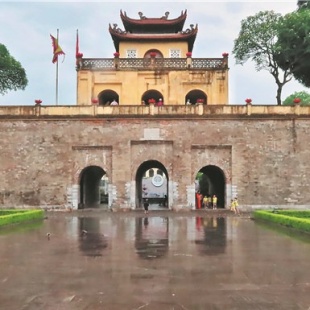
Wu is the first Chinese archaeologist to have been stationed for a long-term study of unearthed materials from the Imperial Citadel of Thang Long. Though he came to Hanoi relatively late, he arrived just in time. The past 20-some years witnessed a boom period of archaeological findings on the site.
The archaeological site at 18 Hoang Dieu Street in the west of the imperial citadel yielded rich findings of constructional components throughout the history of Thang Long.
From 2011 to 2023, continuous excavations on the central sector of Thang Long further provided key clues to identify the layout of palaces and other spaces around Kinh Thien Palace, the highest-level building within the royal compound.
"Due to a lack of firsthand materials, there was a gap in our knowledge of the early-stage Vietnamese wooden structure," he says. "But many of the ancient architecture in Vietnam use craftsmanship and decorative patterns of Chinese traditions. Thanks to this precious chance to approach the newest findings, I can draft a general picture of how these elements developed."
The dragon, the most recognizable royal totem in traditional Chinese culture, for example, also represents sacredness, power, and supreme authority in Vietnam. Thang Long means "a soaring dragon". Many motifs of the phoenix also appeared on the site to represent nobility.
"You will notice the difference between Chinese and Vietnamese dragon motifs," Wu explains. "Other cultural elements, like Champa (in present-day central Vietnam that was largely influenced by Hinduism), can also be seen to influence these Vietnamese patterns. That's the meaning of cultural exchange and mutual learning."
Influenced by Buddhist legend, the Bodhi tree leaf becomes a symbol of enlightenment, and it is often decorated with a dragon and phoenix in a harmonious and aesthetic combination in Thang Long.
"This motif also reminds us of the widely seen Buddhist totem of flames in China, which bears a similar shape," Wu says. "We may have different explanations for the same theme, but it at least demonstrates a close cultural link."
Mandarin duck-shaped roof decorations, made of pottery, also frequently appear in Thang Long. For example, in present-day Guangzhou, Guangdong province, the earliest Chinese architectural relics of such patterns also appeared in some architectural ruins of the 10th century, shortly before these bird patterns began to adorn the Thang Long palaces.
Speaking of construction methods, the dougong, the Chinese interlocking wooden brackets, also has a similar counterpart, dau cung in ancient Vietnam.
Glazed tiles, decorations such as clouds, and many other similarities existed in the ancient architecture of the two countries.
"It stunned me that white porcelain was used as tiles in Thang Long as early as the 11th century," Wu says.
In contemporaneous China, only Xixia, a regional power ruled by the Tangut people across the northwest of the country, was known to adopt similar techniques, according to findings in their rulers' mausoleums.
"Where did such techniques originate? More clues await to unveil their possible connection," Wu adds.
Wu and his Vietnamese colleagues often brainstorm in their workshop. With the three-dimensional modeling technology, which Wu often uses back in Beijing, bringing higher accuracy to his colleagues, he also learns the scrupulous attitudes in categorizing materials by his Vietnamese colleagues.
" (Wu) Wei gave us a lot of ideas on the world's architecture," Lam Anh, an archaeologist who has worked with Wu for eight months, says. "Then, when I dealt with the excavated materials, he inspired me to think more.
"You see a piece, you have to see more than a single relic, but a bigger picture in comparative studies," Anh adds. "My imagination thus becomes broader."