People of Western Regions 'co-creators' of Chinese identity









The internationally prevalent narrative that portrays the relationship between the culture in the Xinjiang Uygur autonomous region, historically known as the Western Regions, and Chinese culture as being the "assimilation" of the former into the latter is untrue and reflects the widespread ignorance of Chinese history, Pan Yue, director of the National Ethnic Affairs Commission, said.
"In fact, peoples of the Western Regions have always been co-creators of Chinese culture," Pan said while delivering a speech at the International Forum on the History and Future of Xinjiang on Wednesday.
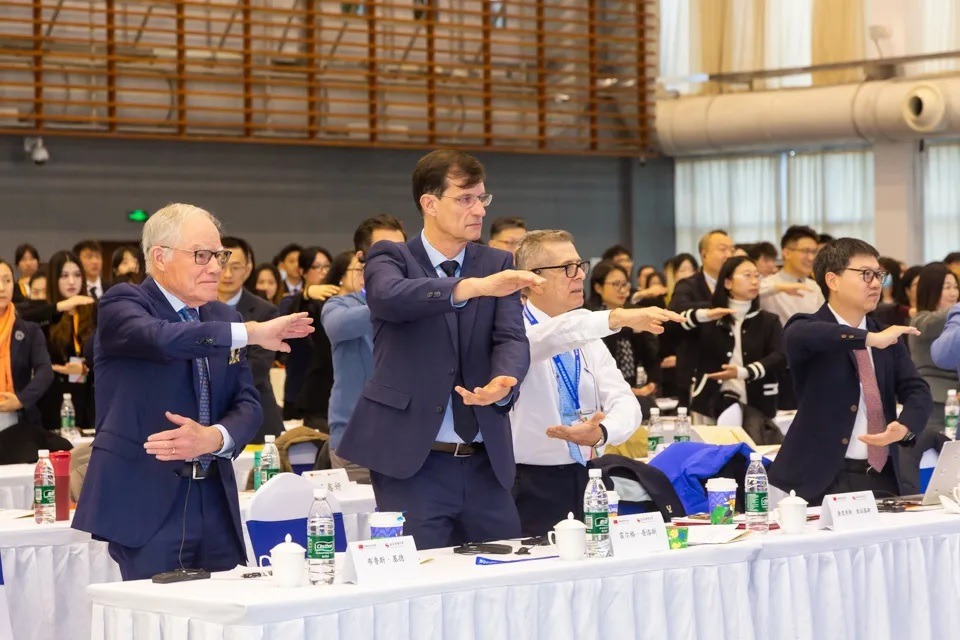
Some 170 scholars and archaeologists from countries such as China, the United States, Australia, Germany, Egypt and Kazakhstan took part in the forum in the city of southern Xinjiang, sharing the latest archaeological findings in the region and the ties between the history of the region and Chinese culture.
Pan said there are many examples of the influence of the Western Regions in shaping the Chinese culture. For instance, Nongsang Yishi Cuoyao, the ancient treatise on agriculture and sericulture, was compiled by the Gaochang agronomist Lu Mingshan, an ethnic Uygur in the Yuan Dynasty (1271-1368).
Many important texts in Chinese Buddhism, including the Diamond Sutra, were translated by monk Kumarajiva in Kuqa. He introduced terms such as "compassion", "world", "enlightenment", "sea of suffering", and "river of love", which are terms adopted by Chinese language.
The Chinese culture and the Chinese nation have been continuously inherited and developed over generations. It's a collective creation and inheritance of various ethnic groups, including those from the Western Regions, he said.
The foundation of a cultural community is the deep integration of the economy and society. The geographical layout of the Pamir Plateau and the Hexi Corridor has been a significant factor in the economic integration of the Western Regions with the East. It was the high connectivity between the regions and the vast market of the Central Plains that enabled the Western Regions to facilitate communication across the Eurasian continent, he added.
"Ultimately, Xinjiang and the Central Plains belonged to the same political community, which was the inevitable result of the development of economic, social and cultural communities," Pan said.
He added that, in China, unity fosters diversity, and diversity enriches unity, as exemplified by the Mo'er Temple in Kashgar.
The site with a history spanning at least 700 years, contains an Indian Gandhara-style Buddhist stupa, a Central Asian and Xinjiang-native square-shaped temple, and a Chinese Buddhist grand hall. It reflects how early Indian Buddhism evolved into a Western Regions variant in the Tarim Basin before spreading east to the Central Plains. Centuries later, Sinicized Buddhism returned to the Western Regions, building Chinese Buddhist halls at its original entry points into China.
Whether Buddhism or Islam, on entering China, both underwent collisions and integrations, evolving into Sinicized Buddhism and Sinicized Islam. The process of collision and integration was not aimed at eliminating each other but at enhancing each other, resulting in the emergence of more inclusive civilizations, Pan said.
"The stories of the peaceful coexistence of multiple ethnic groups and diverse religions in Xinjiang illustrate to the world that China, a country that has experienced almost no religious wars for thousands of years, and a country that has never engaged in colonial expansion or forced cultural exportation, may offer another perspective into ethnic and religious conflicts," he said.
He added that the world may not fully agree with each other's methods of seeking unity, but people can learn from each other, and realize their aspirations in their own ways.
Xinjiang will continue to protect the cultures of various ethnic groups to enrich and develop the splendid and diverse Chinese civilization, he said.
"Xinjiang is not only China's Xinjiang but also the world's. It is our shared vision to make Xinjiang, with its past, present and future, reach out to the world," Pan said.
cuijia@chinadaily.com.cn