Open-minded villagers key to success of cooperative project









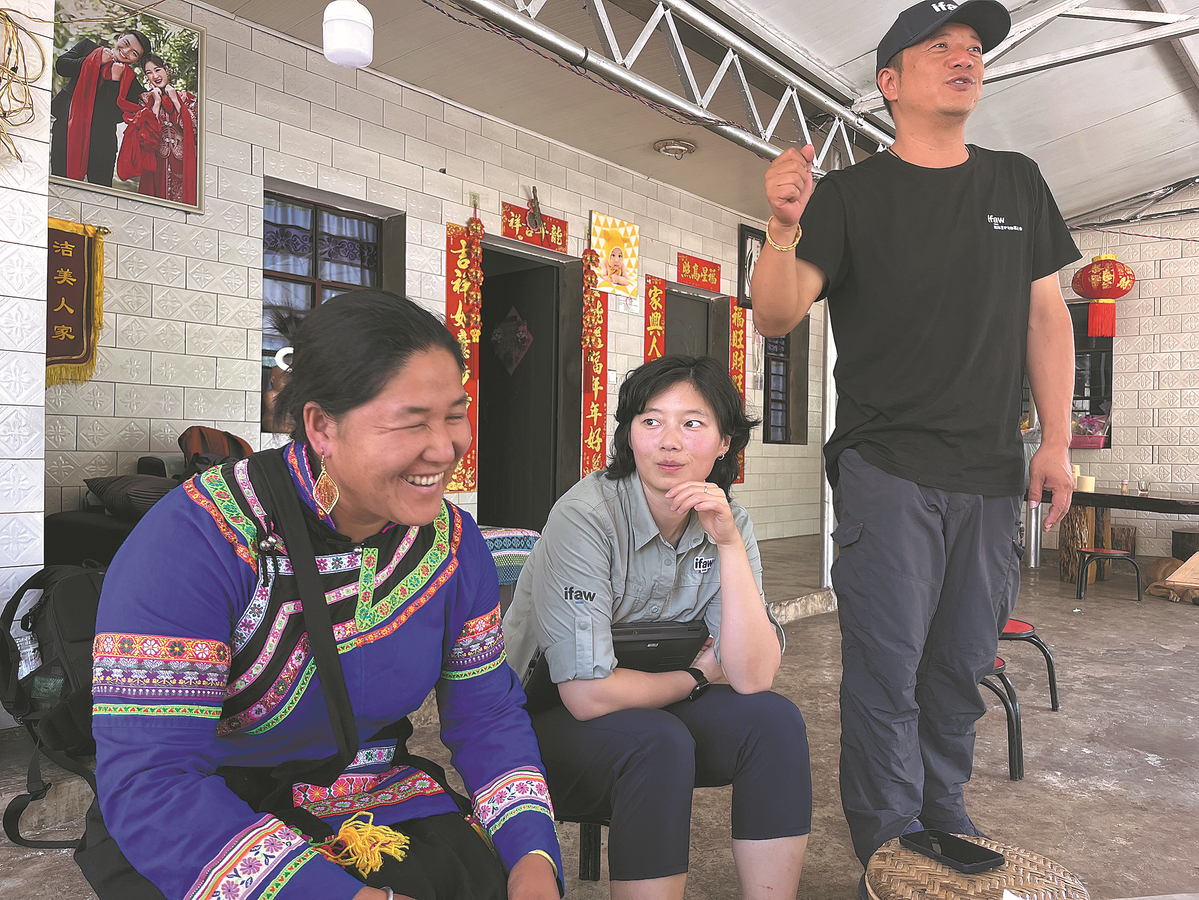
Before conservationists from the International Fund for Animal Welfare China, the Xishuangbanna National Nature Reserve and the Rainforest Foundation of Xishuangbanna launched their cooperative community project in Daotangqing, in June 2020, Zhang Jiangmei rarely wore the traditional dress of her Yi ethnic group. "Hardly anyone, aside from the elderly, would don our traditional garments," said the 40-year-old. "We used to consider it unattractive and uncomfortable."
This perspective gradually shifted after Cao Dafan, program officer at IFAW China's Asian Elephant Protection Program, and his colleagues began visiting Daotangqing in Jinghong city, Yunnan province. There they have promoted beekeeping, the cultivation of mangoes and macadamia nuts and photovoltaic power generation, and tried to foster a concept of low-carbon development among the villagers.
Zhang and her family of five actively engaged in the beekeeping initiative. While learning beekeeping and new agricultural practices with the experts from Jinghong, and especially after a study trip to Hainan province in July last year, Zhang started wearing her cultural attire regularly.
"I've come to realize that our attire is part of our identity," she said. "And people from other places appreciate our traditional dress and consider it pretty."
To Cao, residents like Zhang have been key to the success of the community project. "They are open-minded and embrace change," he said. "These genuine influencers are valuable helping hands in our project."
Zhang, a mother to a 14-year-old son, said that her family owns 0.13 of a hectare of flatland and less than 2 hectares of hilly terrain. They mainly cultivate rubber trees on the hilly land and grow corn on the flatland. Because of the corn cultivation, wild elephants sometimes visit the family's plot.
The family's income, about 50,000 ($6,900) yuan a year, is mainly from tapping rubber. As the government will compensate about 70 percent of the family's corn loss caused by the elephants, Zhang said, she doesn't mind the animals' occasional visits to her plot. In the past two years, the family has replaced some rubber trees with mango and macadamia nut trees on part of their land.
Since 2000, with an additional income of about 5,000-6,000 yuan from 10 beehives they maintain, she said she and her husband no longer need to gather mushrooms and fresh bamboo shoots in the forest during the rainy season. "With fewer trips to the forest, our chances of an encounter with wild elephants have decreased a lot," Zhang said.
Since the launch of the beekeeping project, Zhang said the villagers have learned the importance of maintaining a clean living environment to ensure the production of high-quality honey. "We were told that proper waste management, including the treatment of domestic sewage and livestock excrement, is crucial to prevent any contamination that could affect the quality of the honey," she said.
As a result, the living environment in the community has been greatly improved in the past few years, she added.
In Daotangqing, villager Wang Baozhong and his family have provided the space for the community's only photovoltaic panel system.
At 50, Wang is a forest ranger employed by the Xishuangbanna nature reserve's Mengyang protection station. Working for the protection of wild Asian elephants for many years, he supports any action to reduce human-elephant conflicts and to find a sustainable way forward.
He said the photovoltaic panel system installed in his courtyard started operating in April 2022 and generated more than 10,000 kilowatt-hours of electricity last year. In April last year, it generated 2,030 kWh of electricity, a record high for a month.
"Before, we used dried rubber tree branches as our firewood," said Wang Shaokuan, Wang Baozhong's son.
"It often filled the whole kitchen with smoke, blackened our walls and made our eyes water. Now we use electric stove tops to cook and boil water. It's cheap, clean and convenient."
The photovoltaic system generated an income of 4,000 yuan for the family of six last year. "I will retire as a forest ranger at 55," said Wang Baozhong. "I hope that I don't need to tap rubber anymore after my retirement."





- World's largest-capacity centrifuge goes into operation in Hangzhou
- Half a century of friendship: China's role in shaping Bangladesh's talents
- International Circus Festival brings top performers to Cangzhou
- Tianwen 2 spacecraft halfway to target asteroid
- Vibrant China during holiday: Hitting the road
- International Cartoon and Illustration Exhibition on a Community with a Shared Future for Humanity 2025 Announcement