


Painting across borders










Pioneer of China-US art exchange has spent four decades to bridge worlds together, Chang Jun reports in San Francisco.
In the 1980s, Ren Ming, who was then in his 20s, realized the need for dialogue between the East and the West. On his first visit to the United States, he packed more than 3,500 slides of Chinese art, which he later used to introduce his motherland — the mysterious, less discovered, yet multifaceted China.
Four decades later, Ren is an international award-winning artist, with professorships at several esteemed American colleges of fine arts, including the Rhode Island School of Design. He has also organized international programs at top-notch art schools such as the China Academy of Art in Hangzhou, Zhejiang province, and the Shanghai Academy of Fine Arts.
He still believes that China-US communications through art should be robust, frequent and more revolutionary, a reference to the use of technology such as artificial intelligence.
"It (art exchange) has played a unique and irreplaceable role in enhancing mutual understanding and trust," Ren tells China Daily. "Painting and art have no national boundaries, neither should exchanges and collaborations between artists."
Ren enrolled at the China Academy of Art in 1980 to major in oil painting. Although he excelled in pursuits such as traditional Chinese ink painting, his claim to fame on campus was that he could speak fluent English, a foreign language rarely spoken or studied at the time, as China had only just opened its doors to the world.
"I was often asked to interpret for visiting artists and professors from American art schools," Ren says. "Through these conversations, I realized that there was a gap in their knowledge. Their understanding of Chinese art history stalled during the Qing Dynasty (1644-1911) with no further updates. The modern development of Chinese art was a blank.
"I hoped to fill that gap by showing them an authentic, comprehensive and complete history of Chinese art," Ren remembers thinking at the time. "China had so much … to offer when it came to art; Westerners should have no doubt about that."
It took him three years to fulfill his vision. He spent every penny collecting lecture materials, artifacts and more importantly, preparing 3,500 slides on Chinese art that he divided into 20 themes.
In January 1988, Ren was invited to teach at the Rhode Island School of Design, becoming the first scholar from the Chinese mainland to attend the American art institute, taking with him his passion to understand and embrace differences.
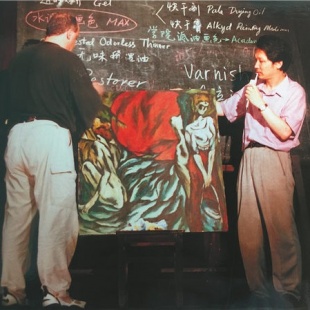
Thanks to his illuminating methods, artifacts and slides, Ren's lectures earned him instant recognition in the American art world. Mainstream art schools and universities invited him to lecture and the San Francisco Art Institute offered him a position.
"The work of art calls; the viewer, the listener and the reader responds. We see, hear and read now, but all of that is in the context of lifetime memories," Fred Martin, then vice-president of the institute, told Ren.
To generate such a "lifetime of memory", not only in American but also Chinese hearts, Ren expanded his overview of art in the 1990s.
He extended his studies and research to Western abstract expressionist paintings and won international recognition for his work, earning the gold medal at the 2003 Florence Biennial International Exhibition of Contemporary Art in Italy.