


Breaking down the fourth wall










The Detective Zhao Gan'e series blurs the lines between actors and audience, creating an interactive and emotionally resonant experience.
In traditional theater, actors and the audience are typically separated by the stage, as if there is an invisible wall between them.
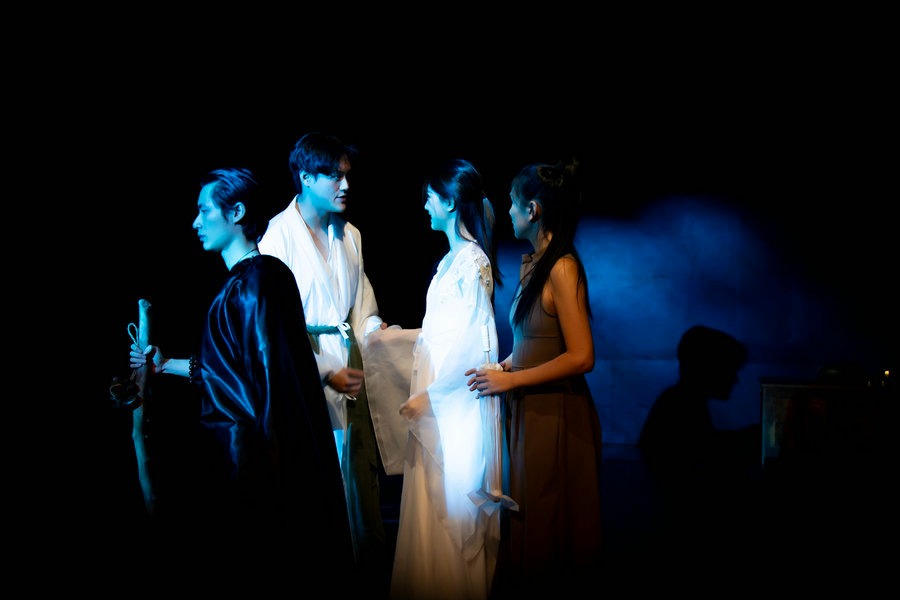
"You exist in a state of 'public solitude'," said Li Muyi, 30, one of the actors portraying the protagonist Zhao Gan'e in the play Dazhentan Zhao Gan'e 2(Detective Zhao Gan'e 2), currently staged in Beijing.
The play is a sequel to Detective Zhao Gan'e (2023), where Zhao Gan'e solves murder cases, set in a specific period of 2005.
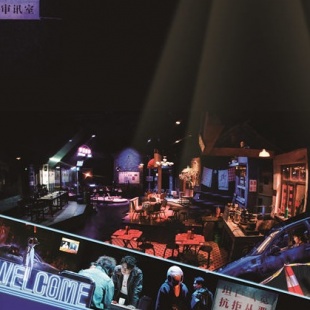
Like the first installment, the sequel offers an interactive and immersive experience. The audience becomes part of the stage setting: some sit behind the desk at the police station, others occupy the back seat of the car, which is the crime scene, and some sit in an internet cafe with computers from two decades ago in front of them.
"In immersive dramas, we perform right in front of the audience most of the time. We can hear their breaths and observe their facial expressions," said Li. "It's essential to be attentive to their responses and exercise caution during actions, such as closing a car door with audience members inside."
The play's director, Zhang Xiao, 32, defines the Detective Zhao Gan'e series as "environmental theater", a concept originating from US theater theorist Richard Schechner's 1968 article.
"Theater transcends mere plots. The biggest difference between theatrical dramas and TV shows or movies lies in their live nature," Zhang said.
"We're telling a story through the environment, within that environment; we can bring you back to 2005, where you can physically touch a milk carton from 2005 or a computer from 1998."
According to Zhang, the first drama of the Detective Zhao Gan'e series was more experimental, aiming to attract and familiarize the audience with this genre of theater.
"There were more interactions and games like Train Dance in the first installment. In the sequel, we're more focused on theatrical expression, conveying a more mature and touching story," he said.
Li Huiling, a 30-year-old theater enthusiast who enjoys musicals, dance dramas, traditional plays, and environmental theater, said that her initial attraction to Detective Zhao Gan'e was its interactive games.
"I wasn't familiar with this immersive drama style, so I was surprised when the cast came out and chatted with us during the 30 minutes before the performance," she said.
"They would inform us in advance of the parts that require our cooperation or reaction. I think it's also a chance for them to gauge the audience and decide who to interact with more."
Li Muyi pointed out that in immersive theater, where actors are in closer physical proximity to the audience, there is a need for heightened awareness and adaptability to audience responses and energy levels.
Sometimes, however, the audience may get overly excited and too chatty.
Li Huiling recalled watching Detective Zhao Gan'e when the actor playing the senior police officer told everyone to be quiet in a serious tone.
"He stayed in character, which felt believable and kept us immersed in the story," she said.
Li Chenhui, 34, who plays an alternate for Zhao Gan'e, noted that although the interactions with the audience are controlled and limited in the sequel, challenging cases do arise from time to time.
"Zhang taught me that if it seems like the audience is picking on us or going too far, a simple compliment like 'Okay, that was a pretty interesting line; keep it up next time' can help resolve the situation and restore the flow," he said.