


Restoring a colorful tradition to dye for
Artisan revives ancient technique that still captivates a modern audience, Yang Feiyue reports.










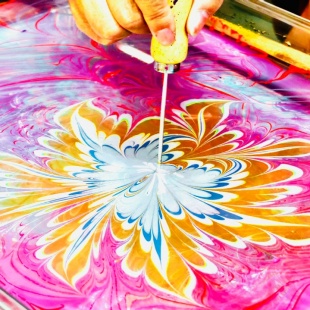
Zhang Shuangmin might look a bit haphazard as she drips pigment onto a square container of water. The pigments immediately disperse into small circles once they touch the surface of the transparent liquid, and without wasting any time, Zhang swirls them with an awl in seemingly casual movements.
As minutes pass, the random arrangement of pigments begins to take shape and eventually evolves into stunning floral patterns.
A bigger surprise comes when she gently places a white porcelain plate into the water and lifts it in slow motion. The pattern then magically transfers onto the plate.
This procedure never fails to elicit a gasp of amazement from her audience.
This type of printing art is known as tangliucai (Tang flowing colors), and Zhang, 53, has practiced the craft for more than three decades.
"It requires calculation and precision every step of the way," says Zhang, who was born and raised in Xi'an, Shaanxi province.
"I need to have a design in mind before execution. If I want a pattern to appear in warm colors, I need to plan ahead and use cool colors for the background.
"I also have to consider beforehand if I will place it on a folding or round fan, a porcelain plate, silk, leather, or any other medium, which will determine the composition of the pattern and ultimately the success of the work."
Years of practice has seen Zhang develop a strong leaning toward bringing out Tang Dynasty (618-907) elements when practicing the craft of tangliucai, which was named an intangible cultural heritage in Xi'an in 2020.
"I want it to match the historical thickness of the art, which boasts a long history," Zhang says.
Zhang was first attracted to a rough version of the craft from her grandmother, who would steep various fabrics into dyes, resulting in intriguing patterns.
This childhood predisposition to the dyeing art prompted her to pursue design and environmental art at a local art institute in the 1990s, when she got to know her grandmother's daily life production might be associated with the ancient water-printing technique.
In Youyang Zazu (The Miscellaneous Morsels From Youyang), a compilation of diverse social and folk narratives by Tang Dynasty writer Duan Chengshi, an ancient technique of coloring paper on water was detailed.
Experts regard this collection as the earliest documentation of the historical roots of the practice.
Then, in the compilation titled Four Treasures of a Scholar's Study by Song Dynasty (960-1279) scholar Su Yijian, a kind of decorative paper called liushajian, meaning flowing-sand notepaper, was mentioned of being made in what is now Sichuan province.

According to this collection, the process of notepaper production involved pulling a sheet of paper through a fermented flour paste combined with an array of colors, resulting in spontaneous and asymmetrical patterns.
Furthermore, the compilation described an alternative method using a paste derived from a regional plant blended with croton oil and diluted with water.
Ginger extract was subsequently employed to scatter the hues. Then a hairbrush was used to create designs resembling human figures, clouds or flying birds.
These intricate designs were then transferred onto a paper surface, showcasing the artistry and skill of the creators.
"It was so fascinating, yet a great pity," Zhang says about the fact that the art form failed to prosper and was almost on the brink of extinction in the country.
As she delved further into her research, she discovered that this art form had transcended borders and acquired unique local characteristics, such as in Turkiye, where the marbling art known as Ebru was inscribed on the Representative List of the Intangible Cultural Heritage of Humanity of UNESCO in 2014.
She made a point to pursue the art through scraps of information from historical documents.
"Many people said it had died. It is not true since we can still find the water-printing technique continuously being applied in marbling Xuan paper," Zhang says.
Handmade Xuan paper, or rice paper, was originally produced during the Tang Dynasty in Jingxian county in today's Anhui province, and calligraphy and painting artists have put a premium on it ever since.
With an art background, Zhang managed to piece together bits of information and restore the craft through consultations from experts and her own expertise.