


Discoveries in Jiangsu shed light on life in canal-side sites










The Grand Canal, the longest artificial waterway in the world and a UNESCO World Heritage Site, runs through many cities in China from north to south. One such city is Huai'an in Jiangsu province, once an important station, the fortunes of which waxed and waned with those of the waterway. Archaeological efforts between 2021 and 2023 at three sites in Huai'an — Qingchengmen, Xinlu and Banzhazhen — along the Grand Canal from south to north, shed light on ancient city life during the Ming (1368-1644) and Qing (1644-1911) dynasties, scholars told a National Cultural Heritage Administration news conference in Beijing on Friday.
The first site, Qingchengmen, or the Qingcheng Gate, was the western gate of Jiucheng, a city located in present-day Huai'an. Historical literature shows that construction of the original gate began during the Eastern Jin Dynasty (317-420). During subsequent dynasties, it underwent several rounds of reconstruction, says Zhao Libo, deputy director of the Huai'an Institute of Cultural Relics Preservation and Archaeology.
Archaeologists have discovered the gate, city walls, wengcheng (a type of defensive enclosure outside a city gate) and a drainage system, as well as more than 80 artifacts, including inscribed bricks and stone building units in the 3,000-square-meter excavation area.
"Studies show the existing gate and wengcheng were built during the Ming Dynasty," Zhao says, adding that archaeologists have gained some understanding of the structure, development and history of the gate from the Five Dynasties and Ten Kingdoms (907-960) to the Qing Dynasty, as well as of how it was constructed.
Dong Xinlin, a researcher at the Institute of Archaeology with the Chinese Academy of Social Sciences, says that since the gate existed for such a long time, it has the potential to contribute important information to the study of the evolution of ancient city gates.
For its part, the second site at Xinlu presents a vivid picture of a well-preserved street with a clear layout. It is located in ancient Hexia town, which is known to have been a salt distribution center during the Ming Dynasty, before being destroyed by flooding at the end of the period.
A 4-meter-wide road that extends for 75 meters is a highlight discovered at the site. It was used over a long period of time, probably for transporting goods, and underwent multiple repairs, Zhao says.
Foundations, probably of shops and residences, line both sides of the road. Archaeologists have excavated one complex not far from the road, and have discovered that it had a shop on the street, as well as rooms to the rear and a courtyard, probably for the residential use of shopkeepers.
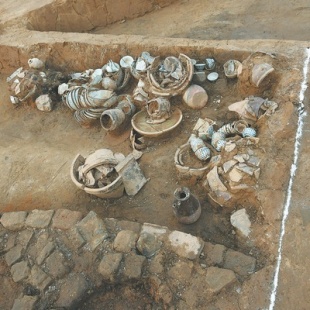
The site has yielded many pieces of ceramic, mostly blue and white porcelain, and 370 everyday articles can be reassembled.
Lin Liugen, an archaeology professor at Zhejiang University, says he was impressed by what he saw. "When people visit the site, they will see that the road is still visible, so are the thresholds of each household. These elements will help them imagine the lively ambiance of the street," Lin says.
Zhao says that archaeologists believe the road was related to the salt trade in Hexia town during the Ming Dynasty.
The third site, Banzhazhen, or Banzha town, was named after a banzha, a water lock to regulate canal levels, and was built during the Ming Dynasty. Records show a tax office was established in the town to collect tariffs. Nearly half of the town's residents were engaged with tax-related work during the Ming and Qing dynasties.
However, the town was destroyed by a flood during the reign of Emperor Qianlong of the Qing Dynasty.
Archaeologists have found 61 complex foundations, 18 roads, two wooden bridges and one tomb. The largest complex foundation is believed to belong to a Buddhist temple, as the tomb of a monk was found within.
In the southwest of the excavation area is a complex foundation believed to belong to a restaurant, since a cooking stove was found along with bowls, plates and cups.
"With the support of waterway facilities and local government institutions, and the advantage of combining canal transportation, salt transportation and tax inspection, these sites primarily thrived on commerce and in the service industries, and formed a town cluster along the Grand Canal in Huai'an," Zhao says. "Their existence was connected to the canal, reflecting the transformations of waterways ...and the evolving dynamics of relationships between humans and the environment during the Ming and Qing dynasties."
wangru1@chinadaily.com.cn