


US students display their chops










"I played a couple of Chinese instruments before I joined the ensemble, but I didn't know anything about the beauty of Chinese music," says Capistrant.
A vocal performance major, he has gradually found that studying Chinese music has opened his mind to thinking about music differently, including singing.
"I've learned that the culture is just as important as the music when learning a new musical tradition. It's important to have an open mind," he adds.
During the concert that night, Capistrant's bandmate Emory Gaskill also had a shining moment. It happened as he seamlessly switched from playing the cello to performing on the jaw harp. The audience was amazed by the smooth transition from the rich tones of the cello to the vibrant, metallic twang of the harp. Gaskill earned a bachelor's degree in music performance with a specialty in the cello at MTSU two years ago. While at university, he joined the ensemble to learn the sanxian, a three-stringed plucked instrument.
"My first impression of traditional Chinese music is that it's deeply emotional and connected to the musicians," says Gaskill. "There's a meaning behind every movement and sound and it all connects to the surrounding space."
Earlier this month, the ensemble traveled to Fujian province where they participated in a weeklong China-US youth exchange camp. The program took them to Xiamen, Quanzhou and Zhangzhou, where they were able to immerse themselves in the local culture, experience traditional art forms such as nanyin music (an old folk music style that is popular in Fujian) and Liyuan Opera, and interact with students from Huaqiao University. They also displayed their talent during concerts.
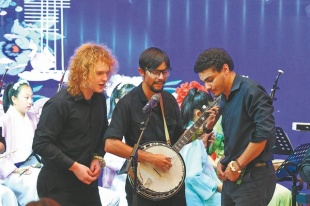
Reflecting on a memorable moment from the trip, Gaskill recalls the fun of discovering the pipa (a four-stringed Chinese lute) and banjo, both plucked string instruments. The pipa may have originated in West and Central Asia but is best known as a popular instrument in China, while the banjo, which was based on West African instruments like the ngoni and the xalam, was originally an instrument devised and played by African slaves in the US before later gaining wider appeal.
"One day in Xiamen, I was sitting among the students playing the banjo. I wear picks on my fingers, similar to the nails that pipa players use. The pipa is played with an outward motion, whereas the banjo is played inward," he says.
"That became the topic of discussion. When the students finally had the chance to play my banjo, they commented on how strange it was that the technique was the opposite of what they were used to."