Dance and dribble to new bonds









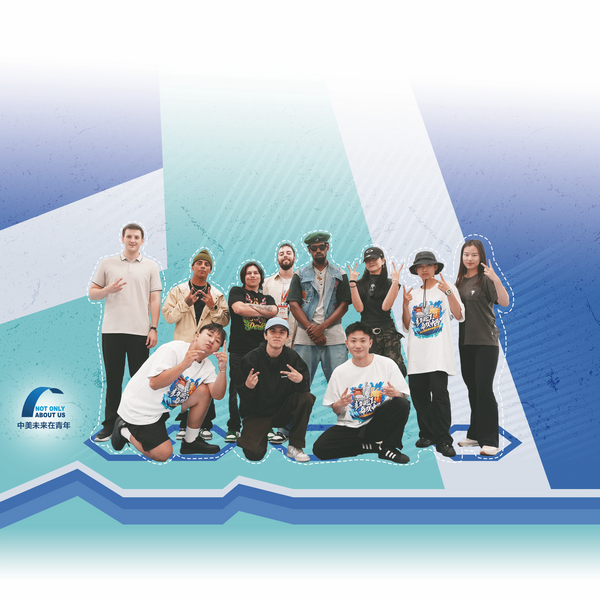
Chinese and US youth showcase the power of sports to bridge cultures and build friendships during a recent exchange program in Quzhou, Zhejiang.
Sports are often seen as highly competitive, but historical events like the 1970s' "Ping-Pong Diplomacy" and the ongoing Paris Olympic Games demonstrate that sports have the power to bring people together.
Last month, as part of the "Bridge of the Future" China-US youth exchange program organized by the All-China Youth Federation, a series of sporting events took place in Quzhou, East China's Zhejiang province, vividly demonstrating the universal language of sports and the Olympic spirit.
One highlight was a friendly basketball game between a group of Chinese high school students and their peers from the United States.
Luke Bevilacqua, one of the US players, emphasized the importance of separating the intensity of the game from life off the court.
"Whatever happens on the court stays on the court. At the end of the day, we know we're all friends and family," he said in the latest episode of China Daily's Not Only About Us.
Ben Luber, one of the US basketball coaches, echoed Bevilacqua's sentiments: "In the Olympics, you play to win, so the competitive spirit is crucial. You play to win during the game, but once it's over, you must be respectful."
Bevilacqua mentioned that being physically present in China meant a lot to him because he had always imagined his Chinese peers to be very different.
"It turns out we like the same things. They play in a style or shoot threes just like I do. We can understand each other no matter the language or ethnicity," he said. "Just coming here opens a lot of doors for me. Opportunities like this bring people together from one side of the world that you never thought you would meet or even understand. This is awesome."
Luber also acknowledged the significance of this opportunity. "Since we're physically here, the exchange between Chinese and US youth is no longer hypothetical, but we have an actual experience to talk about in the future," he said. "It's about connecting one person at a time and building one relationship at a time."
While basketball has long been a staple at the Olympics, break dancing is making its debut at the Paris Games this year. To celebrate this new addition, a street dance event was also held last month between Chinese and US youth.
Deng Yucong, a Chinese dancer, likened her passion for break dancing to a universal language.
"Even if I don't speak English and you don't speak Chinese, we can use breaking as a way to communicate; you perform certain moves and I get inspired, then I do some moves and you get inspired. We don't need actual words to communicate," she said.
Ke Weizhong, a member of the organizing team for the dance event, pointed out that, like the Olympics, the "peace and love" ideal of street dance is what unites people.
"This ideal breaks down barriers among people and builds harmony. Through street dancing, people may get along with less confrontation," he said.
Chinese dancer Wang Zhiqiang also believes that street dance perfectly embodies the Olympic spirit.
He explained that break dance competitions typically feature various formats, including one-on-one battles, two-on-two matchups, crew battles, and synchronized dance. While both synchronized dance and crew battles highlight teamwork, one-on-one competitions provide a greater sense of personal accomplishment when reaching the finals alone.
"Even if you lose, that's OK, because the Olympics is all about participation and friendship," Wang said.
Wang Yan, one of the event judges, observed the growing friendship among the Chinese and US participants at the event.
"As a judge and a dancer who travels a lot, I noticed that while the participants performed the standard moves, they also made unique modifications, such as using traditional music and wearing traditional outfits," he said. "Even though I was the judge, I learned a lot from the dancers as well, which I think is why we call it an 'exchange'."
US dancer Elijan Montaeus Delgado believes that building friendships and fostering cultural exchanges are just the beginning.
"Events like these help us understand one another," he said. "They create a bond of 'I get where you're coming from, you get where I'm coming from'. Once you get that understanding, that's when we can work together to find solutions to many of the problems that we face in the world."
lixinran@i21st.cn