Japanese veteran confronts gruesome germ-warfare crimes in China









HARBIN - As 94-year-old Japanese veteran Hideo Shimizu concluded his four-day visit to the northeastern Chinese city of Harbin on Thursday, he remarked, "This may be my last chance to come to China and express my apologies."
Over the past 79 years, Shimizu became the fifth member of the notorious Japanese Unit 731 germ-warfare detachment during World War II, and likely the last, to return to Harbin to confess and seek forgiveness for their war crimes, said Jin Chengmin, curator of the Exhibition Hall of Evidences of Crime Committed by Unit 731 of the Japanese Imperial Army.
Out of the 3,607 registered members who served in Unit 731, only a few have acknowledged the historical facts, according to Jin.
Shimizu fled China with the retreating Japanese forces on Aug 14, 1945. His trip to Harbin, the capital of Heilongjiang province, from Aug 12 to 15 marked his first return to Chinese soil in 79 years.
Even after nearly 80 years, the former member of the Unit 731 Youth Corps still remembers the place where he stayed more than four months and witnessed the war crimes committed by the germ-warfare detachment during World War II, including the cultivation of pathogens, human dissections and human experiments.
During his poignant visit to the former headquarters of Unit 731 and the Exhibition Hall of Evidences of Crime Committed by Unit 731 of the Japanese Imperial Army, Shimizu walked through the commander's office, the specimen room, and the site of the frostbite laboratory, recounting to the museum curator and others what had seen during his military service.
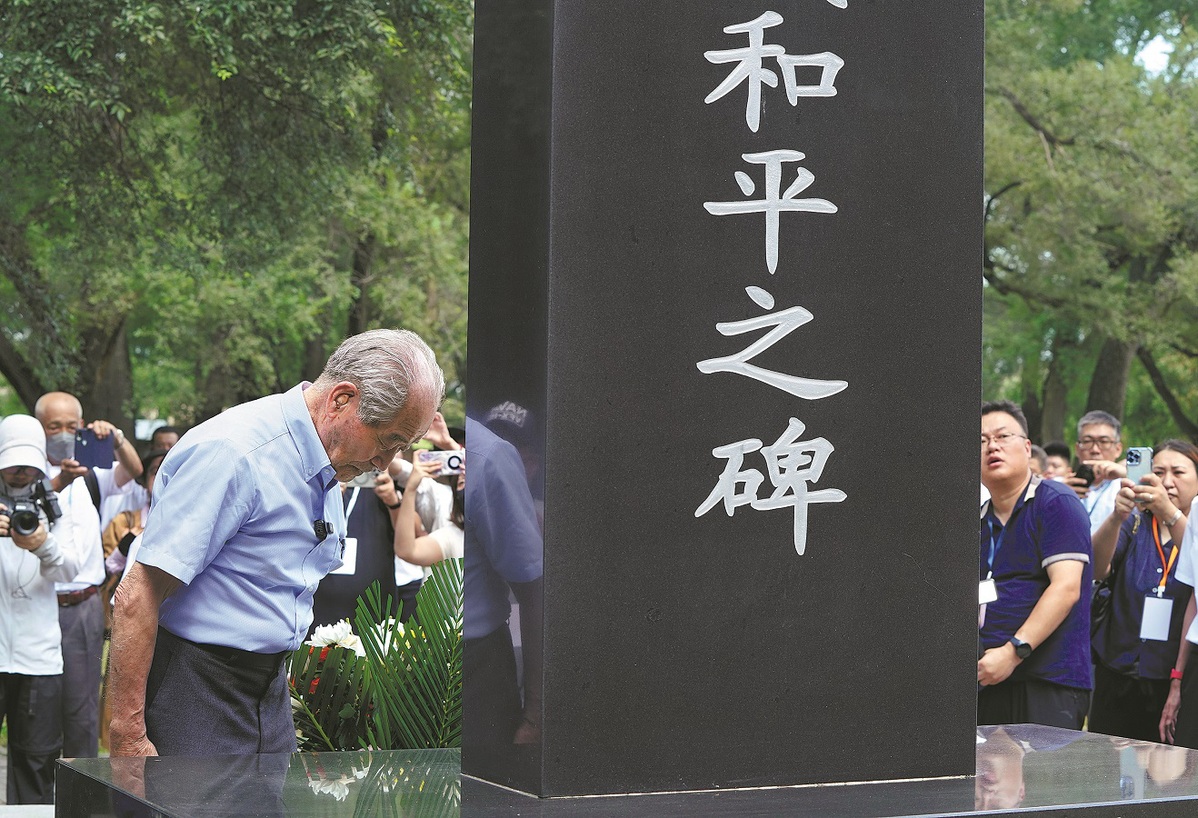
He repented, bowing deeply before the monument dedicated to "apology and the commitment to peace without war." Then, he stepped forward to touch the black tablet engraved with white Japanese characters.
"I cannot restrain my profound regret and apology for joining the germ corps and becoming an aggressor," Shimizu said. "Once again, I express my heartfelt apologies."
Headquartered in Harbin, the Japanese bacteriology unit killed thousands of Chinese civilians and prisoners of war at its sprawling complex from the late 1930s until the end of the war.
Shimizu said that as a teenager, he was coerced by his Japanese school teacher to join the army as an "apprentice technician," unaware of the unit he was being recruited into.
In Unit 731, he saw the remains and bodies of Chinese victims, referred to in Japanese as "marutas," or wooden logs. Even pregnant women and children were soaked in formaldehyde in the specimen room. He described the actions of Unit 731 in China as war crimes that have always haunted him.
Before his trip to China, Shimizu had delivered over 20 public speeches exposing Unit 731's germ-warfare crimes using his personal experiences and historical records. He had also expressed a strong desire to return to China to pray for the deceased and apologize to their families. His visit to Harbin was made possible by donations from various Japanese civilian groups.
The crimes committed by Unit 731 were among the most gruesome atrocities of the Japanese invasion of China during World War II. On Thursday, China marked the 79th anniversary of the victory of the Chinese People's War of Resistance Against Japanese Aggression and the World Anti-Fascist War, as people across the country held activities observing these historical memories.
The Chinese people remain profoundly dismayed by the revelations of the germ warfare conducted by Unit 731. More than 2 million people had visited the Exhibition Hall of Evidences of Crime Committed by Unit 731 of the Japanese Imperial Army by Aug 1 this year, making it one of the top tourist destinations in Harbin, as people choose to confront this history and yearn for peace.




- Xi congratulates Paul Biya on re-election as president of Cameroon
- Xinjiang launches consumption voucher program to boost winter tourism
- 161 nominations received for Hong Kong LegCo election
- China's State Council appoints, removes officials
- Changping builds core of science power
- Explainer: How China's leadership sees domestic, global landscapes for country's development over next 5 years