Sensitive restoration means old is new as residents enjoy streets of charm









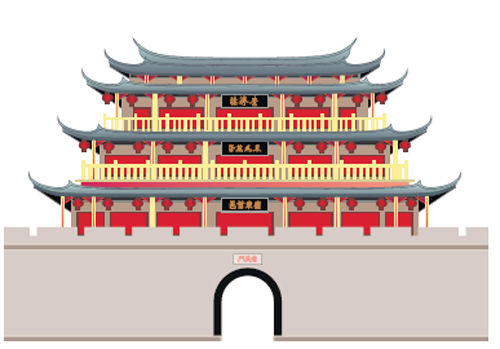
The Guangji Gate Tower, a landmark of Chaozhou ancient city. LIU CHEN/CHINA DAILY
Traditional and modern elements combine beautifully in the ancient city of Chaozhou in Guangdong province, especially along its famous Paifang Street. The residents of the Taiping Road historical area, which includes Paifang Street, cherish its memory, while welcoming the interest of the hordes of visitors attracted by its distinctive culture.
According to Chen Xiayang, head of the department of ancient city protection and development of Chaozhou's culture, radio, television, tourism and sports bureau, there are more than 50,000 residents still living in the old city, which is very much alive, bustling with the energy and activity of everyday life.
Chen believes that besides the deep affection residents have for their historical neighborhood, the primary reason they continue to live there is that the infrastructure and supporting facilities have been improved for their convenience.
"For example, we have restored the facades of residential buildings, paved the roads, improved drainage facilities, and upgraded underground pipelines of all kinds," says Chen.
He adds a cautious approach to restoration has been taken, and even the repair of a single wall can require the input of experts. As a result, they have adopted different methods of restoration for different walls to retain the features of each.
Thanks to these efforts, former residents have remained, enabling the block to retain its soul. "On the main street we can see flourishing commercial activities and the development of tourism. And when we walk around the back alleys, we see residents living and working in peace and satisfaction. This balance between residents and visitors is what we have been working for," says Chen.
Huang Laisheng, a 73-year-old resident whose family has lived in the area since the Qing Dynasty (1644-1911), is among them. Growing up, he watched his father and grandfather sell homemade shoes on Paifang Street, and has seen the area's development from uneven ground to paved stone roads.
He has worked as a volunteer in the area for the last 12 years, monitoring sanitation and public security at primary and secondary schools and helping direct traffic.
He says that after he retired, he was bored staying at home, and finds it more meaningful to be of use to people in the area.
"I walk back and forth along the street nearly 20 times on average every day," he says. "Every time people have a problem to solve, they contact me."
Ding Shouyi, director of the Beijing branch of the Guangzhou Urban Planning and Research Institute, says that retaining the block's residents was part of the city's original plan for its development.
In 1992, Chaozhou proposed protecting its ancient city without large-scale demolition or reconstruction.
A new city was built to the west, which is 10 times the size of the historical city, and took over many of its functions instead of upgrading the old city itself, which would have necessitated the removal of historical buildings. Ding says this is why it remains intact today.
He makes a point of highlighting the upgrades that have enabled the historical area to cater to modern needs.
"We encourage the proper innovation of historical areas. Protection is not solely focused on keeping all the original features, as is the case with artifacts. Instead, we regard historical areas and buildings as living heritage, and support protection through use," says Ding.
Consequently, he says that commercial activities are not designated by the government or by urban planners, but grow out of the needs of daily life.
For example, there are many stalls selling herbal tea. That's because the area's humidity has led to the local habit of drinking tea to dispel dampness and prevent lethargy, even though many tourists may find themselves not used to the taste.
"If we tried to designate the commercial activities along the street, we probably would not allow so many herbal tea stalls, as they do not attract tourists. Instead, we might open more fast food chains. But since the block is primarily a community for local people, rather than a tourist attraction, the stalls remain as part of the area's vibrant culture," says Ding.
"Our experience in recent years has demonstrated that with the appropriate architectural design and improvements to facilities, the quality of life in old houses and neighborhoods is no worse than that in apartments in new residential areas," he adds.
Xing Yu contributed to this story.
wangru1@chinadaily.com.cn