


Key evidence found at leading base against Japanese aggression









In the past, historical accounts of the Northeast Anti-Japanese United Army, a Communist-led guerrilla force during the War of Resistance Against Japanese Aggression (1931-45), were mainly recorded in archives and documents, prompting researchers to seek more tangible evidence.
The excavation of the first anti-Japanese guerrilla base established by the Communist Party of China in the northeastern region — Hongshilazi — has provided archaeological discoveries to enhance the study of the history.
Located 20 kilometers west of Panshi city in Northeast China's Jilin province, the Hongshilazi Site, spanning about 32 square kilometers, served as a crucial base to resist Japanese aggression, and today provides remnants, such as barracks, outposts, defensive fortifications and military training grounds.
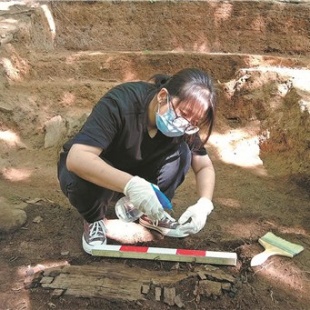
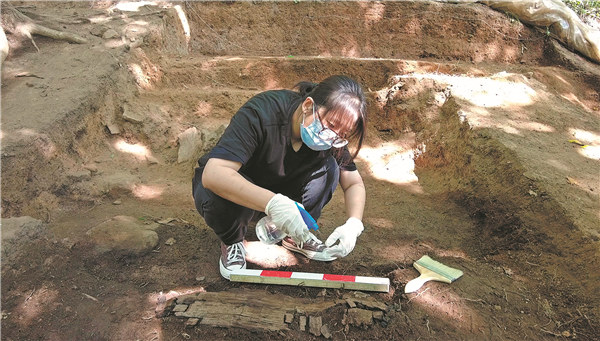
"The study of the Northeast Anti-Japanese United Army used to face the challenge of being 'historically untraceable'," says Meng Qingxu, leader of the Hongshilazi Site's excavation team. "In recent years, the archaeological work at the site has provided detailed materials to prove the 14-year history of the guerrilla force's resistance."
For 14 years, soldiers of the Northeast Anti-Japanese United Army waged an arduous struggle against the Japanese militarist aggressors.
The Sept 18 Incident in 1931, when the Japanese invaders triggered an explosion on a section of a railway owned by a Japanese company near Shenyang, Liaoning province, and falsely accused Chinese troops of sabotage, marked the beginning of the War of Resistance Against Japanese Aggression. The Japanese invaders occupied Northeast China in the following months and the "Manchukuo" puppet regime was established.
The Hongshilazi Site is widely considered the largest and among the most significant complexes commemorating Chinese people's strong resistance against the Japanese invaders in Northeast China, as it was one of the earliest anti-Japanese aggression bases under the leadership of the Communist Party of China. The resistance preceded the nationwide full-scale war that ultimately culminated in victory for China.
At the Hongshilazi guerrilla base, excavation teams from the Jilin Provincial Institute of Archaeology have found more than 3,300 war remnants that have shed new light on the battlefields. Designated as the eighth batch of national key cultural relic protection units by the State Council in 2019, the site was shortlisted for the country's top 10 archaeological discoveries for 2023.
The discoveries at the Hongshilazi Site have been showcased in various museums within and outside Jilin, attracting more than 700,000 visitors so far.
"Closely intertwining with the history of the Northeast Anti-Japanese United Army, the items selected have unveiled a vivid story at the Hongshilazi Site," says Li Qiuhong, director of the Panshi Museum, also known as the Panshi Memorial Hall for the War of Resistance Against Japanese Aggression.
The importance of such an exhibition is that it not only protects revolutionary relics, but also delves into the essence behind them, Liu adds.
To better protect, manage and utilize the discoveries at the sites and illuminate the war and its legacy, a meeting highlighting the cultural relics related to the period in Northeast China was held in Panshi early this month.
Officials from central and local government departments and experts from cultural relics institutes discussed how to enhance heritage protection and utilization to improve remembrance and education.
By the end of last year, a total of 608 sites related to the War of Resistance Against Japanese Aggression, 24 commemorative venues and about 100,000 items of cultural relics had been documented and registered nationwide, according to statistics from the National Cultural Heritage Administration.
At his speech addressing the meeting, Li Qun, director of the National Cultural Heritage Administration, called for concerted efforts to deepen the exploration of the value of these relics, and coordinate the planning and orderly progress of archaeological surveys and excavations of the sites.
To mark the 80th anniversary of the Chinese people's victory in the War of Resistance Against Japanese Aggression and the end of World War II, which will fall in 2025, the National Cultural Heritage Administration, the National Development and Reform Commission, and the Ministry of Finance issued a three-year plan last year to conduct a thorough census of the relics and artifacts during the period.