Historical opening-up paves way for fashion revolution
From the Zhongshan suit to Guangdong's textile trade, self-expression through clothing brings sense of pride, Zhao Xu discovers.









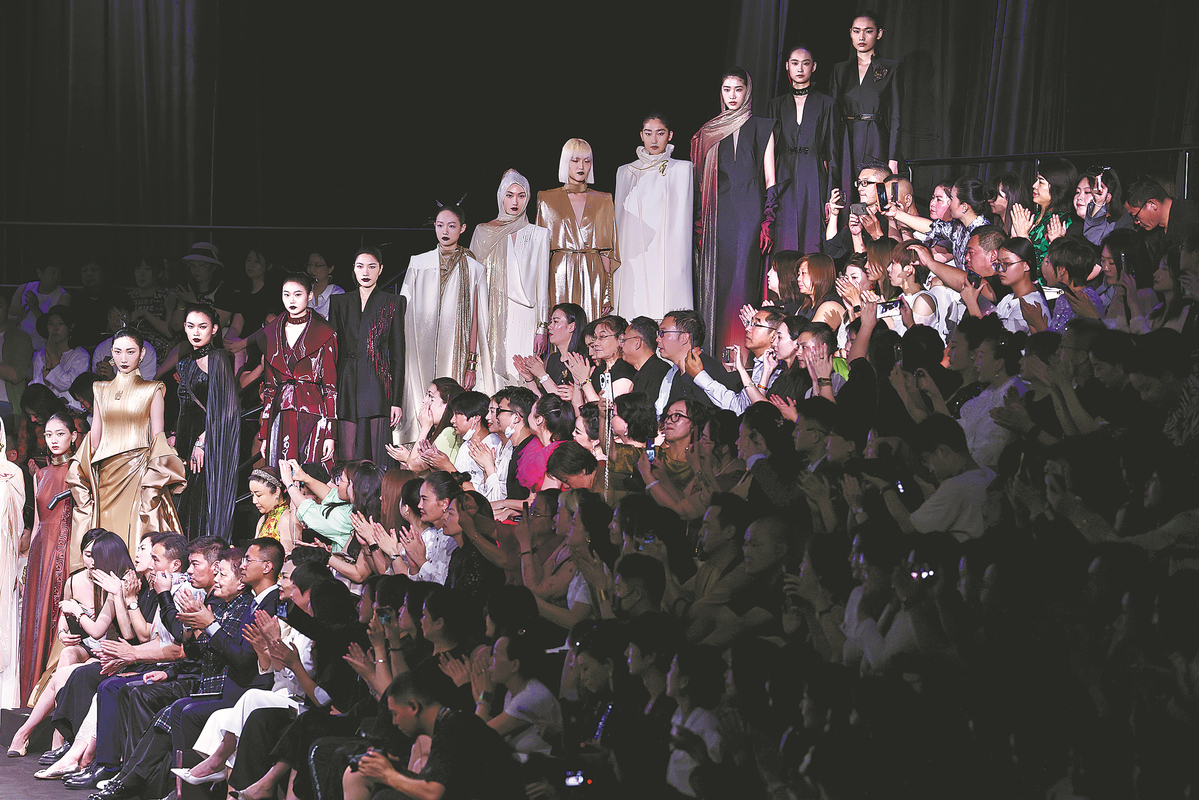
At 3 pm on Oct 1, 1949, Chairman of the Communist Party of China Mao Zedong declared the founding of the People's Republic of China from the tower of Beijing's Tian'anmen Gate, joined by other prominent figures who would form the core of the country's leadership. More than 300,000 people filled Tian'anmen Square to watch the announcement.
"For 75 years, this moment has been viewed by generations of Chinese as a deeply emotional milestone in contemporary Chinese history. Yet not many are aware of the fact that almost all who had turned up at the tower that day, including Chairman Mao himself, was wearing a special type of formal suit known in China as the Zhongshan suit," says Liu Wei, a professor from the Beijing Institute of Fashion Technology, one of China's top fashion colleges.
For those unfamiliar with the history, Zhongshan is the name of Sun Zhongshan, more commonly known as Sun Yat-sen (1866-1925), a Chinese revolutionary widely revered for his instrumental role in the 1911 Revolution, which overthrew the rule of China's last feudal dynasty — Qing (1644-1911).
With its stand-up collar and buttoned-up design, the Zhongshan suit (Chinese tunic suit), combining traditional Chinese aesthetics with a Western cut, endeared itself to Sun and his progressively minded countrymen who wore the design proudly, partly as a call for change.
"The suit got its name not from Sun himself but from his followers and admirers, including Mao, who decided to continue what he started," says Liu, who has researched and written extensively about the history of Chinese fashion.
According to Liu, Chinese fashion in the 1950s and 60s was characterized by uniformity and practicality, due to the dominant social ideology and the era's economic situation. Somber, muted colors like "army green" and "police officer blue" reigned. Functionality was prioritized; and a straight cut was favored for its minimal use of material.
"The need to feed and clothe everyone was pressing. And it was against this background that the Huadong Institute of Textile Science and Technology, the very first of its kind, was founded in Shanghai in 1951," says Liu. "Huadong" means East China, where Shanghai is located.
This was followed eight years later by the founding of the Beijing Institute of Textile Science and Technology, which changed its name in 1961 to the Beijing Institute of Synthetic Fiber Engineering, and again in 1988 to the Beijing Institute of Fashion Technology, or BIFT.
"The name changes were reflective of the larger trends both within the industry and across society," says Liu, pointing to a type of polyester fabric whose durability and wrinkle resistance had made it so popular among Chinese between the 1960s and 70s that it was effectively dubbed "di que liang", meaning "really good".
In the case of the second name change, the decision was made a decade after the official start of China's reform and opening-up in 1978. Spearheaded by Deng Xiaoping, whom many today regards as the initiative's "chief architect", the reform focused on transitioning Chinese economy into a more market-oriented one and making the country more connected to the rest of the world.
The message was sent out, first and foremost, by top Chinese leaders donning Western suits, which had been absent from view for the previous decade as China weathered the tumultuous "cultural revolution" (1966-76).




- Curtain comes down on Shanghai's popular tourism festival
- Local team effort enables evacuation of hikers from Qomolangma
- Mainland slams Taiwan leader's separatist narrative
- China, Malaysia to hold joint military drill
- Over 2.4b cross-regional trips expected during Golden Week
- China uses seawater for equipment cooling