China Focus: China makes great achievements in environmental protection over past 75 years









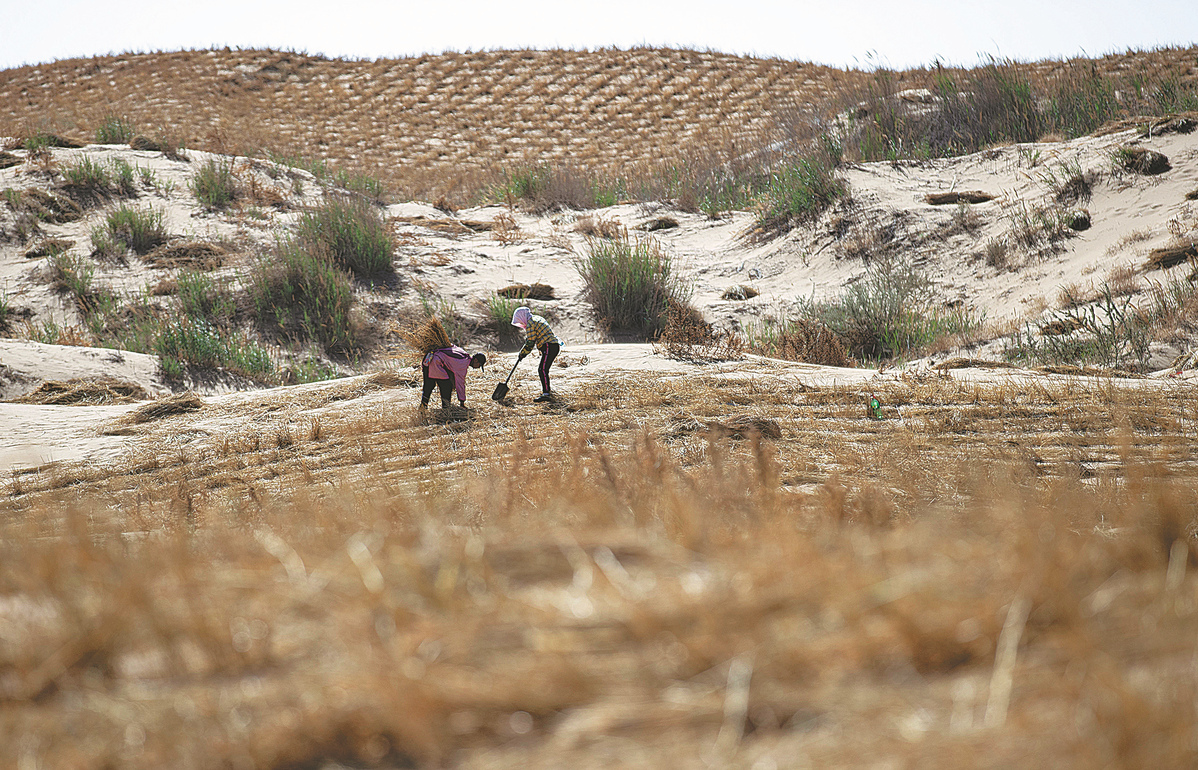
BEIJING -- China has made remarkable strides in ecological and environmental protection over the past 75 years, increasing the green coverage ratio, improving the system for natural protection areas, better-protecting wildlife species and their habitats, and enhancing air pollution control.
INCREASING GREEN COVERAGE
In the early days of the founding of the People's Republic of China, the green coverage ratio of Youyu county, located at the edge of the Maowusu Desert, was less than 0.3 percent.
Local government and residents' continuous afforestation efforts over the past seven decades have increased the county's green coverage ratio to 57 percent. The once "barren land" has become an "oasis in the desert."
Youyu county's story epitomizes China's national efforts to make the country greener.
China's forest coverage rate has increased to over 24 percent from only 8.6 percent around 70 years ago. According to data from the Ministry of Ecology and Environment, the country has contributed about a quarter of the world's total new green area since the beginning of this century.
In 1978, China implemented the Three-North Shelterbelt Forest Program, which has effectively curbed the expansion of desertification and become a "green great wall" to prevent sandstorms, conserve water and soil, and safeguard agriculture in Northwest, North and Northeast China.
By 2020, the program saw afforestation of 480 million mu (32 million hectares) of land, the management of 1.28 billion mu of degraded grasslands, and the forest coverage rate increased from around 5 percent in 1978 to about 14 percent in these regions.
PROTECTING BIODIVERSITY
After Dinghushan became China's first nature reserve to preserve primary forest and protect biodiversity in 1956, China gradually established nearly 10,000 natural protection areas at all levels, including nature reserves, forest parks, natural heritage sites and geoparks.
The country attaches great importance to biodiversity conservation, as evidenced by being among the first countries to sign and ratify the Convention on Biological Diversity.
In 2021, China established its first national parks, covering a protected land area of 230,000 square km.
These parks, including Sanjiangyuan National Park, the Giant Panda National Park and Wuyishan National Park, are home to nearly 30 percent of the country's key terrestrial wildlife species.
The progress in these national parks has made protecting biodiversity evident when considering the numbers involved.
The population of the Hainan gibbons, a rare primate that lives in the Hainan Tropical Rainforest National Park, had risen to 37 in 2022 from 13 in 2003. Sanjiangyuan National Park, meanwhile, is now home to more than 70,000 Tibetan antelopes, in sharp contrast to less than 20,000 in the 1990s.
Official data shows that 90 percent of China's terrestrial ecosystem types and 74 percent of key protected wild animal and plant species populations are now effectively safeguarded.
ENHANCED ENVIRONMENTAL PROTECTION
Environmental protection has been a high priority for China since the State Council convened the first national conference on the issue in 1973.
Following the introduction of an action plan to prevent and control air pollution in 2013, China became the first developing country in the world to impose large-scale efforts to reduce PM2.5 density.
The country has seen fast improvement in air quality, with 203 cities, or around 60 percent of the total cities, meeting the air quality standard in 2023, according to the Ministry of Ecology and Environment.
China has also made substantial strides in protecting the water ecology of key river basins, with national water quality continuing to improve.
According to the ministry, the proportion of surface water bodies nationwide classified as having excellent water quality reached 89.4 percent in 2023.
This figure surpasses the target set in the 14th Five-Year Plan (2021-2025) by 4.4 percentage points.
Using the Yangtze River as an example, 98.5 percent of monitoring sites in the basin achieved excellent water quality in 2023, up 0.4 percentage points year-on-year.
Additionally, the number of indigenous fish species recorded in the Yangtze River Basin increased to 227, up by 34 species from 2022. The number of nationally protected aquatic wildlife species rose to 14 in 2023, an increase of three compared to the previous year.
Official data showed the country's total investment in environmental pollution control reached 901.4 billion yuan (about $128.64 billion) in 2022, compared with only 2.5 billion to 3 billion yuan per year in the early 1980s.




- China Focus: China's intelligent river governance draws global attention
- Major cultural landmark opens in Xiong'an New Area
- Intl fishing competition attracts 1,200 athletes from 21 countries
- Across China: Climate change in China's arid northwest draws academic, public attention
- China Focus: Chinese scientists propose excess 40Ar in lunar soil possibly from Earth wind
- Chinese team achieves breakthrough in multiple drone flight against challenging winds