A new generation's passion for heritage and arts









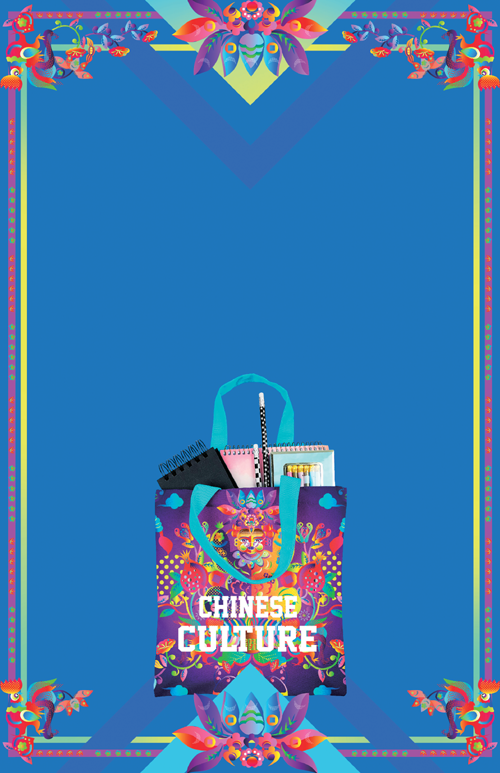 Bronze medal winner of the second International Pattern Design Competition, created by Dong Jin, an associate professor at Taiyuan University, inspired by Shanxi paper-cutting art. CHINA DAILY
Young enthusiasts are seeking to revive and modernize traditional Chinese art forms, blending innovation with heritage to appeal to a new generation, Gui Qian reports.
Peking Opera, Huangmei Opera, Pingju Opera — whenever traditional Chinese opera is on TV, Zhang Yang can't help but stop and watch.
This 29-year-old from Beijing has an innate passion for opera. Although she studied journalism and directing, she now works as a drama teacher at a children's palace (a center for extracurricular activities). Despite her profession not being directly related to opera, she actively seeks opportunities to learn and perform it.
"No matter if it's quyi (a collection of storytelling, crosstalk, and singing) or opera, our traditional Chinese performing arts are incredibly charming if you delve into them, as they embody a unique Chinese aesthetic," Zhang said.
Passion unleashed
Recently, Zhang has been particularly fascinated by Yueju Opera, which originated in East China's Zhejiang province. Last year, performances by young Yueju actors Chen Lijun and Li Yunxiao went viral on Chinese social media, sparking a newfound love for Yueju among many viewers, including Zhang.
In her view, Chen and Li's performance of New Dragon Gate Inn is a pioneering adaptation of traditional Yueju. It blends immersive theater with martial arts and a more rugged aesthetic, expanding beyond the typical scholar-beauty themes of traditional Yueju.
Zhang strongly agrees with Chen's perspective that Yueju needs both preservation and promotion, and that it's important to "make intangible heritage fashionable and classics popular".
"This kind of innovation is why Yueju Opera can break out of its niche and ignite a passionate wave among the public, particularly among young people," she said. "Personally, whether I'm eating or resting, I always have Yueju playing on a small speaker. At home, I sing it all the time, as if I'm possessed."
Zhang has joined a free, amateur Yueju Opera club in Beijing, where most members are in their 20s — a surprising sight, considering opera was once thought to be in decline. Many of these young enthusiasts have no performance background and participate purely out of their love for the art. They gather every weekend to practice together.
Her dream is to become a skilled amateur Yueju singer. "If one day I could truly make a name for myself in this field and meet the actors I admire on stage, connecting through our art, that would be my greatest happiness," she said.
As a drama teacher, Zhang also tries to incorporate traditional opera into her teaching. "I hope to contribute to the development of traditional culture. I want the children to understand their national art and develop genuine cultural confidence," she said.
While she compares professionals like Chen to "stones making large waves", Zhang sees opera novices like herself as "small pebbles".
"Together, many of us can create gentle ripples too," she said.
Cultural connections
Sharing Zhang's vision is video blogger Jiang Huajie, known online as "Langhua Jiang". At 27, Jiang comes from Rizhao in East China's Shandong province.
Since posting his first video on Bilibili last June, Jiang has amassed nearly 690,000 followers, thanks to his deep dives into niche areas of Chinese history.
His videos cover topics such as the 5,000-year history of Chinese names, the 3,000-year history of meat consumption in China, how ancient Chinese people learned foreign languages, and the evolution of secret jargon in the martial arts universe, known in Chinese as jianghu.
"All my videos are stories from the past that everyone has thought about but never explored deeply. It boils down to a formula: familiar topics plus unexpected interpretations equal delightful discoveries," Jiang explained.
His passion for making videos comes from an early fascination with history and a desire to influence more people in a down-to-earth way, helping them appreciate and understand the true value of the past.
For example, some of Jiang's viewers work in artifact restoration or write historical novels, and they often use his videos as a reference. He also has many "mom fans" who encourage their children to watch his videos to learn about history.
"Everyone's life leaves behind memories, and history is the collective memory of a nation," Jiang said.
He pointed out that, for a long time, many of China's popular cultural products haven't effectively showcased the rich heritage passed down from our ancestors. However, progress has been made in recent years, marked by a surge of outstanding domestic films, animations, and games. The current hit, Black Myth: Wukong, is a great example.
"The flourishing of national culture relies on the younger generations. Those born in the 2000s and 2010s naturally possess cultural confidence, thanks to the groundwork laid by previous generations and the rise of our national strength," he said. "Chinese culture is gradually establishing its presence in the world through these young people."
Jiang describes himself as "a small screw in the grand machinery of carrying on our predecessors' work".
"I tend to be quite self-centered in most aspects of life, but when it comes to history, even if I were to remain unknown my whole life, I would still find it meaningful and fulfilling," he said. "Our ancestors achieved so much, and it's up to us to work even harder."
Designing the future
Huang Qingsui, a young man from the Zhuang ethnic group in the Guangxi Zhuang autonomous region, is working to revive traditional Chinese patterns while helping young enthusiasts of Chinese-chic design bring their creative visions to life.
Huang spent five years traveling to numerous villages across Southwest China, collecting traditional patterns from local communities.
In 2018, he established an online database of Chinese patterns. Starting with about 3,000 patterns, the database now boasts more than 30,000 designs categorized into over 300 themes, including dragon motifs, Chinese celebrations, and mythical creatures.
"We created this database to bridge the gap between traditional and modern design," Huang explained. "Our goal is to help designers easily access and incorporate traditional Chinese patterns into their work, from architecture to fashion and cultural products."
Over time, Huang noticed that many designers started to draw inspiration from their cultural roots. This motivated him to launch the International Pattern Design Competition (WZD) in 2020, aiming to encourage innovation and the practical application of traditional patterns in contemporary design.
"My hope is to see more products that feature Chinese patterns make it to the market, bringing traditional designs into the mainstream and fostering a positive cycle between commerce and culture," he said.
This year's WZD, the fifth edition of the competition, is being held from July to October and has already attracted 2,497 entries from 16 countries and regions, mostly from young designers under 30.
The theme for this year, "China. Pattern", aims to integrate the spirit, culture, and lifestyles of China with those of the world. Participants are positioned as inheritors, creators, and disseminators of patterns that hold both historical significance and contemporary relevance, as noted on the official website.
According to Huang, patterns are like a "silent language" deeply embedded in traditional Chinese culture, carrying aesthetic and symbolic meanings. However, he noted that with modernization, many things have become standardized and industrialized, stripping away decorative elements and causing patterns to fade from our lives.
"Now, as our material and spiritual living standards improve, we are no longer satisfied with uniform products, opening up new opportunities for the creative development of patterns," he said. "The revival of Chinese chic also provides a sense of spiritual fulfillment for many."
Huang's current goal is to make traditional patterns trendy and globally appealing. "Patterns have an immediate visual impact and can transcend language barriers, making them ideal for cross-cultural exchange. I believe our traditional patterns will gain more popularity overseas in the future," he said.
Contact the writer at guiqian@i21st.cn