Small specks of dust a big threat to lunar missions









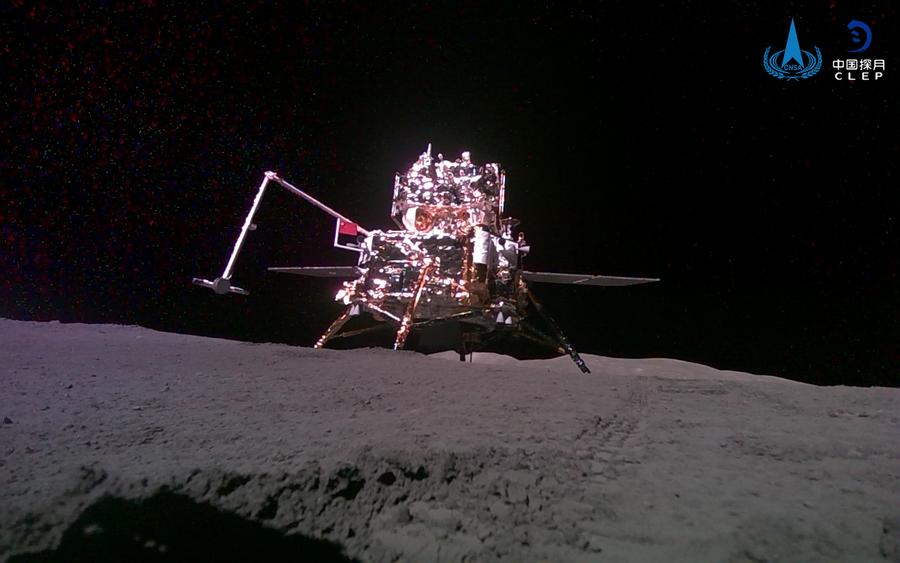
China has initiated the landing phase of its manned lunar exploration program, with a plan to complete a manned landing by 2030. Among all the challenges faced by scientists and engineers working on the program, lunar dust is very small in size, but potentially a big threat to successful missions.
However, Chinese researchers have found a simple, fast and promising way to build a dust-repellent surface via laser etching, according to a paper published in the journal ACS Applied Materials & Interfaces.
Lunar dust threat
Lunar dust consists of tiny silicate particles, which are formed from lunar rocks after long-term exposure to micrometeorite impacts, solar winds and cosmic radiation. From tens to hundreds of microns in size, these particles are almost invisible to the naked eye.
Despite their small size, such particles pose a significant risk, as high temperatures generated by meteorite impacts make them sharp and electrically charged. This means they tend to stick to exploration equipment and spacesuits.
According to Wang Xiao, an author of the paper and a member of the research team from Xidian University, lunar dust can infiltrate gaps and bearings of mechanical equipment and accumulate there, leading to increased friction, intensified wear and other difficulties in equipment operation.
Lunar dust can also cover critical parts like radiators, preventing effective heat radiation and making the equipment either too cold or too hot.
In addition, lunar dust can stick to optical lenses or solar panels, causing a decline in image quality and the accuracy of data collection, and can block the absorption of sunlight by solar panels, leading to insufficient power supply.
Nanosecond laser etching
According to Wang Weidong, leader of the Xidian University team, there is active and passive anti-lunar dust technology. Active protection relies on external energy sources. Due to limited lunar energy resources and the high cost of energy generation and storage, such active technology is seldom used.
Passive technology, in contrast, can protect equipment from lunar dust by altering the surface structure, selecting materials with self-cleaning properties, or applying a dust-resistant coating to equipment. This has become an important approach due to its high efficiency, long-term reliability and energy independence.
Wang's team opted for aluminum as their chosen material, as it is lightweight, high-strength and corrosion-resistant, and then used nanosecond laser etching to prepare multi-level and micro-structure surfaces with different structural parameters.
Nanosecond laser etching utilizes ultra-short pulse lasers with a duration measured in nanoseconds, or billionths of a second.
The team achieved multi-level, micro- and nano-structures by adjusting parameters including laser energy density, pulse frequency and duration, as well as scanning speed.
Anti-dust impact
The study found that the adhesion of lunar dust to the aluminum surface etched by nanosecond lasers was 52 percent lower than the adhesion to an untreated surface.
Dust coverage on the surface etched by the laser was about 85 percent less than on the untreated surface, and was easily cleaned up by a combination of flipping and gravity.
Wang Xiao revealed that the team will conduct extensive engineering tests and assessments, hoping that this technology could become one of the options used for spacecraft surface protection.
If proven effective, this technology could be applied to the surfaces of lunar rovers, thermal control equipment, mechanical structures and solar panels to achieve low adhesion of lunar dust, resulting in greater convenience and safety for human exploration efforts on the moon, he added.
Xinhua






- 'Separatist fallacy' of Lai Ching-te 'doomed to fail'
- Shanghai Symphony Orchestra rings in the new year
- New power station opens in Shanghai
- Series on Shanghai revolutionary sites airs
- Xu Beihong's horse-themed art exhibition opens in Shanghai
- China has enhanced social safety net: government minister