China unveils future space science plan










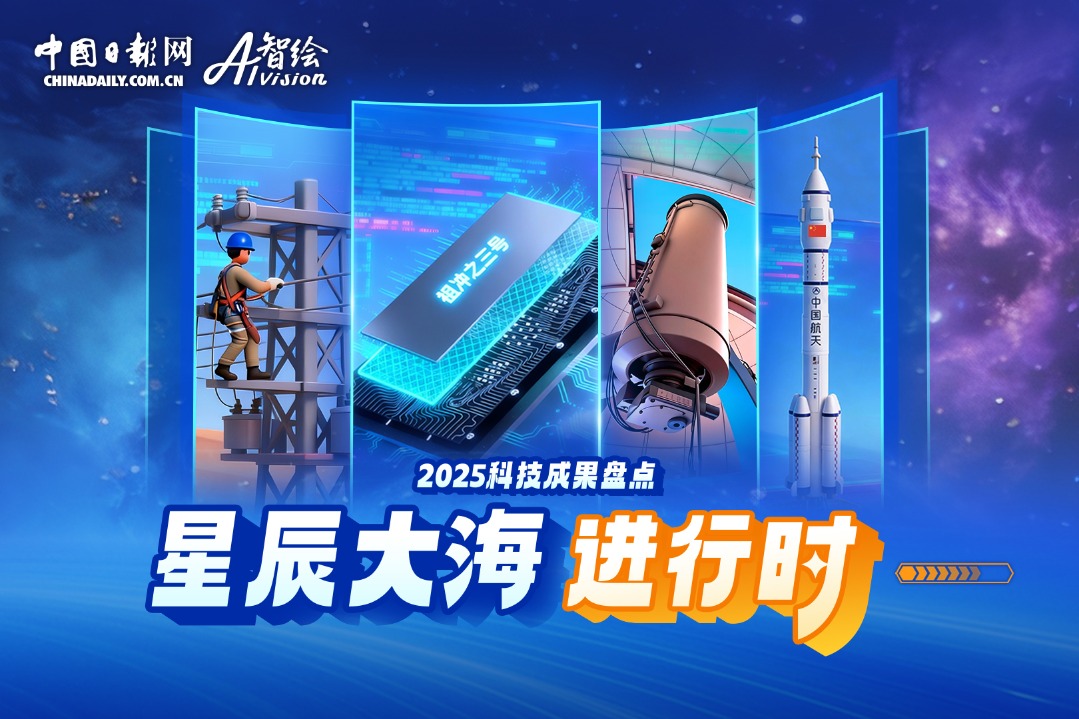
China unveiled on Tuesday its first-ever medium- and long-term plan for space science development, looking to establish itself as a "global space science power" by 2050.
The plan, which was jointly released by the Chinese Academy of Sciences, the China National Space Administration and the China Manned Space Agency at a news conference held by the State Council Information Office, aims to achieve "landmark original results with significant international impact".
It outlines the development goals of China's space science, including 17 priority areas under five key scientific themes. The themes include the extreme universe, the sun-Earth panoramic view, habitable planets, and biological and physical sciences in space, said Ding Chibiao, vice-president of the CAS.
China will explore the habitability of celestial bodies in the solar system and of exoplanets, as well as conduct missions to search for extraterrestrial life, Ding said, adding that the priority areas also include sustainable development, the origin and evolution of solar system, and characterization of planetary atmospheres.
The key scientific questions to be addressed include the habitability and signs of extraterrestrial life on Mars, icy moons and ice giants, and exoplanets.
The plan outlined a three-phase road map leading to 2050.
By 2027, China intends to continuously secure world-class achievements in disciplines where it has a strong foundation and advantages, such as high-energy time-domain astronomy, the origin and evolution of the moon and Mars, and microgravity physics.
Additionally, it will consider implementing a series of space science missions in cutting-edge areas, including dark matter and extreme universe studies, gravitational waves, exoplanets, and solar activity. In these fields, five to eight missions will be proposed and initiated, with two to three major projects expected to deliver landmark results.
Between 2028 and 2035, China will deploy a range of space science missions, envisioning about 15 projects in frontier areas such as the early universe, nearby habitable exoplanets, early solar system exploration and the search for extraterrestrial life.
During this phase, China will also continue operating the Tiangong space station, undertake feasibility studies for crewed lunar exploration and the establishment of an international lunar research station, and conduct approximately 15 space science satellite missions.
Between 2036 and 2050, China aims to achieve international leadership in critical fields, establishing itself as a "global space science power".
During the period, the country aspires to make "revolutionary breakthroughs in basic research" in areas such as the origin and evolution of the universe, the nature of space-time, the origins of the solar system and life, and crewed deep-space exploration, thereby "expanding the boundaries of human knowledge and advancing human civilization".
Meanwhile, China also plans to guide the global development of space science, proposing over 30 missions and positioning itself with core competitiveness and strong leadership in the next wave of the scientific and technological revolution.
Lunar missions
At the news conference, Yang Xiaoyu, director of the Department of System Engineering at the China National Space Administration, revealed more details about China's specific plans for future lunar exploration.
The Chang'e 7 robotic probe will investigate the environment and resources on the lunar south pole, while the Chang'e 8 robotic probe will carry out technological verification of in-situ resource utilization, he said, noting that the two missions will form the basis of the proposed international lunar research station.
Yang also shared the progress in research related to lunar samples brought back to Earth. In December 2020, Chang'e 5 brought back 1,731 grams of lunar soil, which he said is the "youngest moon sample" ever obtained.
Research has found that volcanic activity on the moon occurred as recently as 120 million years ago, and it has been discovered that the moon's cooling rate is much slower than previously thought, Yang said.
Scientists have identified a new mineral in the lunar samples and named it "Chang'e Stone", which is the sixth mineral ever discovered on the moon by mankind, he added.