Chinese researchers develop 'lunar bricks' for future lunar base construction









BEIJING -- Chinese researchers have developed bricks from a material that has a similar composition to lunar soil, with the hope that they can be used to build a lunar base in the future.
According to a recent video clip provided to Xinhua by the Huazhong University of Science and Technology (HUST), a team of researchers led by Ding Lieyun used a lunar soil simulant to make "lunar bricks" that are more than three times stronger than standard red bricks or concrete bricks.
The team also developed another construction option using additive manufacturing technology. The researchers invented a 3D-printing robot to print houses using lunar soil.
According to Zhou Cheng at HUST, the team used five different simulated lunar soil compositions and three different sintering processes, which can provide more accurate scientific data for the selection of materials and process optimization for future lunar base construction.
The composition of lunar soil varies in different locations on the moon, Zhou said, noting that there is one composition that simulates the lunar soil at the landing site of Chang'e 5, which is mainly basalt. Some other compositions simulate the soil found at other locations, soil that is mainly anorthosite.
He explained that the bricks need to undergo performance testing to determine if their mechanical performance will degrade in the lunar environment and whether they can withstand the high frequency of lunar quakes.
The moon has a vacuum environment with significant cosmic radiation, and temperatures exceed 180 degrees Celsius during the lunar day, dropping to minus 190 degrees Celsius at night. The team has to determine how well the bricks can insulate and if they can withstand the radiation, Zhou said.
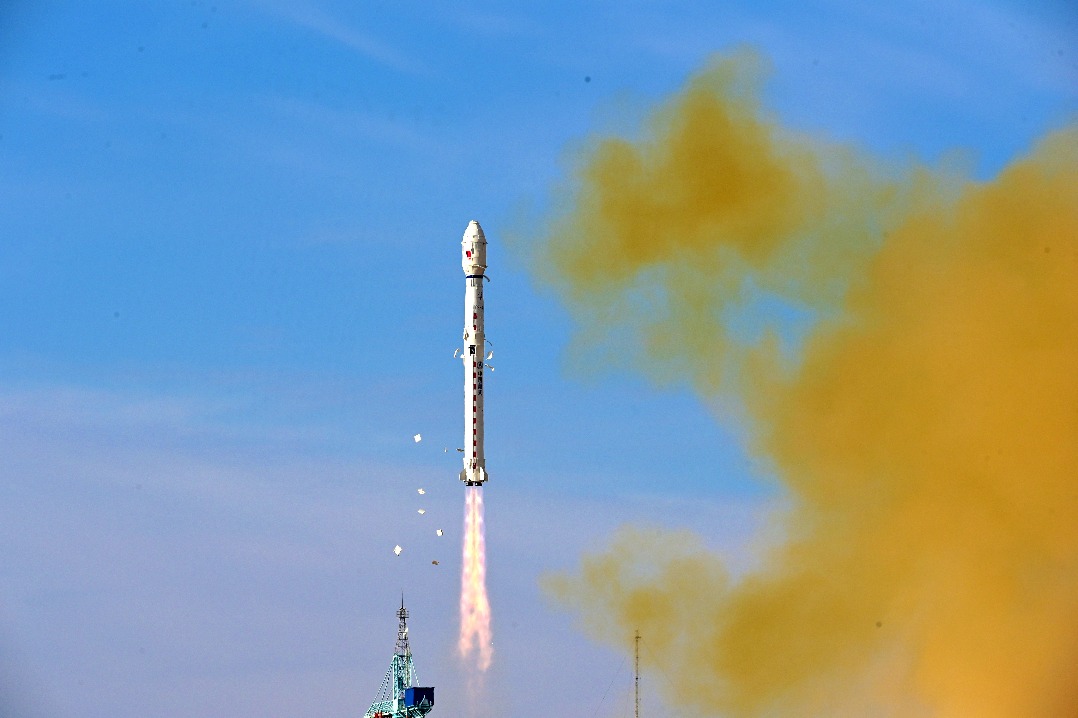
According to China Central Television, the lunar bricks will be sent to China's space station aboard the Tianzhou-8 cargo spacecraft to verify their mechanical and thermal performance, as well as their ability to withstand cosmic radiation. The first lunar brick is expected to return to Earth by the end of 2025.
China unveiled a national mid-term to long-term development program for space science on Tuesday, outlining a roadmap for the development of space science in China through 2050. The international lunar research station, which was initiated by China, will be constructed during the program's second phase from 2028 to 2035.