


Excavation unearths 5,000-year-old royal tomb amid capital speculation










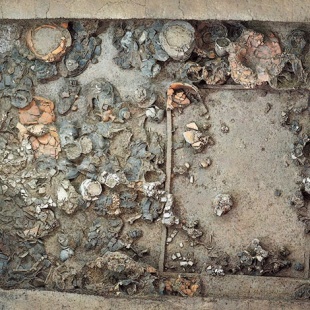
A tomb dating back approximately 5,000 years, presumed to be the grave of a prehistoric king, has been discovered at a ruins site in Central China's Henan province with more than 350 artifacts unearthed to date.
Located in the Wangzhuang ruins in the city of Yongcheng, the tomb covers more than 17 square meters, a super large size for that period.
The Wangzhuang ruins belong to the middle and late periods of Dawenkou Culture (4000-2600 BC) of the late Neolithic Age. Since 2023, experts from the Henan Provincial Institute of Cultural Heritage and Archaeology, the Beijing-based Capital Normal University and other institutions have jointly conducted excavations at Wangzhuang.
"The latest discovery indicates that the Wangzhuang ruins are not an ordinary settlement but rather, the capital of a prehistoric kingdom," says Zhu Guanghua, associate professor at Capital Normal University.
The tomb, measuring between 4.52 to 4.8 meters in length and 3.47 to 3.68 meters in width, features both inner and outer coffins. It contains many burial items, including more than 100 pieces of pottery, nearly 200 small jade ornaments, bone tools and animal remains, such as pig mandibles symbolizing wealth.
According to Zhu, the ancient tomb was once severely damaged. "The tomb owner's remains were removed and many significant artifacts were looted," he says.
"Most of the tomb owner's skeletal remains within the wooden coffin are missing, with only a few toe bones left.
"Small jade ornaments were scattered inside and outside the coffin and many stone ceremonial blades were deliberately broken," the archaeologist adds.
He notes that the findings suggest a deliberate act of tomb destruction shortly after the burial. Further research is underway to determine the reason.
This year, 45 tombs of Dawenkou Culture were discovered at the Wangzhuang ruins, with 27 already excavated. Some of the tombs are of higher status, yielding a wealth of artifacts and many contain pig mandibles, says Liu Haiwang, leader of the joint archaeological team.
More than 1,000 burial artifacts, including pottery and jade items, have been unearthed from the Wangzhuang ruins this year.
"The exquisite pottery, stone tools and jade artifacts vividly demonstrate the division of labor and the level of productivity at that time," Liu says. "The richness of the burial objects is closely linked to the size of the tombs, indicating that a clear social hierarchy and class stratification had already emerged."

What excites archaeologists even more is that the artifacts unearthed from the latest tomb suggest that the Wangzhuang ruins were a cultural melting pot in prehistoric times, where diverse cultures intersected and exchanged influences.
"The ancient residents were clearly influenced by the cultures of the eastern and the central regions, as well as cultural elements from the Yangtze River Basin," says Li Xinwei, deputy director of the Institute of Ancient History at the Chinese Academy of Social Sciences.
According to Zhu, customs observed at the tomb, such as the burial of water deer teeth and the deformed occipital bone of the deceased, align closely with those of the eastern Dawenkou Culture.
However, excavations have also unveiled typical artifacts from contemporaneous Yangshao Culture, such as small-mouthed pointed-bottom jars and small-mouthed shoulder jars, indicating a cultural interplay between the Dawenkou and Yangshao traditions in the region.
Archaeologists highlighted the innovative spirit and artistic prowess of the ancient inhabitants of Wangzhuang, who skillfully blended various cultural influences to create a distinct group of pottery.
"Its discoveries testify to the initial exchanges of early Chinese civilization, providing evidence for its nature of diversity," Li says. "This site offers important examples for studying the cultural fusion across different prehistoric regions."