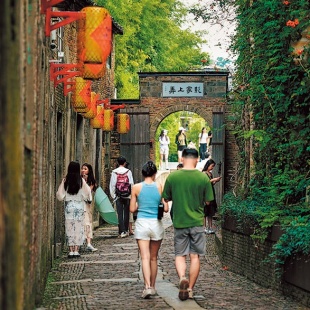



Taoyangli's rich culture gets a refreshing look









Zheng Dazhe never imagined he would end up spending an entire afternoon touring porcelain workshops, engaging with craftsmen, and becoming captivated by their stories and creations, but when he visited the Taoyangli historical and cultural district in Jingdezhen in Jiangxi province, that's exactly what happened.
Zheng visited the popular tourist destination in September to learn about porcelain. After exploring the Jingdezhen Imperial Kiln Museum, he found himself fascinated by the area's many porcelain workshops in their centuries-old courtyards, and had engaging conversations with the craftsmen, learning about the intricate process of making porcelain, from the initial shaping of the clay, to the hand-painting of the designs.
"It's like being in a movie. The porcelain artisans have lived and worked here for centuries. The buildings are old, and the city's glorious history of porcelain making comes vividly alive," says Zheng.
The Taoyangli historical and cultural district at the heart of Jingdezhen, which is known as the "porcelain capital of China", consists of significant remains and ruins that bear witness to its millennium-old porcelain industry. This includes imperial and ordinary kilns dating back to the Ming (1368-1644) and Qing (1644-1911) dynasties, as well as workshops and trading houses once inhabited by ceramics makers and business owners.
Restored in 2016, the area has since become a popular destination for tourists like Zheng who are interested in porcelain. According to Liu Zili, president of the Jingdezhen Ceramic Culture Tourism Group, which oversees the district's operation and restoration, Taoyangli received more than 3.7 million visits last year. During the National Day holiday earlier this month, daily visits peaked at 80,000.
Liu says that Taoyangli owes its birth to ceramics, and went on to develop a rich culture. The group aims to revitalize the historical district, and entice more young people to engage with its deeply rooted ceramic traditions.
Some 40 ceramic artisans and 300 apprentices are currently working in the historical workshops, mainly to demonstrate the intricacy of making porcelain and share their stories with visitors — tales of tradition, innovation, and the pursuit of beauty.
Sun Lixin, a fourth-generation inheritor of blue-and-white porcelain craftsmanship, continues the family legacy at his Taoyangli workshop. Growing up immersed in ceramic culture, he learned the craft from his grandfather, who also worked there.
The 57-year-old makes porcelain every day and enjoys engaging with the visitors who enter his courtyard. He has 60 apprentices, some of whom practice alongside him in the workshop.
"Most of the tourists coming here are young people. The district is a good window onto our porcelain culture. I believe as long as it interests young people, ceramic culture will continue to thrive and remain vibrant," he says.
Apart from the traditional workshops, new shops have also been introduced. Two years ago, when Wen Jing first visited, she was captivated by Taoyangli's blend of ancient architecture and old kilns. This January, she moved her aromatherapy shop from Shanghai to the district.
"Taoyangli is different to other ancient districts. It has not only imperial kilns and many old workshops, but also an abundant alleyway culture. It's amazing to see all these well-preserved old homes and production spaces packed into such a small area," says the 34-year-old.
Wen took the area's tradition of ceramics into consideration when she worked with her designer to create a stylish bottle for her aromatherapy products. It is covered in thorns, like those of a rose, and so has to be handcrafted, and Wen says the mass production of such an item is only possible in Jingdezhen.
"It has a well-established system for everything, from molding to making porcelain, and there are many skilled craftsmen who can work with us," she says.
Her shop is located in a centuries-old house and the interior can't be changed due to preservation laws, so Wen has added some stylish furniture and decorations to create a blend of old and new.
"Being here allows us to connect with more young people and directly interact with customers, which is really helpful for developing our future products. We get a lot of valuable feedback from them," she says.
As artisans deftly continue age-old traditions, visitors are invited to step back in time and experience the enduring legacy of this unique cultural enclave.
Taoyangli hosts numerous ceramic culture-related events each year to attract visitors. In addition to trying their hands at ceramics and exploring shops, tourists can visit the archaeological sites of the kilns that used to produce porcelain for the imperial families, participate in ceremonies held to mark the removal of freshly fired porcelain from the kilns, visit immersive ceramics exhibitions at the museum, and even do some role-playing.
"We will continue to explore cultural resources as a driving force for the integrated development of culture and tourism in Taoyangli," says Liu.
In recent years, the group has been reaching out to former residents and craftsmen who moved out of Taoyangli, inviting them to return for a visit, and to record oral history videos.
"Their stories are an inseparable part of the culture and history of the old neighborhood."
Related: