


Exhibition zooms in on cultural heritage
Film and photography highlight handicrafts, performing arts and ritual celebrations, Yang Feiyue reports.










Scenes of stone-paved alleys lined with ancient-looking houses and lush forest with waterfalls have a way of drawing the audience in to the arcadian landscape of Jiangjin district in Southwest China's Chongqing.
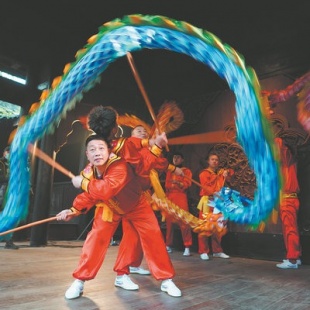
They are shown at the beginning of a 4-minute film highlighting a local distinctive dragon dance and set the stage for the subsequent emergence of dancing performers dressed in bright red costumes.

They move in harmony with the beat of drums and gongs, and the painted bamboo-made dragons they carry nimbly slither and coil, gliding through the air, as if having a life of their own.
The film recently stood out for vividly capturing the dance as a distinctive cultural heritage. It was among 500 selected pieces at the 2024 intangible cultural heritage film and photo exhibition that was hosted in Kaihua county, Quzhou city, Zhejiang province, from Oct 23 to 25.
The exhibition was hosted by the Center for Ethnic and Folk Literature and Art Development under the Ministry of Culture and Tourism, the Zhejiang provincial department of culture, radio, film and television, and tourism, and the Quzhou government. It showcased a range of ICH domains, including traditional handicrafts, performing arts and ritual celebrations from 22 provinces, autonomous regions and municipalities, including the Guangxi Zhuang autonomous region, Zhejiang, Shanxi, Henan, Guangdong and Gansu provinces.
"I am a representative inheritor of the small dragon dance, and I deeply feel the responsibility to preserve this precious cultural heritage through recorded images, contributing my part to cultural transmission," says Zhong Jie, a crew member of the film production team.
Named a municipal-level intangible cultural heritage in Chongqing in 2011, the dragon dance acquired its distinctive characteristics out of interactions among dragon dance artists. It took shape in the 1940s, with a dragon normally six meters long and 25 centimeters wide.
"It is characterized by four key features," Zhong says.
Compared with its counterparts across the country, the Jiangjin dance applies relatively small and intricately crafted props and requires only a few dancers.
"Usually three people can deliver a show, or in some cases, two or even a single dancer can pull it off," Zhong explains.
However, it entails a variety of movements and requires advanced skills.
A set of movements vary based on the number of performers, ranging from jumping and diving to interlocking hands, dangling upside down, and head-tail catch.
"Each movement requires strength, agility, and flexibility, making it a challenging and skillful dance for the performers," Zhong says.
The art form has been popular in local communities for being highly adaptable to different occasions and seasons.
"It is suitable for both solo and collaborative performances with larger dragon dances," Zhong says.
His team made sure all the highlights of the dance were captured in the short film, as well as the close connection of the art with local life.
"We also tried to tap into the cultural connotations of the small colorful dragon dance as a folk cultural heritage typical of western Chongqing, and show them to the audience in a vivid way," Zhong says.
Every cultural heritage item, he adds, carries the historical memory, values, and lifestyle of a specific region or ethnic group and is closely linked to local customs and ways of life, thus reflecting people's understanding and perception of nature and life.
The short film also makes a point of presenting the creation of props.
It shows that only "female" bamboo that has grown for more than three years is selected. The outer layer is scraped off before the bamboo is sliced into strips with a knife. These strips are then soaked in hot water for two to three days to enhance their flexibility. Once the frame is assembled, it is painted and decorated with colorful fabric to complete the dragon's appearance.
"Each step, from the rigorous selection of materials to the precise craftsmanship, demonstrates the inheritors' exceptional skills and unwavering commitment to quality. This craftsmanship is not only the core value of intangible cultural heritage but also a key reason it has been preserved over time," Zhong says.