


Breaking barriers
Korean visually impaired orchestra links lives through music, Hou Chenchen reports.










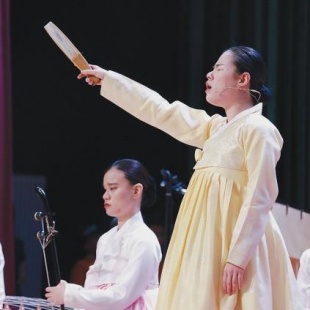
Academy of Beijing on June 5. [Photo provided to China Daily]
"Cause, ah-ah, I'm in the stars tonight. So watch me bring the fire and set the night alight."
These lines from Dynamite, a popular song of top K-pop band BTS, were accompanied by the rhythms of traditional Korean percussion drum beats and the soothing melodies of string instruments.
The mesmerizing mix subsequently converged seamlessly into the elegant Chinese folk favorite, Mo Li Hua, or Jasmine Flower.
Loud cheers and thunderous applause from the audience filled the air as the musical performance gently faded into its finale. Listeners' amazement grew when they learned that the beautiful renditions were performed by a group whose members were visually impaired.
In June, the Korean Traditional Music Orchestra of the Blind performed at the Korean Cultural Center in Beijing. Themed 600-year history of Blind Kwanhyun music echoes through Beijing, the performance showcased captivating traditional Korean music such as Arirang folk songs, as well as a mix of K-pop and classic Chinese tunes.

"I planned this performance in China several years ago and put a lot of thought into it," said Choi Dong-ic, the director of the orchestra.
"We presented six songs from our history and even attempted to sing Chinese songs. Additionally, we included more popular songs like Dynamite."
Korean traditional music is Choi's passion, but he never imagined it would one day serve as a bridge between the visually impaired community and people worldwide.
Born with healthy vision, Choi's life took a drastic turn when he was 9 after an accident left him visually impaired for life. But his deep love for Korean traditional music helped him surmount the impairment and led him to dedicate himself to upholding and passing down the cherished musical legacy.
"I want to revive traditional Korean music played by blind musicians, and I want to develop more fame for our music in the world," Choi said.
Visually impaired musicians have a unique place in Korean traditional music. During the Joseon Dynasty (1392-1910), visually impaired people with exceptional auditory abilities were provided professional music education and training by the royal palace. Known as "Blind Kwanhyun", they were designated as court musicians and performed during official engagements and royal festivals.
"Blind musicians can hear sounds even if they cannot see, so no one in this world should be abandoned," according to the dynasty's King Sejong (1397-1450). Historical records showed that he actively supported visually impaired musicians to overcome eye diseases and promoted their welfare.
But the Blind Kwanhyun tradition of court orchestras ended during the Japanese colonial period. In 2011, the Siloam Center for the Blind in Seoul launched the Korean Traditional Music Orchestra of the Blind with the support of the South Korean Ministry of Culture, Sports and Tourism. Choi was inaugurated as the first director.
The orchestra now consists of 13 members and eight of them are visually impaired musicians. The musicians perform with traditional Korean instruments like the ajaeng, a large Korean bowed zither with seven strings, and the yanggeum, a trapezoidal wooden instrument with strings stretched over it.
The orchestra plays a variety of music genres, including Jeongak, which was performed during royal ceremonies of the Joseon Dynasty, folk music that reflects the lives of commoners, and fusion music where the past and present coexist.
On his 13-year tenure as the group's director, Choi said: "Looking back, I have no regrets. If the brilliant artistic spirit of the visually impaired blossomed over those 600 years, the last decade has been dedicated to reviving that flower that was once broken and disappeared."