Draft revision to boost science popularization
It underscores importance of making new tech, knowledge more accessible










China is advancing its commitment to science education with a draft revision of the Law on the Popularization of Science and Technology in order to broaden public engagement with science and technology and adapt to the rapid advancements the country has seen in high-tech fields, experts said.
Wang Ting, director-general of the China Research Institute for Science Popularization, hailed the nation as the only one in the world to enact a law specifically for science popularization.
Underscoring achievements made in fields such as artificial intelligence, quantum physics and biotechnology, Wang said, "We have done extensive research to support the law's revision, proving the need for high-quality science popularization as China leads in several scientific fields."
The new draft, which includes two additional chapters compared to the current 2002 law, emphasizes "science popularization activities" and "science popularization personnel," totaling 60 articles in eight chapters.
It highlights the importance of making new technologies and knowledge accessible to various demographics, guiding people to understand and apply scientific achievements. Targeted science education activities in cutting-edge technological fields are also encouraged to promote public understanding and the integration of scientific advancements.
"Building on achievements in education, the new draft further clarifies the mission of science popularization in China's modern era," Wang said.
Historically, science popularization served as a tool to dispel superstitions and promote literacy, he noted. In the early post-1949 years, efforts focused on basic health messages such as the dangers of drinking untreated water. The role of science education grew gradually after 1949, expanding to agricultural and technological knowledge sharing, especially after China's reform and opening-up period in 1978.
Today, the field has evolved to encompass the latest developments in space exploration, quantum research and satellite technology.
President Xi Jinping has repeatedly stressed that scientific popularization should be placed in a position that is equally as important as scientific and technological innovation.
A survey released by the China Association for Science and Technology in April reported that 14.14 percent of Chinese citizens have attained scientific literacy, a notable increase from 1.44 percent in 2001.
"When scientific literacy exceeds 10 percent of the population, it represents a favorable environment for science and technology to thrive," Wang said.
Meanwhile, China's rank in the global innovation index has climbed from 34 in 2012 to 11 this year, making it the only middle-income economy among the top 30, according to the Global Innovation Index 2024, which was published in September by the World Intellectual Property Organization.
The draft encourages popular science initiatives that integrate with sectors such as tourism, agriculture and sports. Research institutions, universities and tech companies are urged to establish science popularization centers. Intellectual property protections are also included to support the development of science education products.
Wang gave a vivid example of such initiatives when he mentioned the Beijing Yizhuang economic and technological development zone, which is creating a city of science museums.
"Unmanned helicopters, autonomous taxi services, Beidou navigation, commercial rockets, etc. ...these hardcore technologies will showcase their charm in the science museums of many enterprises in Yizhuang," Wang said.
"The first batch of 50 corporate science museums opened to the public in 2021, including the Beijing Benz Museum, the JD Technology Exploration Museum and the Beidou Satellite Navigation Application Museum, demonstrating how companies and other organizations can engage in science popularization," he said, adding that he had visited some of the science museums and was deeply impressed.
The draft also strengthens science education responsibilities for primary and secondary schools and even extends to kindergartens. Wang noted that this would prompt educational reforms, cultivating children's scientific thinking and innovation from an early age to "provide a solid foundation for future science and technology development".
According to the Ministry of Science and Technology, China had nearly 2 million science popularization personnel in 2022, with over 80 percent working part-time. The draft proposes systems for title assessments and performance evaluations to encourage more professionals to participate in science education.
Currently, 18 provinces have initiated professional title evaluations for science popularization, a move expected to increase volunteer involvement and improve quality across science communication efforts. Wang noted that the reforms would promote a more professional, high-quality approach to science education, enhancing public understanding of China's technological strides.


- China successfully launches new test satellites
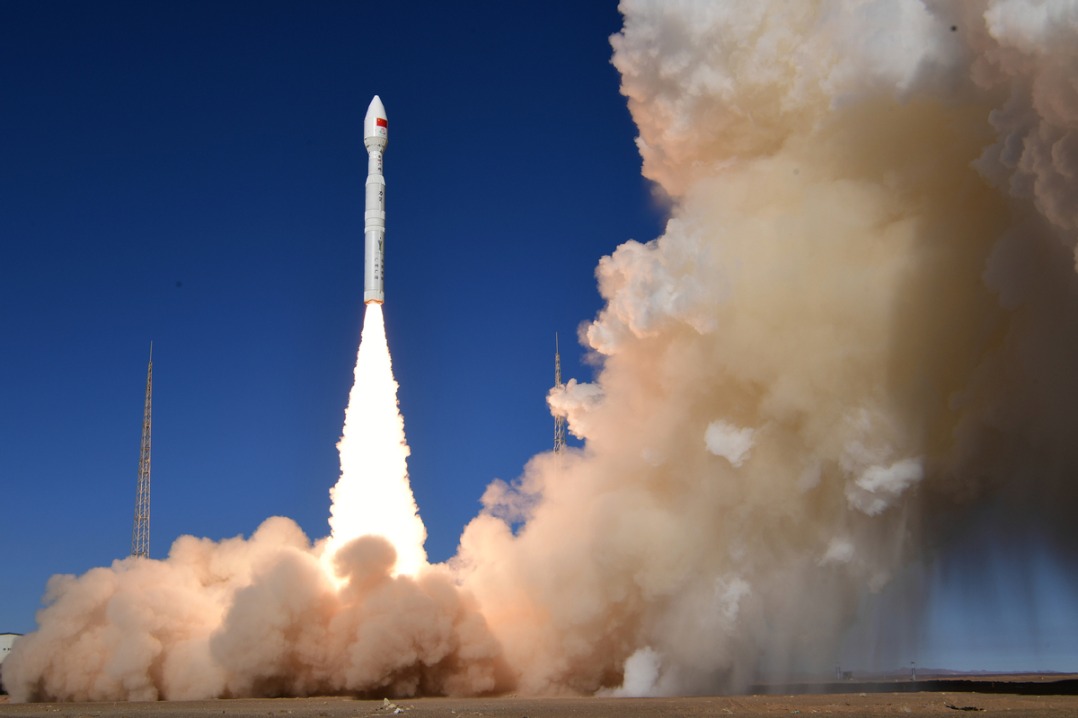
- China launches Lijian 1 Y9 carrier rocket
- First cross-border event debuts at the National Games
- China Focus: National Games enhances coordination under 'one country, two systems'
- China's Fujian aircraft carrier to make regular appearances on high seas: spokesperson
- A decade of dialogues