


Beyond blending in
Salon participants agree that Peru's legacy of immigration means Chinese culture is inseparably infused into its society. Erik Nilsson reports.









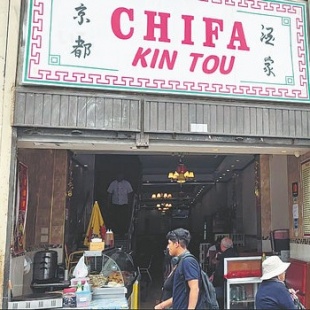
Chinese food isn't Chinese food in Peru. Instead, the fusion cuisine chifa is staple fare for all Peruvians of any background.
And this blend of culinary characteristics transcends ingredients and preparations. It ultimately reveals how Peru's legacy of immigration has inextricably baked Chinese culture into Peruvian society, like flour into bread.
"Chifa, for us, is not Chinese food anymore. It's part of what makes us Peruvians, and it's not just about the food, you know," said Selena Zhou, Peru's culture, education and tourism attache in China.
Zhou, who joined a recent Embracing Cultures salon China Daily hosted at the Peruvian embassy in Beijing, is among the estimated 10 to 12 percent of Peruvians with direct Chinese heritage. Most are descendants of immigrants who came to Peru around the mid-1800s.

"We are really happy with that immigration," Zhou said. "It has enriched our history, our food, our way of speaking, our way of making friends and our openness to foreign cultures."
She explained that Chinese were more willing to marry locals than many immigrants during that period.
"Some countries learn to coexist with different cultures. But in the Peruvian case, we not only coexist, we mostly embrace it. So, we created a brand-new identity," Zhou said.

"Chifa is a reflection of how the Chinese people who emigrated to Peru many years ago learned to adapt their own heritage with the ingredients they had at hand. They even shared it with the Peruvian locals. They didn't keep it to themselves like other immigrants."
The names of many of its dishes are portmanteaus of pure Spanish and words that Peruvian Spanish incorporated from Chinese, especially Cantonese. Arroz chuafa, for example, combines the Spanish word for rice — arroz — with chuafa, from the Cantonese word for fried rice.
Even the name for chifa itself came from Chinese, Zhou explained.
" (Chinese) would yell out 'chifan', (Chinese for) 'it's time to eat'," she said. "And the Peruvians around them would just hear 'chifa', and they would say, Oh, that's chifa then."
Luo Xun, a Tianjin University of Technology professor and co-director of Connected Universal Experiences Labs, who joined Zhou at the salon, said chifa offered a taste of home when he visited Peru.
"This gives you a lot of familiarity that you feel," Luo said. "That's a deep connection with Chinese culture."
He said he's particularly fond of chifa's seafood offerings.
"It gives you the feeling of being somehow remotely separated but still culturally connected because of the food and also because a lot of people there are of Chinese descent," he said. "You have a feeling of going to a familiar place that you never visited before."
- Embracing Cultures: Culture ties China and Peru
- Expo provides an international insight
- Video: Diplomats discover China's beauty in Guizhou
- Colombian ambassador to China praises Guizhou's primitive Dong villages
- Counsellor of the Mexican embassy in China: Building bridges of friendship through sports