


A tradition set in stone










Another noteworthy aspect is that all Liangzhu cong pieces feature a distinctive pattern: a figure wearing a feathered crown rising above a wide-eyed, open-mouthed beast.
According to Fang, the prevalence of this pattern attests to a unified belief system upon which the civilization was built.
The same pattern also adorns a jade axe and a scepter unearthed from a royal cemetery on the site. Representations of military and religious power, they speak for the connection between jade and regal authority. The connection was fully explored in the ensuing millennia by successive Chinese emperors who reigned under the teachings of Confucius who believed in "rule by virtue".
During the Eastern Zhou Dynasty (770-256 BC), when Confucius lived, and the following Western Han Dynasty (206 BC-AD 24), the creation of funerary jade reached an artistic pinnacle. Kings of various vassal states were routinely interred from head to toe with exquisitely carved jade wares, which were expected to keep their bodies intact while their soul took the heavenward journey.
From the burial ground of a Han Dynasty vassal king in today's Xuzhou city, Jiangsu province, archaeologists unearthed what is believed to be some of the most majestic jade dragons yielded by any ancient Chinese tomb.
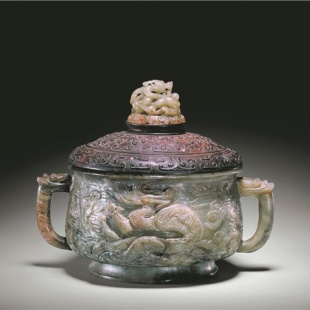
Horned and bearded, with flowing manes on the back and upwardly curled tufts of hair sprouting from the ankles, these S-shaped dragons are an amalgam of fantastical details, all contained within graceful curves, which in turn were realized with powerful simplicity. Their task was to carry the soul of the deceased to heaven.
In 139 BC, the powerful Western Han Emperor Wudi, who made Confucianism the official ideology for his and the following Chinese dynasties, sent envoys on a westward journey that was to give rise to the ancient Silk Road.
In conversation with Emperor Wudi upon his return 13 years later, Zhang Qian, head of the team, described a place where exquisite jade stones could be found along rivers or deep within mountains.