


Weaving a decorative history
Xinjiang artisans use traditional patterns to tell stories and attempt to ignite the next generation's interest to keep the ancient craft alive, Xing Wen in Hotan and Mao Weihua in Urumqi report.










As an ancient Silk Road crossroads, Xinjiang produces carpets reflecting diverse cultural influences.
"For instance, the idea of using rose patterns in carpets comes from Egypt while mountain peak designs originate from Turkiye and Iran," says Pei Ming, 66, a craft artist from the Xinjiang Uygur autonomous region folk literature and art association.
"Meanwhile, the peony and lotus patterns on Xinjiang carpets are inspired by popular embroidery designs from the Central Plains of China."
Pei has been researching the history and craft of Xinjiang carpets.
The inclusive beauty of Xinjiang carpets has won international acclaim since ancient times, he says.
During the Yuan Dynasty (1271-1368), Samarkand, an ancient city in Uzbekistan, served as the distribution center for carpets in Central Asia. By the 16th century, Xinjiang carpets had already entered European markets.
The production of handmade carpets in the region flourished during the Qing Dynasty (1644-1911) when carpets produced in Xinjiang's Hotan prefecture became essential tribute items for the imperial court.
Hotan carpets are made from high-quality semicoarse wool from a local breed of sheep, characterized by a rough yet nonsticky texture with moderate thickness, good elasticity and great resilience.
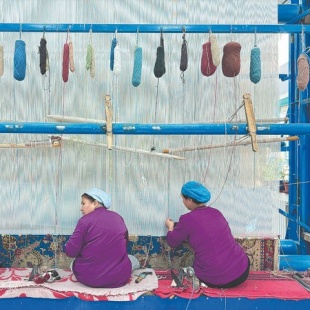
The wool is spun into yarn and dyed into vibrant colors, then twisted together in warp, weft and pile.
To ensure output, patterns and color schemes are designed before workers begin weaving.
Xinjiang carpets are mostly woven with vertical looms. Warp and weft threads are intertwined to create a base, followed by knotting small wool knots on the warp with the pile. A carpet with thousands of knots can withstand the test of time.