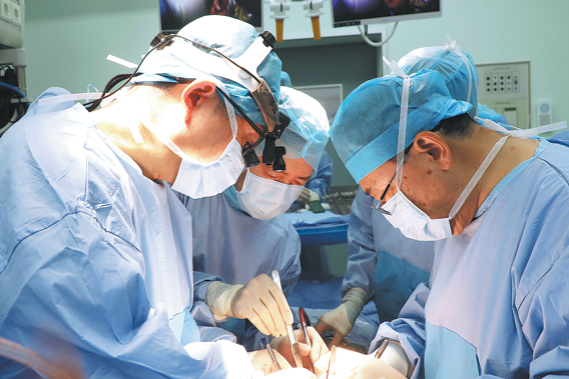
China unveils powerful heavy-ion accelerator










China has launched a groundbreaking scientific facility capable of generating heavy-ion beams far more powerful than any other device of its kind in the world.
The Low Energy High-Intensity Heavy-Ion Accelerator Facility, or LEAF, constructed by the Institute of Modern Physics, the Chinese Academy of Sciences, in Lanzhou, Gansu province, began operations this week, according to researchers.
This facility is expected to help scientists explore the evolutionary history of cosmic elements. Additionally, the techniques developed here could facilitate the synthesis of new elements beyond the current periodic table, experts said.
LEAF is the world's first standalone heavy-ion accelerator of its type and boasts a performance several times greater than similar devices in Europe and the United States.
"Chinese scientists have already used LEAF to produce carbon ion beams with an intensity of 80 particle microamperes and bombard them on target, doubling the known world record," said Sun Liangting, a researcher at the institute and a member of the development team.
Sun said the facility could achieve milliampere-level ion beam intensity, far surpassing the tens of particle microamperes typically produced by similar accelerators globally.
One particle milliampere is a huge amount of particles. It's equivalent to about 10 quadrillion particles per second, which is roughly a million times more than the entire population of the world.
Zhao Hongwei, the project's chief scientist and an academician with the CAS, said LEAF's advanced capabilities allow it to produce intense, high-charge-state beams of elements ranging from light to heavy.
"LEAF holds broad application prospects in frontier interdisciplinary research fields, such as atomic physics, nuclear astrophysics and nuclear energy materials," Zhao said.
Beyond their application in energy, such as in nuclear power plants, nuclear reactions are fundamental to understanding the evolution of the universe.
"According to prevailing scientific theories, the Big Bang primarily produced hydrogen, helium and trace amounts of lithium. Elements essential to life, such as carbon and oxygen, as well as heavier elements like iron, were formed through stellar evolution. Understanding these processes is a key focus of nuclear astrophysics," said Tang Xiaodong, a researcher at the Institute of Modern Physics.
LEAF's development began in 2014. In recent years, Tang and Sun's team have worked closely to enhance the facility's performance to meet experimental requirements.
Tang's team has already conducted a series of experiments, including studies on carbon-carbon fusion reactions, with results soon to be published in international journals.
Tang noted that carbon-carbon fusion reactions are a challenging area of study in cosmic element evolution, remaining a frontier issue since the 1960s.
"LEAF can simulate the nuclear reactions occurring inside stars in a laboratory setting, helping scientists address long-standing questions about cosmic element evolution. It represents a significant milestone in nuclear astrophysics," he said.
Sun added that research at IMP is also underway to synthesize new elements using LEAF's advanced technology, potentially leading to the discovery of elements beyond the current periodic table.
Similar accelerator projects in the United States and Europe have also explored carbon-carbon fusion experiments. However, these efforts have been limited by equipment constraints.
"The primary limitation of traditional electrostatic accelerators has been their relatively small ion sources, which lack the power of LEAF," Sun explained.
"LEAF employs a linear accelerator equipped with a powerful Electron Cyclotron Resonance ion source to deliver high-intensity beams that meet experimental needs. This breakthrough allows for more realistic simulations of nuclear reaction environments in the universe and addresses the demands of nuclear astrophysics research."
Professor Gao Ning of Shandong University, one of LEAF's early users, highlighted the facility's potential for advancing research into irradiation-resistant materials.
"The high-current ion beams produced by LEAF have groundbreaking significance for reducing experimental costs and shortening timelines. For example, conventional ion implantation equipment can irradiate an area of about 1 cm by 1 cm, whereas LEAF's beam can cover 10 cm by 10 cm. This allows us to irradiate 100 samples under identical conditions simultaneously," Gao said.
"With LEAF, we can save about two-thirds of the funding while producing samples 100 times larger. What once required weeks can now be completed in just one or two days," he added.
Sun noted that foreign scientists have already begun using LEAF, and it will be open to researchers worldwide in the future.
yandongjie@chinadaily.com.cn





- Crossing the Strait: Explore Taiwan cuisine in Beijing
- China condemns US defense bill provisions as interference
- China initiates renovation projects at 25,800 urban residential communities from Jan-Nov
- China unveils new mechanism to align higher education with national priorities
- Chinese PLA will not cease efforts to combat separatist activities, promote national reunification: spokesman
- Beijing E-Town humanoid robot half-marathon set for April 2026