Scholar seeks more talks on Sino-Philippine ties









Editor's note: China Daily presents the series Friends Afar to tell the stories of people-to-people exchanges between China and other countries. Through the vivid narration of the people in the stories, readers can get a better understanding of a country that is boosting openness.
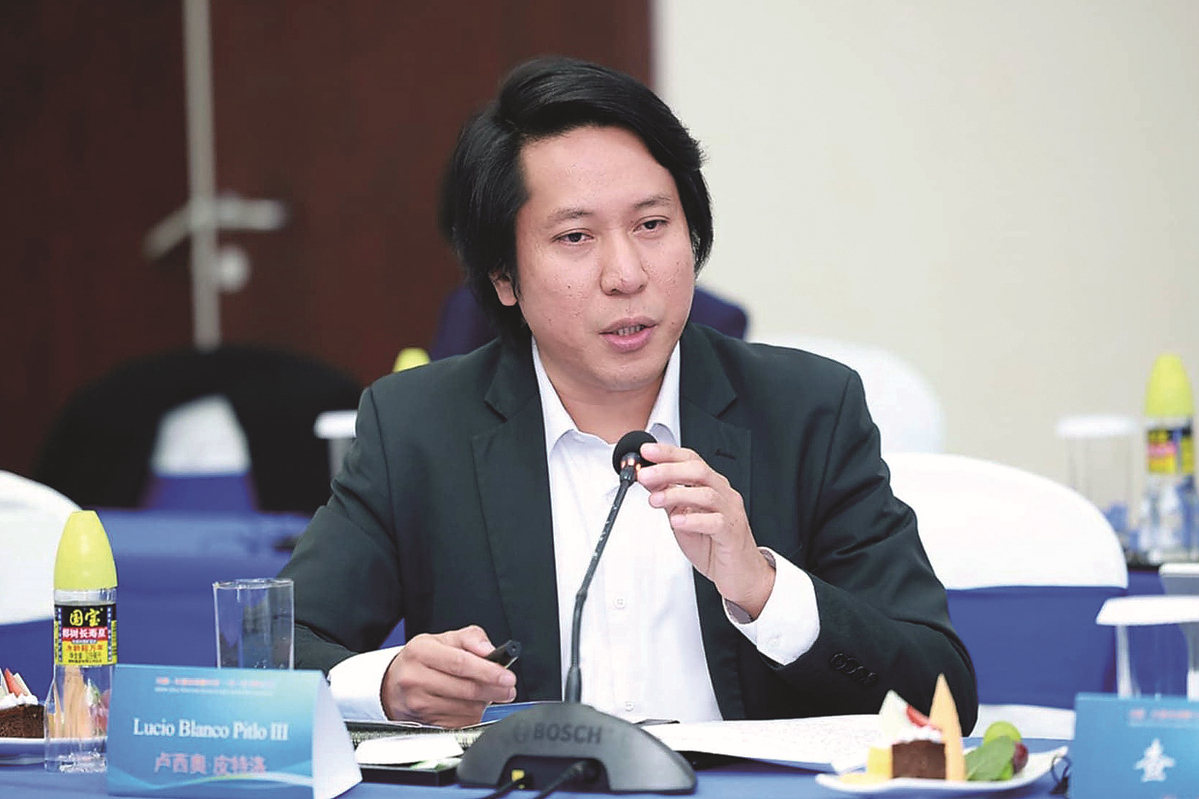
For veteran foreign policy and security analyst Lucio Blanco Pitlo III, there is no better time for him to head the Philippine Association for Chinese Studies, or PACS. Pitlo was elected president of the Manila-based organization in June, and among PACS plans in 2025 is to hold several talks on Philippines-China cooperation as the two countries observe the 50th anniversary of diplomatic relations.
"We will have these forums to discuss issues where the Philippines and China can work together, especially on the economic front," Pitlo told China Daily in an interview during a business trip to Hong Kong in late October.
Pitlo said scholars, industry executives and diplomats will be invited to talk about issues like the Belt and Road Initiative, joint ventures in electric vehicles, traditional Chinese medicine and tourism. Strained relations due to South China Sea issues would also be a topic of discussion as this is "unavoidable", he said.
However, he said the purpose of having several talks is to highlight the fact that there is more to the two countries' relations than the strategic waterway.
"We cannot ignore that the two countries have issues of concern, but they have to find ways to manage (them) properly so that it won't hurt bilateral ties," Pitlo said.
This reflects Pitlo's position on the China-Philippines relations — that the issue of the South China Sea cannot define the otherwise multifaceted relationship between the two countries.
After obtaining a degree in public administration from the University of the Philippines, or UP, in 2004, Pitlo ventured into business development consultancy. But he veered away from that career path after his interest was piqued by local news reports on the tension over the South China Sea.
Pitlo returned to the UP in 2008 to pursue an MA in Asian Studies, with a focus on China. It was at the university where Pitlo would later meet his mentor, Aileen Baviera. Baviera, who died in 2020, was a prominent Filipina Sinologist, dean of the UP Asian Center, and co-founder of PACS.
'Leading light'
Pitlo recalled that Baviera was "one of the leading lights" when it came to Chinese studies in the Philippines, and he appreciated Baviera's view that China-Philippines relations present both a challenge and an opportunity.
Pitlo worked as Baviera's research assistant at a time when Baviera was studying the territorial and maritime jurisdiction disputes regarding the South China Sea. The output from this research was published as an 80-page paper in 2013, with Baviera and maritime law expert Jay Batongbacal as co-authors.
It was also Baviera who encouraged Pitlo to join PACS — an association that comprises Filipino scholars and enthusiasts of Chinese studies and aims to promote mutual understanding and cooperation between the Philippines and China.
Joining PACS was pivotal for Pitlo as it was through the organization that he learned that Peking University was offering a scholarship for a master's degree in law. He received the scholarship, and in 2014, traveled to China for the first time.
He was in Beijing from 2014 to 2015. It was this yearlong stint in China that would shape Pitlo's outlook on foreign relations. While the tension over the South China Sea may have intensified Sinophobia in the Philippines, Pitlo to this day maintains a more nuanced view of China-Philippines ties.
By living in Beijing, Pitlo learned that China is different from what he had learned and what he had read from books written by Western authors. He was impressed by the high quality of infrastructure and roads, as well as China's successes in poverty alleviation and advancements in digital technology compared to his home country.
"China proved that kind of economic miracle is possible because of a strong central government policy. That's also one interesting area that I came to appreciate while I was in China," he said.
Pitlo observed that compared with their peers in the Southeast Asian region, very few Filipinos study in China. While studying at Peking University, Lucio met students from Cambodia, Indonesia, Thailand and Vietnam.
"They are studying in higher learning institutions in Beijing and they're trying to make sense of China as an engine of global growth," he said, adding that while other ASEAN countries also have contesting claims over the South China Sea, they usually find a way to work with China.
Pitlo returned to Manila in 2015 and applied what he learned by teaching Chinese politics and economy at Ateneo de Manila University, and international relations at De La Salle University. He was also a contributing editor at Asian Politics& Policy, a quarterly peer-reviewed academic journal, from 2015 to 2023. Since 2018, he has been a research fellow of the independent policy think tank Asia Pacific Pathways to Progress Foundation.
Pitlo writes and contributes opinion pieces for various local and international publications and has built a reputation as one of the most sought-after experts in security, defense and Philippines-China relations. He continued to deepen his scholarly knowledge by returning time and again to the academy. He was in Washington, DC, from 2018 to 2021, where he finished his MA in international relations at the American University's School of International Service.
As the current PACS president, Pitlo aims to expand the membership by reaching out to students and the younger generation of enthusiasts of Philippine-Chinese ties. He will also continue the PACS tradition of publishing the Chinese Studies Journal, an annual peer-reviewed journal that can be accessed for free, and holding several dialogues as a way to promote people-to-people exchanges.
prime@chinadailyapac.com