JUNO project advances neutrino research









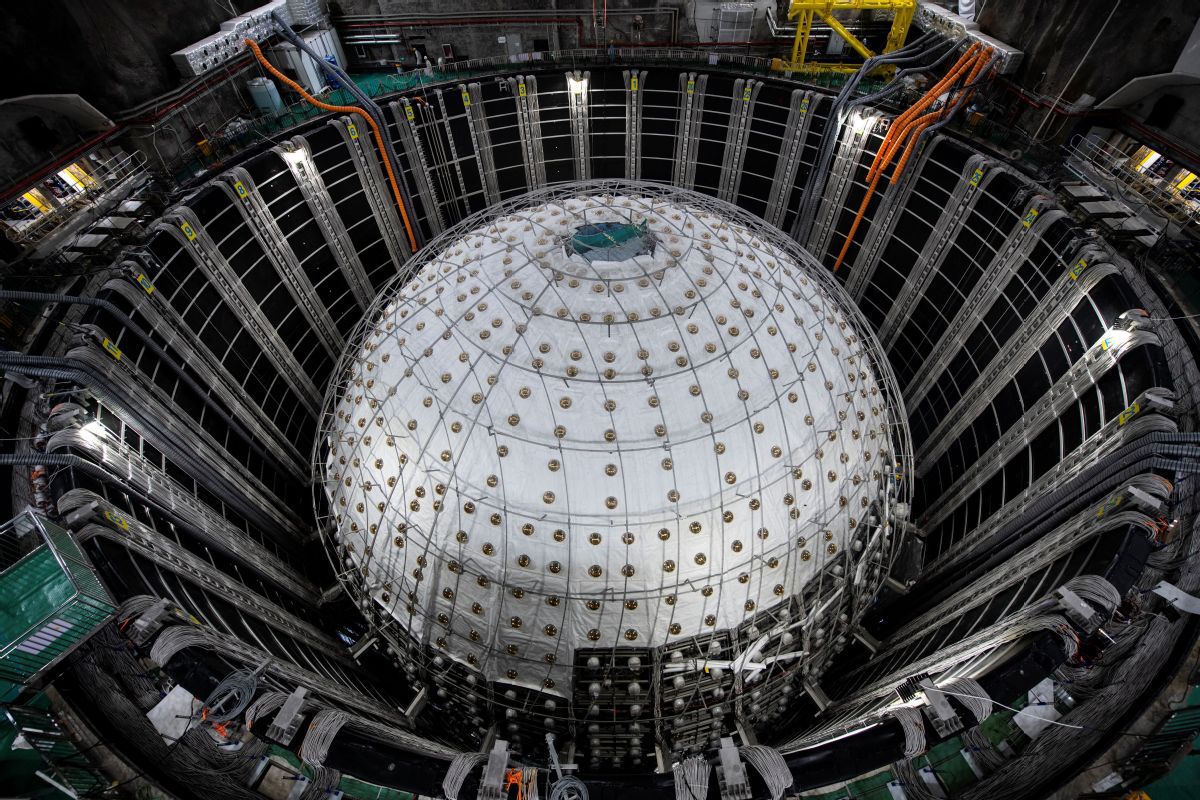
The final stage of the construction of Jiangmen Underground Neutrino Observatory (JUNO) began on Wednesday, with the start of water filling the detector's pool. The process is expected to be completed by August next year, after which the observatory will begin formal data collection.
Ultra-pure water, filtered through multiple stages of a specialized system, will be pumped into the 44-meter-deep water pool at a rate of 100 tons per hour. This pool, located 700 meters underground in Jiangmen, Guangdong province, surrounds the core component of JUNO: a detector with an effective mass of 20,000 tons of liquid scintillator.
The detector is key to studying neutrinos, elusive subatomic particles fundamental to understanding the universe. Neutrinos are abundant in the cosmos but difficult to detect due to their weak interactions with matter. The JUNO project aims to measure the neutrino mass hierarchy, oscillation parameters and could help scientists unravel the mysteries of supernova explosions, the universe's origins, and new physical phenomena.
Wang Yifang, the project's director, emphasized the significance of these measurements for advancing scientific knowledge. "This will be instrumental in testing supernova explosion mechanisms and exploring the universe's origins and evolution," he said.
To detect neutrinos, the shell of JUNO's central detector is covered with photomultiplier tubes pointing inwards, which convert faint light signals into electrical signals. When neutrinos interact with the liquid scintillator, they produce scintillation light, which is invisible to the human eye but provides crucial data for measurements. These interactions are recorded by 45,000 photomultiplier tubes, amplifying the signals by a factor of 10 million. The data is then analyzed to reveal the properties of the neutrinos.
A key feature of the JUNO detector is its use of a water Cherenkov detector. Cherenkov radiation occurs when charged particles, like cosmic rays, move faster than light in a particular medium — such as water. The radiation emitted by these particles is visible as a faint blue glow, which the detector captures to distinguish neutrino signals from cosmic rays. This system works in tandem with a cosmic-ray tracking detector, which helps filter out the background noise caused by cosmic rays, ensuring more precise measurements of neutrino events.
The water in the pool also serves as a shield against natural radioactivity from nearby rocks and secondary particles produced by cosmic rays. This reduces interference with the delicate neutrino detection process.
Compared to similar neutrino experiments using liquid scintillator, JUNO's detector is 20 times larger in volume, has three times higher photoelectron yield, and is twice as accurate in energy resolution, reaching an unprecedented 3 percent. These advancements set a new standard for neutrino research.
The JUNO project is built by a global collaboration involving over 700 scientists from 17 countries and regions. Once completed, it will be a world-leading center for neutrino research together with yet-to-come Japan's Hyper-Kamiokande and the United States' Deep Underground Neutrino Experiment (DUNE). The observatory will significantly contribute to the global effort to uncover the fundamental properties of neutrinos and deepen our understanding of the universe.





- Countdown to 15th National Games: On-site warm-up entertains audience
- Eight missing after cargo ship collides with fishing vessel near Shandong
- Investing in people: a worthwhile investment
- Exhibition commemorating the epic relocation of universities opens in Fujian
- Twelve punished for scaffold collapse that killed 7 in Shandong
- Slovenian official visits whole-process people's democracy practice site of CPPCC committees