Forum brings nations closer to mainland
Portuguese-speaking countries to leverage Macao's free port status and opportunities









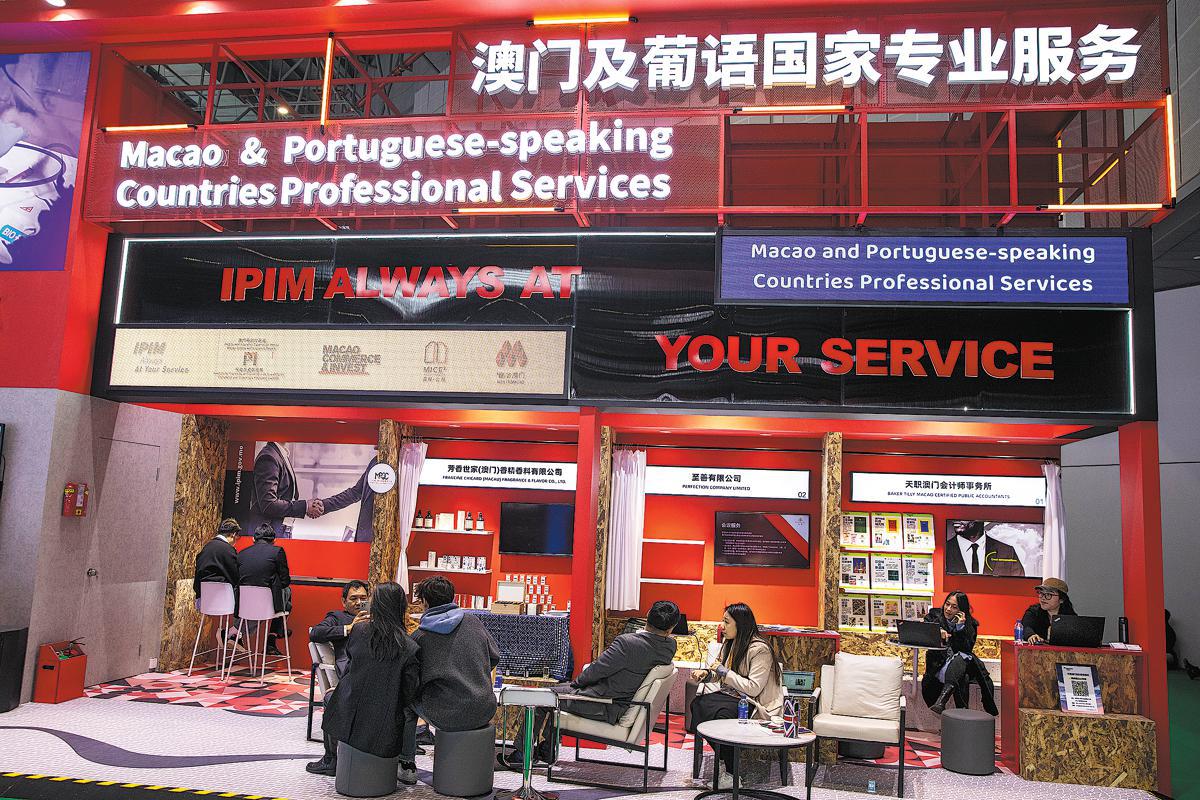
As Macao celebrates the 25th anniversary of its return to the motherland, the city known for its casinos accentuates its role as a hub to foster both economic cooperation and cultural exchange between China and Portuguese-speaking countries.
In November, Savana Pires, director of international business and development at Porto Business School, led a group of 10 MBA students from the Portuguese university to Hong Kong and Macao under one of four overseas exchange programs, others being from the US, Germany and India.
During their time in Macao, the students visited local universities and companies to gain a deeper understanding of the city's economic landscape. From Macao's efforts to diversify its economy, including developments in tourism, exhibition and industries beyond gaming, as well as its unique blend of Eastern and Western cultural influences, their observations and feedback were overwhelmingly positive.
"In the last 25 years, Macao has developed a lot. But it also keeps its uniqueness," said Pires.
Macao has developed deep and extensive ties with Portugal and Portuguese-speaking countries spanning four continents, collectively representing a population of over 300 million, as noted by its Commerce and Investment Promotion Institute. Alongside Chinese, Portuguese serves as an official language in Macao, enabling enterprises to sign contracts and agreements in both.
From a European perspective, China is sometimes seen as "too big" for businesses and universities looking to establish a starting point, Pires noted. "But we have Macao as a cultural bridge. I'd say it helps us open doors when we turn our attention to the Chinese mainland," she said, describing Macao as a "gateway" thanks to its rich cultural heritage and openness to the West.
"If we don't seize these opportunities, we're gonna miss out," Pires said. "We need to be closer to Macao more than ever."
Macao's role as a service platform between China and Portuguese-speaking countries was first established in 2003 with the formation of the Forum for Economic and Trade Co-operation between China and PSCs (Macao), a multilateral, intergovernmental mechanism that today includes all nine countries where Portuguese is an official language: Angola, Brazil, Cape Verde, Guinea-Bissau, Mozambique, Portugal, Timor-Leste, Sao Tome and Principe, and Equatorial Guinea.
Since then, trade between China and Portuguese-speaking countries has grown significantly, surpassing $220 billion last year, marking a twenty-fold growth, according to China's Ministry of Commerce.
Sio Chi-wai, president of the Macao Development Strategy Research Center, highlighted that the city's role as a Sino-Lusophone platform, among its other strategic functions, best reflects its unique advantages and serves as the most promising pathway to achieving the goal of "small size, big impact".
"The function as a commercial and trade cooperation service platform between China and Portuguese-speaking countries provides Macao with vast opportunities for diversified industrial development," said Sio.
Aligning "Macao's strengths" with "the country's needs", has driven the development of sectors such as trade, conventions and exhibitions, and finance, Sio added. The bridging role is expected to extend to broader regions, including the European Union, African nations and Latin American economies. According to Sio, this expansion would be particularly valuable in helping Chinese enterprises venture abroad and explore emerging markets.
Hub for cultural exchanges
Meanwhile, Macao's unique status as a free port with no foreign currency restrictions under a low-taxation system positions the city to explore broader opportunities for financial cooperation with Portuguese-speaking countries.
"Macao should also fully leverage its advantage as a clearing center for renminbi transactions with Portuguese-speaking countries," Sio noted.
Sino-Lusophone exchange extends far beyond the economic sphere as Macao has consistently played a vital role in fostering cultural connections between China and Portuguese-speaking countries, said Lio Kuokman, music director and principal conductor of Macao Orchestra, the city's only professional symphony orchestra.
Founded in 1983, the Macao Orchestra has long been a cultural symbol, showcasing the unique fusion of Chinese and Western cultures and promoting Sino-Portuguese cultural integration through collaborations with Portuguese artists and performances abroad.
In 2019, for example, the orchestra embarked on a special tour in Portugal to celebrate the 40th anniversary of diplomatic relations between China and Portugal and the 20th anniversary of Macao's handover. During the tour, it performed in four cities-Evora, Coimbra, Portalegre and Lisbon — and participated in prestigious events such as the Marvao International Music Festival and the Todos Festival in Lisbon.
"These performances underscored the Macao Orchestra's dedication to supporting Macao's role as a hub for exchange and cooperation, where Chinese culture is the foundation and diverse cultures coexist," Lio said.
Macao is home to many exceptional composers, including the orchestra's former music director Doming Lam Ngok-pui, and former composer-in-residence Lam Bun-ching, both of whom have contributed remarkable works to the city's musical legacy.
To Lio, music is the universal language and a powerful medium for cultural exchange. "We aspire to create more opportunities to invite artists from Portuguese-speaking countries to perform in Macao while bringing Macao's music to global audiences," he said.
evanliu@chinadailyhk.com

- Influencers barred from vulgar, false, or harmful content
- Hangzhou–Quzhou High-Speed Railway begins operations
- China records rise in survival prospects for child and adolescent cancer patients
- Ministry unveils draft revision of the national air quality standards
- Xiaoguo Comedy launches nationwide year-end tour
- CPC expels former China Life Insurance president