


Reading the past in the bones of Beijing's historical alleys










According to Zhang Chun, a professor at the School of Architecture and Design at Beijing Jiaotong University, Nanluoguxiang is emblematic of the balance between preservation and progress in modern Beijing.
She says that the hutong, originally built during the Yuan Dynasty, is one of the oldest in the city and has undergone centuries of social and environmental change.
Nanluoguxiang gets its name from its shape, which resembles a hunchback, in that it's higher in the middle and lower on the sides. Historically, it was one of the most prosperous commercial areas in the inner city due to its proximity to Shichahai Lake, which once connected with the Grand Canal, a vital trade and communication route that links different regions of the country.
"Nanluoguxiang is the most intact and representative historical district to still reflect Yuan Dynasty urban planning ideas," says Zhang, who interned as a neighborhood planner while studying for a PhD at Peking University.
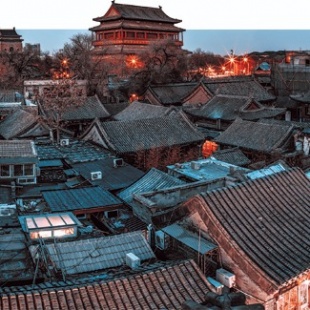
"The neighborhood largely retains its layout of courtyards and alleys, allowing residents and visitors to understand the environment of the original inhabitants of historical Beijing," she explains.
In the early 2000s, Nanluoguxiang began to undergo significant transformation, driven by government-led vitalization projects and increasing interest from younger, more affluent residents. Recognizing the area's historical value and tourism potential, the local government invested in restoration, focusing on preserving traditional architectural elements, improving the quality of life while modernizing infrastructure.
This vitalization introduced cafes, art shops, restaurants and other new small businesses to the area, making it a popular destination for both locals and tourists.
In February 2014, President Xi Jinping visited the Yuhe River area in the west of Nanluoguxiang to inspect efforts to preserve its historical and cultural heritage. Walking along the river, he examined the restoration of its waterway and the reconstruction of traditional courtyards, including those along Yu'er Hutong, a lane east of the river, which was once a typical residential area with large, densely inhabited courtyards.
During February 2019, Xi visited Beijing's hutong area again, saying that a city's heritage and cultural temperament are integral to its vitality. He stressed that hutong was a distinguishing feature of old Beijing. "When promoting modernization, we need to both ensure that this culture is preserved and that hutong residents can enjoy a modern lifestyle. The old and the modern should be combined."