


Miao embroidery tells stories of tradition and hope
Couple dedicates to preserving cultural heritage









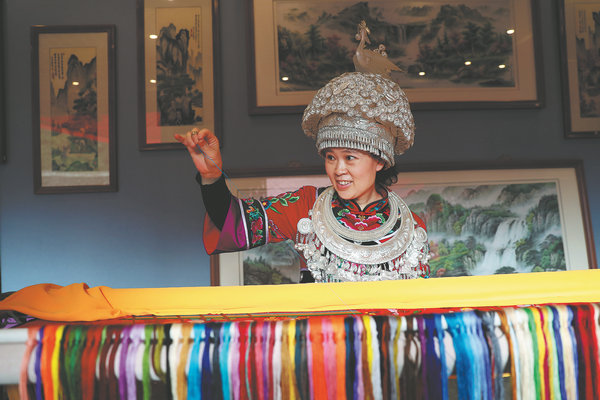
Pengshui Miao embroidery, known as the "fingertip economy" for Miao folks in a county of Chongqing, weaves not just intricate patterns, but also a story of tradition, resilience and newfound hope.
According to authorities in Pengshui Miao and Tujia autonomous county, by employing a collaborative approach that involves local companies, training schools and experienced embroiderers, nearly 10,000 people, many of whom are stay-at-home women or are from disadvantaged backgrounds affected by poverty or disabilities, have found jobs.
Pengshui Miao embroidery is the epitome of Miao embroidery, an intangible cultural heritage in China, which boasts a long history and showcases exceptional craftsmanship. Known for its intricate techniques, vibrant colors and diverse patterns featuring more than 20 needlework methods, it is often called "the Miao epic worn on the body" due to the ethnic group's lack of a written language.
Pengshui is home to 318,000 Miao people who comprise 45.4 percent of the county's population. According to the local government, it has the largest concentration of Miao people in all ethnic minority counties.
Li Shaoyu, 55, and her husband Wang Guangrong, 54, are key figures in efforts to preserve the art form while enhancing the well-being of local folks.
Deeply connected to the traditional attire, Li acquired her skills from her mother, in addition to self-instruction. She fondly recalls crafting clothing with a stand-up collar using Miao embroidery at the age of 17 under her mother's guidance, treasuring it until it wore thin.
Fifteen years ago, the couple began crafting traditional Miao clothing based in an embroidery workshop, then expanded to build a company in 2015, with an annual output value of approximately 6 million yuan ($820,000).
Since Li was designated a representative inheritor of Pengshui Miao embroidery in 2016, the couple has dedicated themselves to preserving these handicrafts.
Through their company, which serves as a cornerstone for training programs, initiatives have been implemented in nearly 30 townships across Pengshui.
These efforts have positively impacted the lives of over 3,000 local residents, including more than 1,000 stay-at-home women and individuals with disabilities, and over 800 people with limited incomes.
Each week, Li teaches complimentary classes at local schools and the youth activity center, aiming to preserve and pass down the cultural heritage.
A proficient artisan and a prominent figure who shoulders social responsibility, Li has won several national honorary titles such as National Excellent Migrant Worker.
Traditional Miao embroidery is primarily used to adorn the collars, lapels, sleeves, handkerchief edges and skirt hems of clothing. It can also be used to make items such as shoulder bags and wallets.
While keeping Miao embroidery's tradition, Li also developed a series of cultural and creative products, such as sachets, brooches, hairpins, earrings, scarves and insoles. She even embroidered local landscapes on cloth to create decorative paintings and has attracted multiple customer orders.
"I want to introduce Miao embroidery culture to a wider audience," Li said. As a delegate to the 13th National People's Congress, during the two sessions in 2018 she brought a meticulously embroidered Miao decorative painting to Beijing. The work took over 10,000 meters of thread to complete.
Notably, Li's embroidery of Dizhuming, a work from Huang Tingjian, a famous calligrapher in the Song Dynasty (960-1279), is part of the National Museum of China's permanent collection.
In alignment with modern aesthetics, Li embraced a minimalist approach as well — adorning pillowcases and garments with selected patterns, which found success in the market.
Li also developed customized services, fusing modern and contemporary aesthetics and integrating handcrafted silk embroidery featuring patterns, totems or logos onto traditional designed chiffon garments and qipao dresses. "We are planning to further develop Miao embroidery cultural and creative products to promote the integration of culture and tourism," Wang said.
In 2022, Pengshui Miao Embroidery Pavilion, the first of its kind in the county, was unveiled to the public at Pengshui's Chiyou Jiuli Town scenic area. The three-story museum offers a comprehensive array of exhibits, as well as a livestreaming center and design base.
Wang, who is also head of the pavilion, said it functions as a hub for training Miao embroidery skills and an educational destination for curious tourists and students.
"Being able to earn an income through Miao embroidery to support my family is something I aspire to," said 38-year-old Luo Xiaoli, a stay-at-home mother from Shangan township of Pengshui, who was once stricken by poverty.
Four years ago, Luo was introduced to the art after a 22-day training program. Later, she enrolled in Li and Wang's company as one of the top six apprentices and gradually gained financial independence. While acknowledging the ongoing learning curve of this intricate art, she remains optimistic about the future.
According to the Chongqing Municipal Agriculture and Rural Affairs Committee, in the first three quarters of this year, Pengshui's GDP grew 7.1 percent and the income of its rural residents rose 6.2 percent year-on-year, ranking among the top in the municipality.
Last year, Pengshui received the top A rating in the national assessment of the effective integration of poverty alleviation achievements and rural vitalization.
The local government has been enhancing cultural and tourism initiatives centered around Miao traditions in recent years, according to Wang Lubo, deputy head of the county. This includes the preservation and promotion of Miao embroidery, cuisine, arts, songs, dance, traditional medicine and herbs, as well as the development of Miao villages and towns.