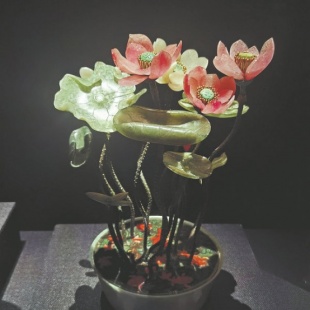



Jade's royal seal of approval
Treasured artifacts from Xinjiang tell a story that extends beyond the Qing Dynasty's imperial court, Wang Kaihao reports.










Tracing the origins
The ritual use of jade dominated China for millennia, and Qing rulers preserved the tradition, using jade for royal documents and seals. Apart from use as offerings in sacrificial ceremonies to heaven, jade was also used to make instruments for musical rituals.
"The Qing court amassed numerous Buddhist statues carved in Hetian Jade," Huang says. "Imperial aesthetics and the distinct features of different ethnic groups were blended."
Nonetheless, the link between the Forbidden City and Hetian jades dates back far before the Qing Dynasty. The collections of Qing emperors merely reflected a millennia-long connection between the jade hub in Xinjiang and the courts of the central dynasties.
Archaeological evidence shows that tremolite jade has been mined in Xinjiang for over 4,000 years to the Neolithic period, Huang adds. Hetian Jade was transported to Central China after the Han Dynasty, the trade booming during the Tang Dynasty. Hetian Jade gradually became the most important material for jade craftsmanship in Central China.

A white jade statue of bixie, a mythical lion-like creature that could ward off evil spirits, is the oldest Hetian Jade artifact in the Forbidden City. Lions are native to Western Asia and North Africa, and images of them were introduced to China via the Silk Road, where they were combined with traditional winged beasts, giving rise to the mythical Chinese creature.
Jade decorations bearing auspicious floral patterns and animal shapes from the Jin Dynasty (1115-1234) and an exquisite cup from the Song Dynasty (960-1279) reflect the evolution of Hetian Jade around the rest of the country.
Emperor Qianlong also had his own way of tracing the origins of his treasured stones.
Huang particularly recommends seeing one artifact, a jade sculpture that resembles a miniature rockery, which includes a scene of several men mining jade in a mountain.
Again in 1761, the emperor wrote a poem on the back of the sculpture to honor their endeavors. "It's not only a piece of art, but also a lively witness to history," the curator adds.
"Emperor Qianlong places the use of Hetian Jade on the summit, and the era also left a rich legacy for future generations. The jade exhibits highlight the historical interaction, exchange and integration of Chinese ethnic groups. They are witness to the formation of a shared national identity," says Du Haijiang, deputy director of the Palace Museum.