Weight gain









With the collective rise of the Global South, a hybrid international order is taking shape
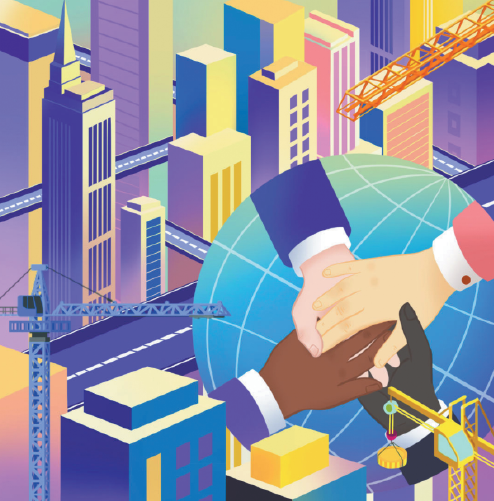
Global political and economic power is undergoing a subtle shift toward the Global South. In terms of economic, military, demographic and cultural strength, the Global South is increasingly gaining weight, emerging as a new force in the global governance structure. The collective rise of the Global South has propelled the growth of international institutions such as the BRICS and the Asian Infrastructure Investment Bank, while also reviving and transforming institutions such as the G77 and the Non-Aligned Movement.
Geographically, the divide between the Global North and the Global South roughly extends along the Tropic of Cancer. The Global South includes Mexico and the Caribbean, most of South America, Africa, the Middle East, Central Asia, East Asia and Oceania (excluding Japan, Australia, and New Zealand).The Global South accounts for more than 85 percent of the world's population and nearly 40 percent of the global GDP.It is projected that by 2030, three of the world's four largest economies, namely China, India and Indonesia, will come from the Global South and the BRICS countries' combined GDP will surpass that of the G7. Global South countries share similar historical experiences and struggles and have common development aspirations, converging on a new consensus for South-South cooperation, which has helped to establish a new political-economic connection based on solidarity, cooperation, and a sense of belonging.
The growing influence of the Global South countries has brought into question the legitimacy and transparency of the Western international system and the so-called rule-based Western order, revealing its inherent contradictions and weakening efficiency. The United States has established a system of institutional hegemony that seeks private interests through its political system, alliances, technologies, currency, and market economy. These institutions often carry out the US agenda, unfairly distribute international public goods, and protect Western interests by marginalizing the Global South's demands.
For example, the International Monetary Fund has failed to complete the reforms of quotas and governance mechanisms on schedule, and the World Bank also faces issues of legitimacy and transparency in the selection and accountability mechanisms of its senior executives, leading to unfair treatment of the Global South. Global South countries need to work together to advance reforms in these institutions to reflect their demands and interests. Fortunately, organizations under the liberal international order are adapting to these challenges and are gradually being replaced by institutional types that reflect the new international power structure.
In addition, the US is increasingly inclined toward exclusive minilateralism rather than inclusive multilateralism. And the North-South rivalry in numerous issues is escalating, particularly in the China-US competition.
As the Western norms are being challenged, the world is likely to be dragged into an ideological competition by the Western countries to maintain their dominance over the Global South through international systems and political-economic power. This includes imposing various restrictions on the Global South through their norms such as human rights, democracy, liberalism and big power responsibility.
This brings South-South cooperation to the center stage of world politics, an independent pole in shaping the international order. Currently the Global South is promoting the construction of a new international system to address issues such as poverty reduction, food security, development financing, climate change and the digital economy. With the diversification of actors, authorities and institutions, a hybrid international order involving multiple actors is likely to gradually replace the US-led one. The functional differentiation in issues will lead to a more pronounced demand for international systems from various countries under the hybrid international order.
In contrast to the West, the Global South advocates for international norms such as sovereign equality, non-interference in internal affairs, the democratization of international relations, international cooperation, and multilateralism. To better promote these norms, the Global South countries persist in their efforts to call for North-South dialogue on the basis of unity and cooperation, engaging in multi-level, multi-field, and multichannel communication, exchanges, and dialogue regarding internationally accepted norms and national behavioral standards.
The distribution of international power is accelerating its shift from a unipolar to a multipolar pattern, with the formation of a multipolar world political landscape continuously gaining speed. The Ukraine crisis and the containment and blockade actions of the US-led West against Russia marked the political awakening of the Global South. More than 50 Global South countries voted against sanctions on Russia. At the same time, the Global South is actively seeking to build a resilient partnership with leeway between China and the US. In addition, it is also actively mediating the Ukraine crisis and the Israeli-Palestinian conflict, becoming an important pole affecting the international security order. After the outbreak of the Ukraine crisis, the vast majority of Global South countries have called for a ceasefire and talks, and are pushing for a de-escalation of the situation. For example, six African heads of state, formed an African mediation group for the Ukraine crisis, highlighting the growing political confidence of the Global South and a new understanding of the shaping of a new international order.
The author is a professor at the School of Government at East China University of Political Science and Law. The author contributed this article to China Watch, a think tank powered by China Daily.
The views do not necessarily reflect those of China Daily.
Contact the editor at editor@chinawatch.cn.