Strumming up a milestone










Brand awareness rises
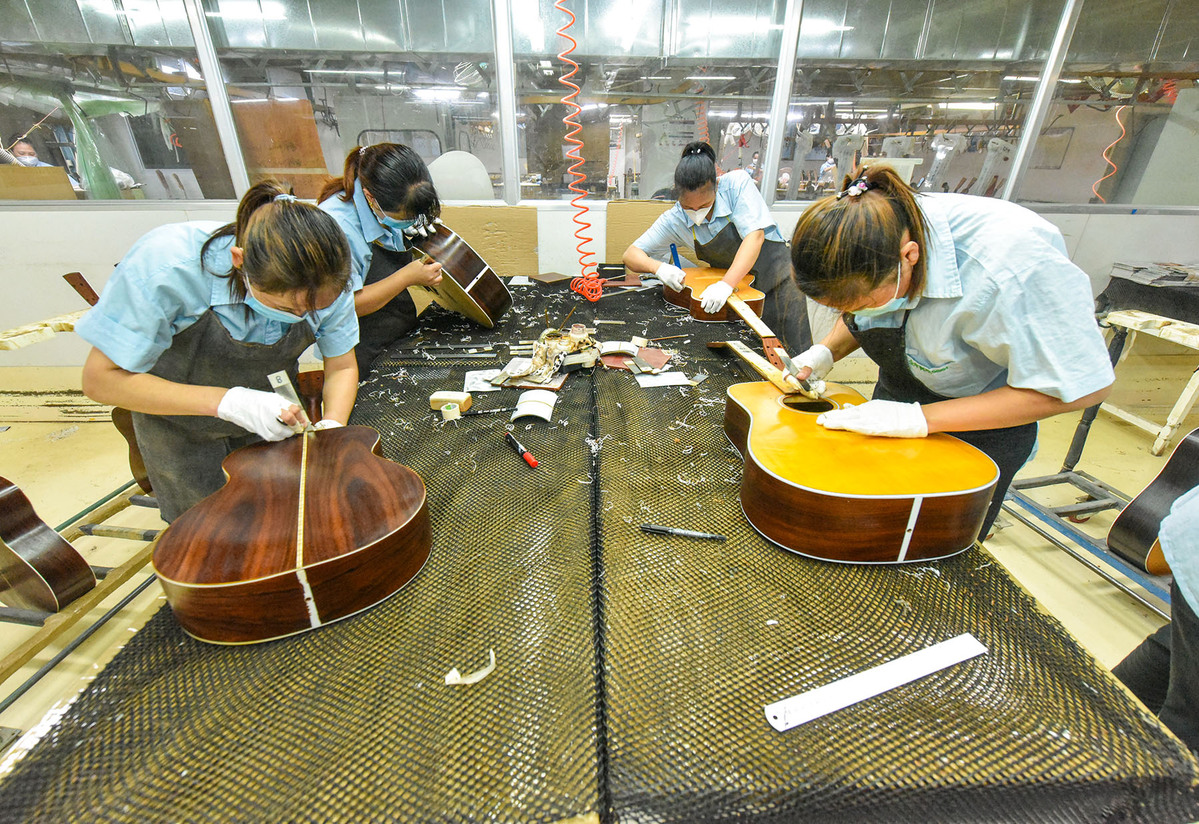
For almost a decade, the company manufactured musical instruments for US and Japanese brands. This approach changed in 2004 when Tsai decided to set up his own label — Farida.
The same year, a turning point came for Mings Musical Instrument Co, which is also based in Huiyang and specializes in guitar pickups that function like built-in microphones, when its general manager Zhao Yanting led a team to Frankfurt, Germany — a city renowned for its instrument craftsmanship.
Describing the trip as an "eye-opener", Zhao says it allowed him to observe firsthand the modus operandi of leading global brands, and get to know what branding was. He realized it was time to team up with top-tier instrument labels by bypassing middlemen that he saw as a stumbling block between his products and the real demands of customers.
Before its inception in 1999, Mings relied on intermediaries from Hong Kong, Taiwan and Japan to secure orders. Since Zhao's Frankfurt trip, the company has enjoyed direct cooperation with industry leaders like Wilkinson and Fishman, and launched its own guitar pickup brand.
Zhao says the company currently serves 80 percent of industry leaders, and three out of 10 acoustic guitars worldwide are equipped with its pickups. About one in 10 acoustic guitars require a pickup, and every electric guitar must have a pickup to function, he says.
In 2020, Tsai decided against manufacturing guitars for other companies, instead focusing on developing his own brand. Besides the fact that returns from the company's previous operational model had declined, Tsai says the main reason for his decision is that Farida had by then built up a strong base in the domestic market.
Huiyang's guitar industry has evolved from scratch. According to Tsai, there was almost no supply in the 1990s and he had to rely on imported accessories. The district now has a sound supply chain to feed a company with all the materials it needs in guitar manufacturing. Besides serving industry leaders worldwide, enterprises in Huiyang have created more than 120 independent brands.
Zhao credits the sector's healthy development to the overall rise of China's manufacturing chain, which has provided "food and fodder" to guitar production.
Domestic sales increase
Another game changer in Huiyang's guitar business is a surge in the spending power of domestic consumers, which Tsai says has given him the confidence to focus on the local market.
Recalling the first decade of his company's operations, Tsai says all its products had to be shipped overseas as local demand for guitars was almost non-existent. With an export price of around $70, guitars were out of reach for most Chinese consumers in 1995 when the average monthly salary of an urban employee was about $55.
Huizhou now produces around 1.5 million guitars and three million ukuleles annually, with about 30 percent sold domestically.
Tsai notes that 20 years ago, Chinese guitar consumption was just two percent of the global market. However, by 2023, China's guitar market accounted for some 13 percent of the global total, according to Grand View Research — a multinational market consulting firm.
At its peak, Huiyang's guitar makers supplied 40 percent of the domestic, and one-fifth of the global market. However, in recent years, rising costs and favorable measures introduced by competing regions have prompted some companies to move to nearby provinces.
Zhao, who is also president of the Huiyang Guitar Industry Association, calls this a "natural process of the survival of the fittest", and says he is not too worried about the shrinking number of enterprises. "Although production may have dwindled, the quality remains strong," he says.
In his view, the real challenge is that the layout of local companies is too scattered, suggesting there should be an industrial cluster. Setting up a museum or a guitar town to showcase the achievements of local guitar companies would be prudent, he says, but it needs money to do all this. Private or government investment may help shape the industry's future, he adds.
Contact the writer at irisli@chinadailyhk.com