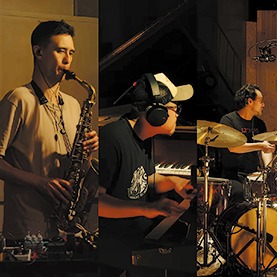



Red Hand gets in Touch with the world
One of China's most beloved jazz bands releases its first album 20 years since its formation, Chen Nan reports.









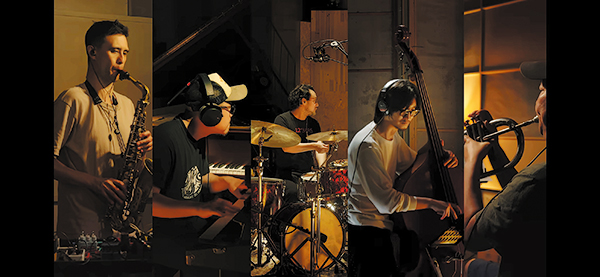
"We are like individual pieces of a puzzle that had been scattered across the globe. When we got together, we began to fall into place. We know one another very well, and we just let the music happen," adds Xia.
To fully appreciate the significance of this release, it's essential to revisit the origins of Red Hand, a band whose history intertwines with the rise of Beijing's underground music scene and the evolution of Chinese jazz.
It began with Wen, who was teaching at a contemporary music school in Beijing at the time, and saxophonist Gao, who was still pursuing his studies in the United States. When the two decided to form a band, Wen called Xia. Later, Wang and Xiao Dou joined the group.
In October 2006, the defining moment for the band occurred when they took the stage for their first performance at D22, a former live music venue in Beijing. This marked a turning point in how many people in the city would view jazz music. D22 became the band's regular haunt, and their weekly performances turned into something of a ritual for some of the city's music lovers. Despite being the only jazz band on a stage that was otherwise known for rock and punk acts, Red Hand found a niche that connected with fans from various musical backgrounds.
"Back in 2006, the jazz scene in Beijing was mostly standard jazz. We also performed standard jazz and interpreted some rock hits at the very beginning, but we soon carved out our own paths by performing our original works," recalls Xiao Dou, 47.
"We spent lots of time together, listening to music and rehearsing. We also watched performances by many other bands and collaborated with several international musicians," Xiao Dou adds.
Those collaborations were not just musical exchanges, but dialogues that enriched the band's approach to jazz.
Jazz took root in Beijing in the mid-1980s. Thanks to pioneering musicians, especially saxophonist Liu Yuan (1960-2024), it later became a vibrant and fast-developing scene. A longtime friend and collaborator with Chinese rock musician Cui Jian, Liu launched CD Cafe and East Shore Jazz Cafe in the 2000s, which helped build the Beijing jazz scene and provide a platform for young Chinese jazz musicians to perform.
Wen can still vividly recall watching a jazz concert in Beijing when he was still a student in the middle school affiliated with the Central Conservatory of Music around 1993. Among the international acts, Cui and Liu performed onstage. Their way of playing music deeply impressed Wen.
"As a classically trained musician, I had never watched any performance like that. It was an overwhelming experience. Their performance was free, and I immersed myself in the atmosphere created by their music, which made me so happy and excited. I wanted to play music just like them," recalls Wen.
As the years passed, the members of Red Hand scattered across the globe, each honing their craft in jazz music. New York, the Netherlands, and other musical hubs became the backdrop for their individual growth. During this time, Red Hand's members deepened their understanding of jazz while remaining connected through their shared philosophy: a commitment to freedom, openness, and an unwavering dedication to musical exploration. Though separated geographically, the band's collective pursuit of jazz innovation remained constant.
These years of exploration proved transformative for each member. They fine-tuned their skills, collaborated with global musicians, and immersed themselves in the diverse styles and philosophies of jazz.
The album also signals a shift in Chinese jazz. As the jazz scene in China continues to evolve, Red Hand's return brings with it a reminder of the genre's limitless possibilities. For listeners, especially those who were too young to experience the band's early years, the album offers a glimpse into a part of Beijing's musical history, blending the past with the future in a bold and exciting way.
"Whenever we got together, we were transported back to the years of performing at D22. I had so much fun. The collaboration among us is very natural thanks to our shared past," says Xia. "It feels like traveling on a flowing river, which took us to different parts of the world, where we experienced our lives and, most importantly, explored music."