Ancient academies thrive, as new generation's interest revived
Bailudong institution at forefront of expounding on history of scholarship, foreign exchanges










Southern strength
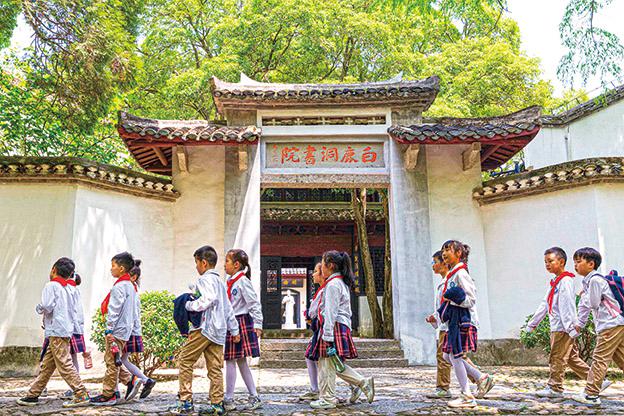
In addition to Bailudong, Jiangxi has had numerous other academies with well-established reputations.
During the Northern Song Dynasty (960-1127), there were 73 large government-sponsored academies nationwide, with 23 located in Jiangxi alone, according to the province's official records.
In the Southern Song Dynasty (1127-1279), there were 417 academies nationwide, with about 100 in Jiangxi.
The well-developed academy system provided Jiangxi with a significant educational advantage, producing many Jinshi scholars (imperial scholars) during the Song and Ming (1368-1644) dynasties.
"At that time, Jiangxi was economically developed and densely populated and a large number of scholars naturally emerged. These scholars, nurtured in a strong academic atmosphere and with the developed academy system, excelled in the imperial examinations during the early Ming Dynasty," said Fang Zhiyuan, a Ming history expert and a professor at Jiangxi Normal University.
According to the Ming Dynasty Jinshi List, over 3,000 Jinshi scholars from Jiangxi emerged during the Ming Dynasty, including 18 who achieved the top rank, the second highest amount nationwide after Zhejiang province.
Jinshi was the highest scholarly degree obtained through official examinations during the Ming and Qing (1644-1911) dynasties, and an end point of a scholastic career and the start of becoming a government official.
The abundance of Jinshi graduates from Jiangxi even affected the Ming Dynasty's imperial examination system.
In the 30th year of the Hongwu period of the Ming Dynasty, all 51 candidates were from the southern regions, leading to protests from the northern examinees. Known as the "Southern List", it included 18 from Jiangxi, accounting for over 30 percent of the total candidates.
In response to northern examinees' anger, Emperor Zhu Yuanzhang decided to reorganize the examination and personally review the papers. As a result, 61 northern examinees were admitted, leading to what became known as the "Northern List".
To prevent southern candidates from dominating the rankings, the central government subsequently began to segregate the admission of Jinshi scholars by region.
In addition to its educational contributions, Bailudong Academy also served as a venue for communication and exchanges between Chinese and Western cultures.
During the late Ming and early Qing dynasties, with the initial wave of knowledge from Western countries sweeping across China, thousands of Catholic missionaries came to the country, including the renowned Italian Matteo Ricci.
In 1595, Ricci arrived in Nanchang, the capital of Jiangxi province, and resided there for three years. During this time, he had significant interactions with Zhang Huang, the headmaster of Bailudong Academy, and his students.
In his letters home, Ricci mentioned Bailudong Academy several times, noting how he introduced Christianity and its doctrines to the academy's teachers and students.
In a letter dated Nov 4, 1595, Ricci wrote: "I am pleased with the scholars at Bailudong Academy. They treated me very kindly, often debating with me on significant issues of life and the afterlife.… The headmaster and I are good friends, and we often meet and talk with each other."
Ricci also mentioned how he introduced Western disciplines like mathematics to the scholars and students in Nanchang, which garnered the interest and attention of the Bailudong Academy community.
In a letter dated Oct 28, 1595, he wrote: "The scholars and other literati at Bailudong Academy enjoy hearing me talk about mathematics. If I could settle here, I would like to introduce them to this field."
Xiao Lang, a professor at the School of Education at Zhejiang University, wrote in a paper: "The historical exchanges between Ricci and Bailudong Academy represent a noteworthy chapter in ancient Chinese educational history, the history of academies, and the cultural and educational exchanges between East and West."
Guo Hongda, the former deputy director of the administrative committee of Bailudong Academy, said: "Bailudong Academy has a long history of education and a profound influence. The set of school rules established by Zhu Xi at the academy has influenced subsequent centuries, serving as a model for later generations and spreading to Japan, South Korea, and Southeast Asia, earning Bailudong Academy a worldwide reputation."