


Reclaiming history's bigger picture
Mural restorers work on ancient artworks to get clearer understanding of the past, Qin Feng and Chen Nan report in Xi'an.









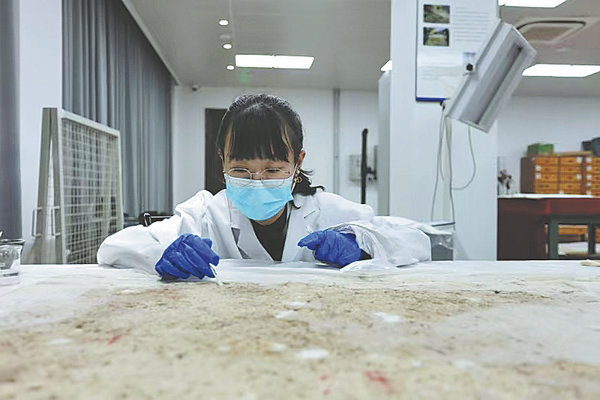
In the restoration lab of the Shaanxi History Museum in Xi'an, Shaanxi province, a group of young people is engaged in a quiet yet profound dialogue with history. Each meticulous gesture breathes new life into artifacts that carry the weight of millennia.
Working on the restoration of Han Xiu's tomb murals, Jin Zilin, a "relic doctor", has devoted herself to the protection and restoration of cultural relics since joining the museum in 2016.
The restoration of Han Xiu's tomb murals began in 2014, after the ancient tomb of Han, a senior official of the Tang Dynasty (618-907), was unearthed in the Chang'an district of Xi'an, capital of Shaanxi province, in 2013.
A joint archaeological team was formed from the Shaanxi Academy of Archaeology, Shaanxi History Museum and the cultural heritage bureau of Chang'an district. Their mission was to recover 21 murals, 18 of which were painstakingly removed using a delicate technique to transfer the fragile artworks to the lab, while the three largest murals were carefully packed and moved intact.
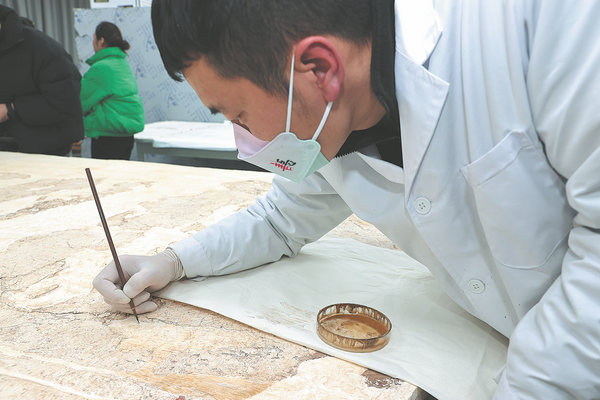
"Each mural is a vessel of history, but when we discovered them, they were already severely damaged. The Picture of Xuan Wu, in particular, had been shattered into countless pieces by tomb robbers," recalls Jin, 33, who graduated from Northwest University in Xi'an with a master's degree in archaeology.
Xuan Wu, also known as the black tortoise, is a traditional Chinese symbol representing the north and protection. It is often depicted entwined with a snake.
The fragments vary in size and, if not handled carefully during the restoration process, larger fragments may become smaller, and smaller fragments could turn into dust. Therefore, the process of piecing them together requires a significant amount of time and precision.
In the lab, Jin and her colleagues pieced together these fragments. "It's like assembling a massive jigsaw puzzle," Jin says. "We rely on the alignment of lines and shapes, constantly comparing them until the entire picture is re-formed."
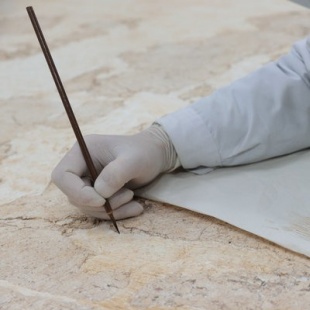
But restoration is not only about putting pieces back together. Another challenge lay in removing temporary reinforcements applied during the murals' transport from the tomb to the museum. These materials, meant to protect the murals, had to be carefully scraped away using cutting tools and specialized solvents, ensuring that the murals were not damaged in the process.