


A hero of our times
Nezha's ancient adventures brought back to life with box office smash-hit movie, Yang Yang reports.









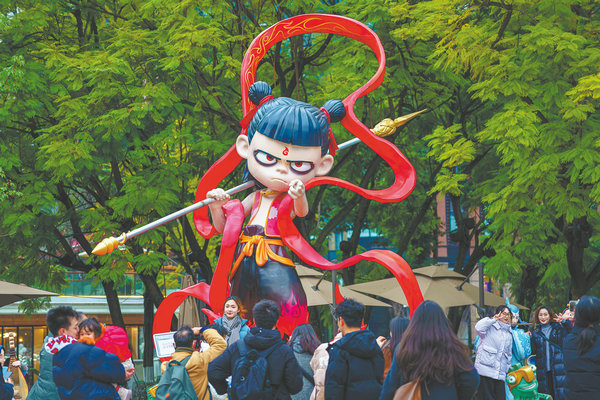
In Chinese literature, there might be no other characters more rebellious than the Monkey King Sun Wukong from Journey to the West and Nezha from Investiture of Gods. Both novels were written during the Ming Dynasty (1368-1644).
With magical power, they defied the hierarchy, fighting against unjust destinies. That's why the two are so popular with Chinese people, writers, artists and, in particular, filmmakers.
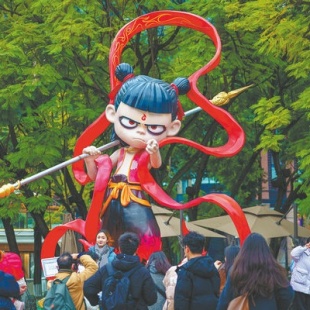
Last year, China's first triple A-rated video game Black Myth: Wukong shone on the world stage. This year, it is Nezha's turn. Since Thursday, Ne Zha 2, an animated movie by director Yang Yu, better known as Jiaozi (Dumpling), the sequel to Ne Zha (2019), has been shown overseas in countries, including Australia, New Zealand and the United States, and will show in others such as Japan, Singapore and South Korea. Opening on Jan 29, the start of the Spring Festival holiday, it made Chinese box office history, with earnings surpassing 10 billion yuan ($1.37 billion) by Thursday, topping China's all-time best-selling movies list. It also makes Ne Zha 2 among the top 20 highest-grossing films in global cinematic history.
Despite their similar determination to resist, compared to the Monkey King, the story of Nezha in Chinese mythology is more tragic in tone. His identity as the child of mortals has given people more space to adapt his story to different eras especially after the Ming Dynasty (1368-1644), though its rebellious core has never changed.
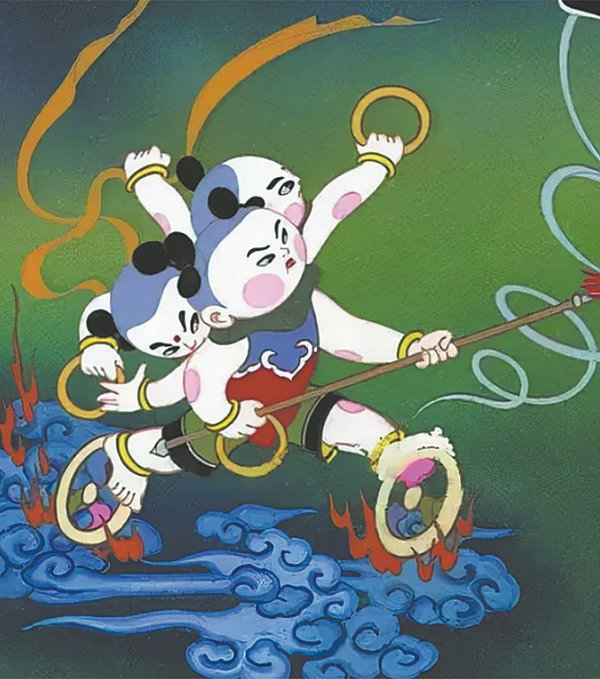
It is said that the mythology surrounding Nezha spread across China in the wake of the arrival of Buddhism. Studies of Buddhist literature from the Tang Dynasty (618-907) have found that Nezha was depicted as the third son of one of the four Heavenly Kings of Buddhism, the Guardian of the North, according to A Study on the Evolution of Nezha's Divine Image, a paper by professor Liu Wengang of Sichuan University, published in 2009 in the periodical Religious Studies. Nezha is a giant Yaksha god (a nature spirit and guardian of wealth) and Dharma protector (a spiritual entity safeguarding the teachings of the Dharma, or religious and moral law).
In Buddhist works, Nezha often appears together with his father, carrying a magical miniature pagoda. His duty is to help him guard the Dharma, ward off evil spirits, and protect people.
As Dharma protectors and Yaksha deities typically have fierce visages, symbolizing their resolution against malevolence, Nezha was often portrayed with a formidable and wrathful countenance.
Buddhist texts about Nezha's unusual relationship with his parents are missing. Researchers found in the retellings and discussions of existing early materials from the Song Dynasty (960-1279) that Nezha once dissected his own body and returned his flesh to his mother and his bones to his father.
Before the end of the Northern Song Dynasty (960-1127), he was basically depicted as a Yaksha god with three heads, six arms and a formidable, wrathful countenance, according to Liu.
As Buddhism continued to spread, ancient China absorbed and adapted the religion, and folk beliefs evolved. Nezha's portrayal gradually departed from its Buddhist origins and took on a more distinctly Chinese character.
For Liu, the first remarkable evolution of Nezha's image occurred in the Southern Song Dynasty (1127-1279), during which Li Jing, a strategist in the Tang Dynasty, was worshipped as the heavenly king, Nezha's father. Consequently, Nezha became the third son of Li Jing.
From a fierce Yaksha god to a Chinese deity, this change opened up space for development of Nezha's image with colorful interpretations of stories in the following centuries. Nezha has gradually become a classic literary character in China, blending elements of Buddhism, Taoism and Confucianism.