Nation ramps up energy security efforts









China has been intensifying efforts to secure energy independence amid trade tensions with the United States, by ramping up technological innovation, diversifying its energy sources and localizing critical supply chains, said industry experts.
These initiatives include increasing investments in renewable energy technologies, such as solar and wind power, alongside a focus on advancing electric vehicle infrastructure, they said.
China's investment in green innovation in recent years has helped it shift from low-cost manufacturing to high-value industries, reducing reliance on traditional exports that are vulnerable to US tariffs, said Wang Lining, director of the oil market department under the economics and technology research institute of China National Petroleum Corp.
Wang believes as geopolitical uncertainties persist, Beijing's bet on green innovation and energy self-reliance may not only insulate its economy from external shocks, but also cement its status as the dominant force in the future of global energy.
"While the trade war aims to disrupt China's access to key technologies and markets, Beijing's push for self-reliance in green energy components, such as solar panels, wind turbines and batteries, has made its supply chains more resilient, ensuring long-term competitiveness."
The International Energy Agency said in a report that China, as a dominant force in the field of renewable energy, has several advantages over others, including the ability to approve and build transmission grids and renewable energy projects more efficiently.
Wang said China has long prioritized scientific and technological research to enhance energy security, strengthening its traditional energy supply while accelerating the growth of renewables.
In recent years, market-oriented reforms and innovation have unlocked new momentum in the energy sector, particularly in renewable energy. This comprehensive expansion has positioned China at the forefront of the global transition toward green, low-carbon energy, he said.
According to global consultancy Rystad Energy, China's total spending, to date, in solar and wind has outpaced the rest of the world, climbing from $150 billion in 2020 to nearly $400 billion in 2023.
Between 2020 and 2024, China made substantial investments in renewable energy infrastructure. While Europe and the US are also gradually increasing their capital expenditure, they are expected to lag behind China through the end of the decade, it said.
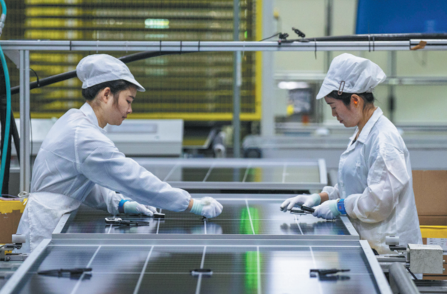
China controls around 80 percent of the global solar module supply chain, a share that is expected to grow further, with production projected to increase by 150 percent by 2030, said the consultancy.
The scale of China's investment capacity has had a profound impact on the global energy transition, said Lars Nitter Havro, head of Energy Macro, Rystad Energy.
According to Rystad Energy, vast manufacturing capabilities and infrastructure are the primary drivers behind China's leading position in the clean-tech sector, particularly its solar and battery supply chains.
Li Zhenguo, president of Longi Green Energy Technology Co Ltd, a key enterprise in the photovoltaic industry, said China's investment in solar power technological advances have made photovoltaic power generation a truly foundational energy source for energy transition and carbon neutrality worldwide.
"China has invested heavily in research and development of renewable energy in recent years, swiftly integrating technological advancements into production and operations to establish a competitive edge in technology, products and costs," he said.
The company achieved a module efficiency of 25.4 percent with its independently developed HPBC 2.0 solar cells last year, a new world record for crystalline silicon module efficiency. This is the first time that a Chinese solar technology company has set the world record since 1988, breaking a 36-year monopoly held by overseas photovoltaic brands.
According to Rystad Energy, while countries like the US and India are aggressively investing in cell manufacturing and module assembly plants, their production costs remain significantly higher than China's.
Chinese modules cost around $0.10 per watt, while US prices hover around $0.30 per watt, affecting project economics and the overall pace of energy transition, it said.





Today's Top News
- Xi says major countries should take lead in abiding by intl law, UN Charter
- Xi meets Taoiseach of Ireland
- New Year holiday drives travel peak
- ROK leader begins state visit to China
- AI must serve humanity, not endanger it
- Initiative sets clear course for Yangtze