Trade-in initiative to be expanded
Incentives stretch to a wider range of goods to boost consumption









With boosting domestic consumption high on China's policy agenda for 2025, the country's consumer goods trade-in initiative is set to play a crucial role in driving economic growth and offsetting the impact of persistent global trade protectionism and tepid external demand, officials and experts said.
By offering more attractive trade-in incentives across a wider range of consumer goods, the world's second-largest economy is creating a much-needed incentive for household spending, which is crucial for maintaining a balanced and resilient growth trajectory, they added.
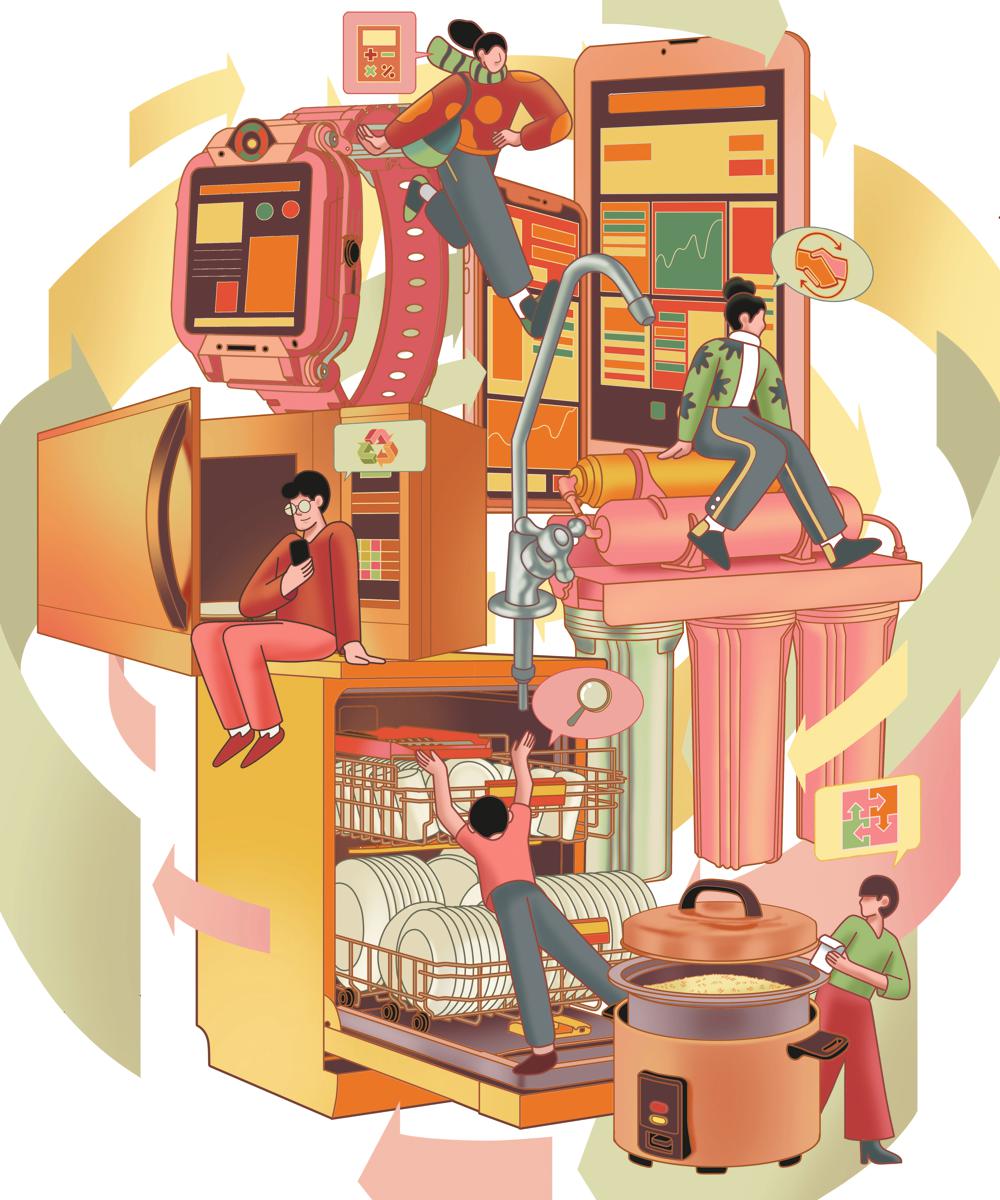
According to a notice released by the National Development and Reform Commission, the country's top economic regulator, along with the Ministry of Finance, in January, the categories of home appliances eligible for government subsidies will be increased from eight in 2024 to 12 in 2025, with microwaves, water purifiers, dishwashers and rice cookers added to the trade-in list.
Consumers will be also been given subsidies of up to 500 yuan ($68.6) per item when purchasing products such as smartphones. A broader range of passenger vehicles will also be added to the trade-in program, according to the notice.
The trade-in initiative implemented last year has proved effective in spurring consumer spending, promoting industrial upgrades, facilitating the green transition and enhancing people's living standards, said Sheng Qiuping, China's vice-minister of commerce.
The central and local authorities collectively allocated around 170 billion yuan in support funds during the implementation period last year, facilitating the widespread adoption of green, intelligent automobiles, home appliances and home furnishing products, Sheng said.
Last year, more than 70 million home appliances and furnishings were purchased by 64 million households across the country, contributing over 1 percentage point to year-on-year growth in total retail sales of consumer goods, he added.
Zhao Chenxin, deputy head of the National Development and Reform Commission, said the consumption push would go further, with plans announced to significantly increase the issuance of ultralong special treasury bonds this year. The funds from the bonds, which are earmarked to support the expansion of the trade-in initiative, should increase substantially, he said.
Wang Qing, chief macroeconomic analyst at Golden Credit Rating International, speculated on the scale of this increase, saying, "China is likely to double the funding for its consumer goods trade-in initiative this year to 300 billion yuan."
This significant increase in funding is expected to drive a substantial boost in consumption, with Wang forecasting an additional 750 billion yuan in spending in 2025, equivalent to a 1.5 percentage point acceleration in the growth rate of the total retail sales of consumer goods.
In early January, the Ministry of Finance front-loaded 81 billion yuan in funding for this year's consumer goods trade-in program.
Fu Jinling, an official with the Ministry of Finance, said policymakers will bear in mind an array of factors, including demographics, regional GDP, household ownership of automobiles and home appliances, as well as the performance of the 2024 trade-in program, to determine the appropriate funding levels for each provincial-level region.
In particular, funding allocation will be weighted toward regions that have registered the most success with consumer goods trade-ins last year, Fu added.
Wen Bin, chief economist at China Minsheng Bank, said the push for catalyzing domestic demand comes at a critical time when global trade tensions and protectionist measures, particularly from the United States and the European Union, have created headwinds for Chinese exports.
Additionally, the post-pandemic recovery has been uneven, with weak consumer confidence and a property market slump weighing on growth, Wen said, stressing that by focusing on domestic consumption, China aims to create a more resilient and self-sustaining economic model.
Data from online retailer Suning pointed to a significant spike in demand for trade-in transactions during the eight-day Spring Festival holiday that ended on Feb 4.
According to the data, Suning experienced an 80 percent year-on-year increase in customer traffic during the holiday, while the volume of trade-ins grew by 92 percent compared to the same period last year.
These sales figures set the stage for a strong start to 2025, as the government's targeted measures to stimulate domestic consumption continue to resonate with Chinese consumers and their evolving preferences, analysts said.
In particular, the scope of the trade-in initiative has expanded beyond traditional big-ticket items such as automobiles and household appliances to now include digital products.
The Ministry of Commerce recently reported that during the period from Jan 20 to Feb 1, some 14.7 million consumers had already applied for subsidies to purchase 18.86 million digital products, including smartphones.
Analysis from market research firm Counterpoint suggests that the incentives are prompting some consumers, who had originally planned to purchase new smartphones later in 2025, to accelerate their replacement plans, which is expected to drive a surge in sales of mid-range smartphone models priced between 3,000 and 5,000 yuan.
Sales of smartphones are projected to reach 289 million units in 2025, representing a 1.6 percent year-on-year increase, with the market expected to maintain a stable growth trajectory in the following years, according to a report by International Data Corp, a global market research company.
Honor, a major Chinese smartphone brand, told China Daily that enterprises in relevant sectors will be able to reap the benefits of the trade-in initiative and fully leverage China's vast consumer market, thereby sustaining the ongoing recovery and driving the next phase of growth in the domestic market.
It is also providing an impetus for businesses to invest in technological breakthroughs and product differentiation. This can strengthen their long-term competitiveness and market positioning, Honor said.
Zhu Keli, founding director of the China Institute of New Economy, said the previous 2009 trade-in and upgrade program was about ensuring the widespread availability of consumer goods, while the current round is more focused on addressing the quality and features that consumers now demand.
To better serve the evolving market demands, enterprises must try to align their product portfolios with the new green and low-carbon requirements, Zhu added.
As China grapples with a potentially turbulent external environment in 2025, policymakers are increasingly recognizing the importance of bolstering domestic consumption to drive economic growth. Against this backdrop, analysts have suggested that the government further expand its subsidy programs, potentially by extending support to the services sector.
Unlike the goods sector, where subsidies can often lead to a temporary surge in purchases, service consumption tends to have a more lasting impact on consumer behavior and spending patterns, said Zhong Zhengsheng, chief economist at Ping An Securities.
Moreover, the services sector is generally more labor-intensive, suggesting that boosting consumption in this domain could have a more pronounced multiplier effect on employment and broader economic activity, Zhong added.
wangkeju@chinadaily.com.cn





- Why learning China studies is a required course now?
- What can the world learn from China?
- Rocket successfully delivers satellite into orbit
- Global Sinologists gather in Shanghai for China studies conference
- Intl Biopharma Industry Week Shanghai 2025 kicks off
- British scholar: The West can never understand China if it insists on making China the same as the West