


Quietly redefining the ink tradition









Peng Wei uses images of the past to paint a picture of today, Lin Qi reports.
Peng Wei is one of those artists who do not speak a lot. When the ink painter sits down for a talk, the range of her interests contributes greatly to the quality of time spent, and is a pleasure, both for herself and for her listeners.
For example, during a recent podcast series, Peng took listeners on a thought-provoking journey through the past and the present, the East and the West, crossing the boundaries of history, culture, society, and technology.
She talked about the life and work of Marguerite Duras (the French author of The Lover) and the music of Mozart — Queen of the Night aria from The Magic Flute being one of her favorites — before delving into the developments of the digital world, which she says human greed has overblown.
She also talked about how talented she feels Italian author Elena Ferrante is to be able to create so many interesting characters, no matter how minor, in her best-known work, the Neapolitan Quartet. Peng said she envies Ferrante's ability to hide away from the world — the writer's name is a pseudonym, and little is known about her.
The podcast, Speaking of the Snake, has invited a string of Chinese celebrities and artists to explore the symbolism of the snake. The series was launched by Prada and is part of the brand's exclusive Year of the Snake campaign, for which it also produced a capsule collection. Titled We, the Snake, the campaign reimagines the snake's serpentine coils as a powerful symbol of community and togetherness.
"I like the snake very much. I like the simplicity of its slender body, and its scales look refined. Snakes have many colors," Peng says. "They are quite beautiful. I say this from an aesthetic point of view."
She once touched a snake. "It felt smooth. I thought about having one in college, because it sounded pretty cool. That is also how I feel about the snake. It is a cool animal."
She adds, "The snake is a complicated creature in both Asian and European mythologies. It is a symbol of good things and also of evil things. I think the mixed imagery of snakes makes them unique and attractive."
She speaks about the White Snake and the Green Snake, the snake spirit-turned human protagonists of Bai She Zhuan, The Legend of the White Snake, the folk tale about a romance between the White Snake and the scholar Xu Xian.
"The two spirits are loved because they are true in temperament, courageous and compassionate. They dare to sacrifice for love, and for others. They are lovely women. One can also find similar female characters in Liaozhai Zhiyi (Strange Tales from a Chinese Studio).
"But I also have a mixed feeling when reading the stories. They were written by men, and reflect their notions of an ideal woman, one who is willing to sacrifice herself for the one she loves."
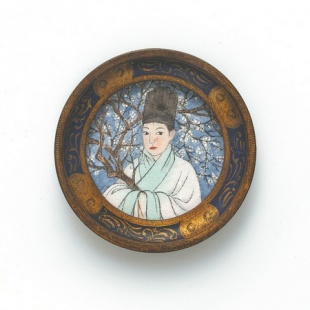
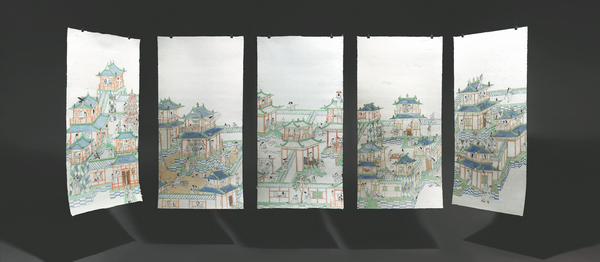
The snake and its symbolism make an excellent entry to Peng's paintings, in which she appropriates the formats, recurring motifs, and figures of classic Chinese paintings, myths and fairy tales, and texts, to tell their stories in different contexts.
She has constructed scenes, half real and half imagined, in which she narrates the stories of men and women, revealing their emotions and thoughts.
Through smooth layering and the shading of pale colors, she gently ushers the audience into a painterly world at a calm pace, in the same soft way she speaks.