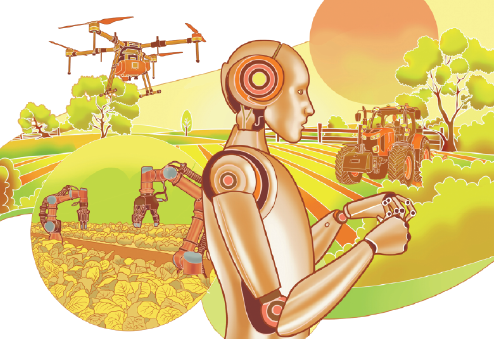
AI pivotal to modernizing agriculture









The No 1 Central Document of the Communist Party of China Central Committee for 2025 emphasized that developing "new quality productive forces" in agriculture suitable to local conditions is pivotal to rural vitalization. The central authorities will support the development of smart agriculture and a digital countryside, while helping increase the application of technologies such as artificial intelligence and big data in agriculture.
The document also emphasizes the importance of better protecting arable land and increasing food production. In light of the recent developments in AI technology, including homegrown DeepSeek, the policy document has provided top-level design support for the in-depth application of AI technology in agriculture.
AI has the potential to resolve the structural contradictions facing traditional agriculture, such as labor shortage and low resource utilization, by optimizing resource allocation and boosting total factor productivity. AI can foster an agricultural revolution by leveraging data elements as a carrier to transform the technological dividend of urban society into a driving force for rural development, thereby promoting integrated urban-rural development.
In recent years, China's rapidly rising aging population and intensifying "hollowing out" of rural areas — the exodus of young workers from the countryside — have created a pressing problem: who will cultivate the land. Agricultural machinery powered by AI has emerged as a tool to mitigate the labor shortage and alleviate the aging demographic strain in rural regions.
The development of intelligent agricultural machinery and equipment is a key focus of China's Ministry of Agriculture and Rural Affairs; it is part of the ministry's strategy to advance agricultural technology. At the 21st China International Agricultural Trade Fair, held in Guangzhou late last year, agricultural robots including those for picking lychees, and harvesting pineapples and dragon fruits were displayed. These emerging technology tools are designed to perform labor-intensive tasks, enabling automated planting and harvesting.
AI also has huge potential for advancing smart agriculture. For instance, the document highlights the need to promote the beef and dairy cattle industries. To achieve this goal, Gangbei district of Guigang city in Guangxi Zhuang autonomous region is developing "intelligent animal husbandry". It has established five intelligent pig farms, including the Xinghe AI pig farm, which has an automatic ventilation and temperature control system, automatic manure scraping machinery, an automatic mechanical feed conveyor system, and an AI inspection system. As a result, its pig rearing capacity has increased from 400-500 heads to 4,000-5,000 heads, and feeding costs have reduced by more than 20 percent.
Also, the Chinese Academy of Agricultural Sciences and Alibaba have jointly developed a smart breeding platform, which efficiently manages, schedules and analyzes big data on breeding using AI algorithms, thereby offering new possibilities for cultivating superior crop varieties.
The No 1 Document has also set a goal — of stabilizing the grain growing areas and increasing production and quality — necessitating the need for AI-driven advancements in smart planting and farming technologies.
In the development of the agricultural industry chain, AI technology is poised to help optimize the supply chains, unlock the value-added potential of farm products, and empower farmers to enjoy the industry's value-added benefits. For instance, Chongqing has developed the Nongpinhui platform, leveraging AI technology to precisely balance the supply and demand of agricultural products. Since its launch, the platform has facilitated 201,000 transactions, helping farmers generate more than 5.9 billion yuan ($814 million) in income and address issues related to stagnant marketing of farm products.
In Lingshan county, Guangxi Zhuang autonomous region, AI technology is being used to achieve digital upgrading across the entire production, supply and marketing chains in the lychee industry. The county has established a digital public warehouse, offering services such as grading, packaging, preservation and logistics for lychees and other farm products. Consequently, the total output value of the industrial chain has surpassed 3 billion yuan.
The document also highlights the importance of establishing specialized agricultural clusters and enhancing the level of industrialization in agriculture. The extensive application of AI in the digital transformation of the agricultural sector and rural e-commerce and other fields will greatly contribute to agricultural prosperity.
However, the widespread adoption and implementation of AI technology in agriculture come with a range of challenges and limitations. First, farmers face a "digital divide" due to lack of digital literacy. Second, the potential leakage of farmland data poses a threat to national security. And third, the huge procurement costs of AI equipment can be a big financial burden on farmers.
To advance the integration of AI technology in agriculture, therefore, the authorities should include AI skills training into the new vocational farmer training course, in order to enhance farmers' digital proficiency. They should also establish a tiered protection framework for agricultural data to ensure the transmission of sensitive information is securely encrypted.
Moreover, the authorities need to encourage and support the emergence of new agricultural management entities, the establishment of intelligent agricultural industrial parks, and leverage the rural collective economy to increase the adoption of intelligent agricultural equipment. By doing so, they will help AI become the pivotal force boosting agricultural efficiency, invigorating rural areas, increasing farmers' incomes — and advancing Chinese modernization of agriculture and the countryside.
Li Cong is a professor at the School of Economics and Finance at Xi'an Jiaotong University; and Li Minglai is a PhD candidate at the same school.



Today's Top News
- Xi's message for New Year widely lauded
- New Year's address inspiring for all
- Xi congratulates Science and Technology Daily on its 40th anniversary
- Xi congratulates Guy Parmelin on assuming Swiss presidency
- China Daily launches 'China Bound'
- Manufacturing rebounds in December