Hot springs gain steam in icy northeastern China









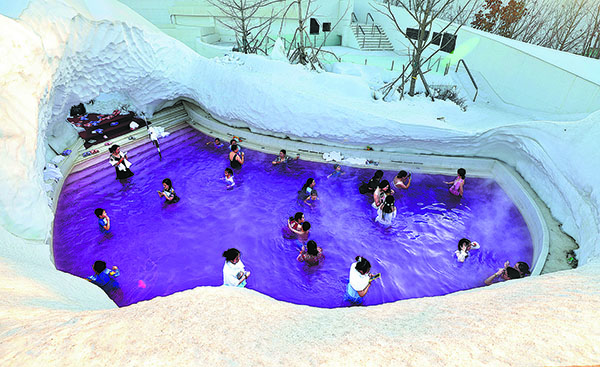
SHENYANG — As the golden hue of dusk washed across the sky, Xu Xin wrapped up her day of skiing at a Changbai Mountain resort in Jilin province, and headed for a bath in an outdoor hot spring.
"The combination of chilly weather and a hot spring is an experience. I immersed my body in steamy water while watching snowflakes fall on a pristine white landscape. Eventually, my fatigue dissolved," says Xu, who is from Shandong province.
Recently, this fusion of "hot and cold" has been gaining popularity on the itineraries of winter tourists flocking to China's northeastern provinces, namely Jilin, Liaoning and Heilongjiang.
Cultural tourism feast
In the mountainous village of Naitoushan in Jilin's Yanbian Korean autonomous prefecture, visitors often unwind in hot springs after hiking snowy trails, or admiring ice sculptures or rime-covered branches, even as temperatures plunge below — 20 C.
"Most of our visitors are from southern China, while international travelers primarily come from Malaysia, Singapore and the United States," says Yang Lina, an operator of the village's cultural tourism project. She says that about 31,000 visitors arrived during the eight-day Spring Festival holiday this year.
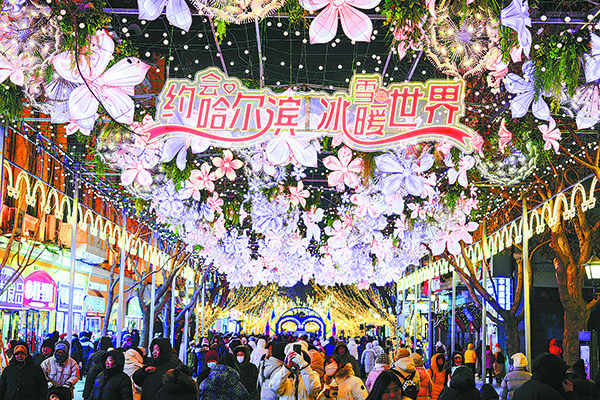
Dubbed China's "ice city", Harbin, capital of Heilongjiang province, recently hosted the 2025 Asian Winter Games, spotlighting its appeal to global winter sports enthusiasts. The city is also home to the Harbin Ice-Snow World, the world's largest theme park of its kind, known for its grand ice sculptures, slides and entertainment facilities.
"As Harbin has gone viral on social media and attracted tourists, there are also visitor spillovers to our hot springs," says Li Fang, assistant general manager of the Lianhuan Lake International Hot Spring Resort of Heilongjiang, located some 200 kilometers from downtown Harbin.
This winter, the resort introduced a new service: guests can soak in outdoor hot springs while dining on meat and vegetables boiled in sizzling hotpots, with tables and stools set in the pools.
"Our guests can enjoy the warm water and food. It is particularly comfortable after outdoor activities," says Li.
To enhance the experience, the resort also organizes a series of cultural activities including dragon boat sleighing, snowball fights and horse riding.
Some international visitors also praised the integration of traditional Chinese medicine therapies with hot spring experiences.
"This is my first trip to China. We soaked in the hot springs and indulged in the mud baths. The experience is amazing and I feel the soreness in my shoulders and knees has been alleviated," says En Sun, a Russian visitor, who stayed with her family at the Tanggangzi Hot Spring Resort in the city of Anshan in Liaoning for two weeks.
Yang Xiaopeng, the resort's deputy manager, highlights the therapeutic benefits of mineral-rich mud baths, which contain elements including iron and manganese that boost metabolism and immunity. The resort also produces soaps and facial masks with minerals extracted from its springs.
"By enhancing services and creating new products, we hope to provide our guests with hospitality and an unforgettable travel experience," says Yang.
Wang Xiaoyu, a specially invited expert from the World Tourism Cities Federation, says northeastern China should have confidence in its combination of ice-and-snow activities with hot springs. "Tourists can enjoy not only snow and play with ice, but also deeply experience local culture," he adds.
Spurring economic vitality
Zhao Kaizeng, 75, spent this winter at Liaoning's Baodi hot springs town in the city of Fuxin, indulging in hot springs and regular physiotherapy sessions at the town's health center. "The hot spring water here is beneficial to the body, and the medical facilities are great too," he says.
The town also provides free recreational activities to seniors, including calligraphy classes, reading and movie screenings. It had over 100,000 tourist visits last year.
"Along with the changing consumption appetite and lifestyle, more and more seniors seek to make new friends and experience the customs of different places through tourism. Liaoning has the advantage of abundant hot spring resorts to cater to these active 'silver-age' tourists," says Chen Yankui, secretary-general of the Liaoning Ice and Snow Hot Spring Tourism Association.
Liaoning boasts over 1,200 hot spring tourism companies and nearly 200 hot spring projects with investments exceeding 50 million yuan ($6.97 million) each. In recent years, the province has been encouraging TCM hospitals and businesses at hot spring resorts, to boost the silver economy, according to Chen.
For international travelers, China's hot springs stand out for their modern amenities and affordability.
"Compared to other hot spring destinations such as Japan's Hokkaido, the service in China is topnotch, while the cost is cheaper," says Kim Ji-yeon, a tourist from the Republic of Korea, who just concluded her trip to Yanbian.
Along with the booming winter tourism, northeastern China has seen satisfying data.
In January, Liaoning received a total of 68.93 million tourist visits, an increase of 25.31 percent year-on-year, generating 69.04 billion yuan in revenue, up 24.66 percent. Harbin Ice-Snow World, which lasted 68 days and officially closed its 26th edition on Feb 26 due to rising temperatures, reported a record-breaking 3.56 million tourist visits, a 31.4 percent swell year-on-year. Jilin's Changbai Mountain ranked among the top 10 winter destinations in China on a series of online travel platforms.
China aims to grow its winter economy into a 1.2 trillion yuan industry by 2027 and 1.5 trillion yuan by 2030, according to guidelines released by the State Council last year.