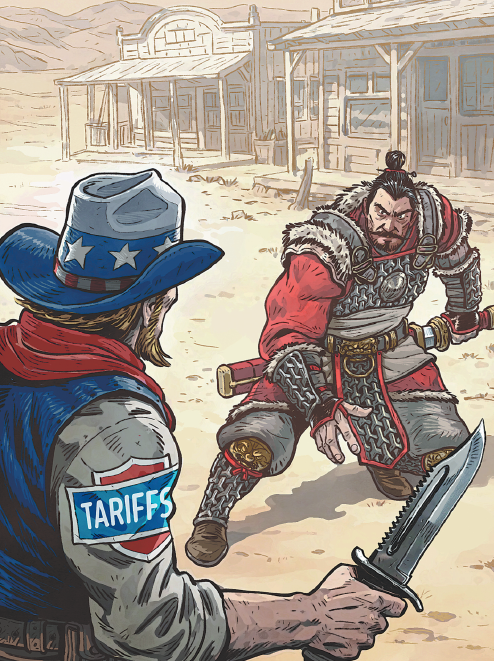
'Wild West' tariff threats challenge and chance









Almost all economists agree that a global trade war is a losing game for all, and will disrupt supply chains, inflate prices, defy the principles of comparative advantage and challenge World Trade Organization rules. Yet United States President Donald Trump sees tariffs not as an economic risk, but as a strategic tool — one he is prepared to use again. His latest tariff proposal, if implemented, will undoubtedly strain trade relations, but it also presents an opportunity for China. Rather than reacting with panic or escalation, China and its businesses should adopt a strategic, measured approach to mitigate immediate risks while accelerating long-term supply chain diversification, innovation and expansion into new markets.
Despite broad consensus that a Wild West-like tariff war undermines efficiency, deters investment and risks a global recession, Trump considers tariffs a "beautiful word".Why is that?
The logic is threefold. First, trade deficits are an easy political target — simple enough for voters to understand, particularly workers who have been told that US manufacturing jobs have been lost to cheap foreign labor. Second, given its large consumer market and trade deficit, the US can impose more economic pain on its trading partners than they can inflict in return. In a tariff war, Washington assumes it can outlast its rivals. Third, the US economy is less dependent on trade than its major competitors. Exports and imports account for roughly 25 percent of US GDP, compared to 35 percent for China and 90 percent for Germany. While tariffs hurt all sides, Trump's advisors believe Washington can afford to absorb the shock better than others.
Additionally, tariffs are not just an economic tool, but a pillar of Trump's broader geopolitical strategy. His campaign slogan and priority are to "Make America Great Again", where great is defined in terms of relative geopolitical strength. Simply put, his priority is not so much shared global prosperity, but more relative dominance by the US. Trade restrictions serve as bargaining chips in negotiations that go far beyond commerce, extending into NATO defense spending, fentanyl shipments and immigration policies with Mexico. In this worldview, tariffs are not just about trade, but also about leverage.
Since returning to the White House for his second term, Trump has moved swiftly, issuing twice as many executive orders in his first 30 days as did former president Joe Biden in his first 100 days. His governing style thrives on disruption — introducing multiple changes simultaneously to keep opponents off balance. His frequent statements create uncertainty, making it difficult for businesses, markets and even foreign governments to respond in a coordinated way. The cost of chaos is outweighed by the advantages of keeping adversaries guessing and confused.
How should China and other countries running large trade surpluses with the US respond? The answer is not tit-for-tat escalation. Since Trump's first term, China and other trade partners have already been adapting — diversifying their export markets, strengthening domestic industry and encouraging firms to reduce dependency on US buyers. US multinationals, too, have shifted supply chains through "China plus one" strategies, favoring production in Mexico, Vietnam and other locations. While this has led to some short-term inefficiencies, it has also created a more resilient and geographically distributed global trade network. However, Trump's administration has threatened to tighten restrictions further by blocking third-party countries from serving as transit points for Chinese goods.
In anticipation of new tariffs, suppliers have accelerated shipments to the US, stockpiling goods ahead of potential duty implementation on March 1, March 12 and April 2. The details — tariff levels, affected products and timelines — remain subject to negotiations. In this window, China should assess potential strategic concessions that would cost it little but hold political value for Trump. For example, Chinese investments in US auto manufacturing — particularly electric vehicle joint ventures with Ford and General Motors — could provide a mutually beneficial solution: market access for Chinese firms and high-quality jobs for US workers.
For Chinese businesses, a smart response requires five key strategies. First, they should remain deliberate and proportionate in their actions, avoiding unnecessary escalation. Second, they should not panic or hide, but rather reassure US customers by working together on contingency plans. Third, instead of emphasizing their Chinese origins, firms should highlight product quality, reliability and their contributions to the US economy, including local job creation. Fourth, they should strategically manage tariff costs — exploring cost reductions, adjusting pricing strategies and determining how best to distribute the impact among producers, distributors and consumers. Finally, Chinese firms should take inspiration from DeepSeek and double down on innovation, developing products that are cheaper, better or faster than competitors, thus creating demand that even tariffs cannot suppress.
DeepSeek is a two-year-old startup based in Hangzhou, Zhejiang province, that has created open-source large language models at much lower costs than its foreign peers.
In summary, if implemented, Trump's latest tariff measures will undoubtedly challenge Chinese businesses. But they can also serve as a catalyst for long-overdue transformations — driving supply chain resilience, technological innovation and deeper engagement with the Global South. The best response is not to engage in a tit-for-tat escalation, but to use this moment to strengthen long-term competitiveness.
The writer is executive vice-chancellor and distinguished professor of social science at Duke Kunshan University in China and the John deButts professor of practice at Duke University's Fuqua School of Business in the US.
The views do not necessarily reflect those of China Daily.





Today's Top News
- China reports 20% rise in inter-regional trips on first day of holiday
- China rebuffs criticism over drills around Taiwan
- Mainland pledges deeper cross-Strait integration in 2026
- Lai's 'separatist fallacy' speech rightly slammed
- Xi's message for New Year widely lauded
- Swiss bar fire kills around 40, injures more than 110