China expands presence in humanoid robotics amid industry boom









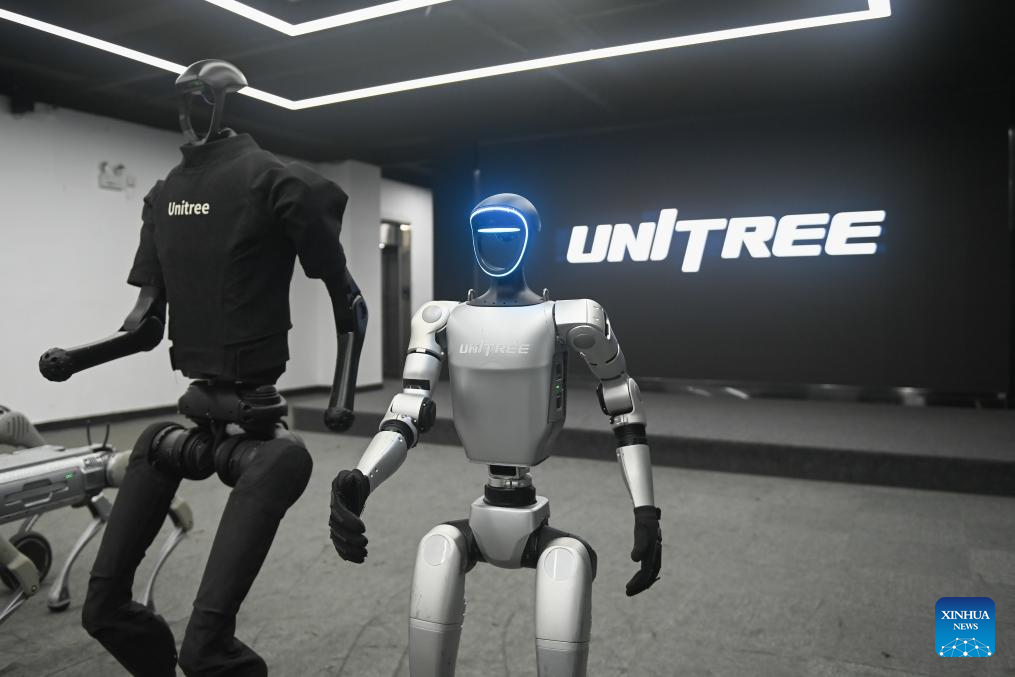
HANGZHOU - The world of robotics may have just found a new martial arts master. In a viral video released by Unitree Robotics, the Unitree G1 humanoid robot executes a fluid series of kung fu moves, throwing punches and even landing a 720-degree spinning kick -- an achievement the Hangzhou-based company has hailed as unprecedented on its official social media account.
Unitree credits the robot's agility to its ever-evolving algorithms, which allow it to "learn any move, any time."
Huang Jiawei, the company's marketing director, attributes Unitree's rapid progress to its strong focus on independent research and development. "That's why our products -- whether quadruped robotic dogs or humanoid robots -- are becoming more refined, more stable, and continuously surprising people."
The company made a big splash on China's 2025 "Spring Festival Gala," one of the country's most-watched television shows each year, sending 16 humanoid robots to perform alongside human dancers in a folk dance, showcasing their advanced motion control and synchronization capabilities.
Zhejiang province, where Hangzhou is located, has been at the forefront of China's robotics push. In 2017, it became the first province to introduce a dedicated "robot plus" action plan, accelerating investment and policy support in the sector. And Hangzhou itself is emerging as a major tech hub, home to more than 200 robot-related companies.
Distinct humanoid robot industrial clusters are taking shape across China. The Yangtze River Delta and Pearl River Delta regions, leveraging their strengths in the mechanical and electronics industries, have become key hubs for the humanoid robotics sector. The former is home to numerous robot body manufacturers and component companies, while the latter has become a magnet for innovative firms.
The global humanoid robotics industry is undergoing a period of rapid expansion, with Citi analysts forecasting that the market will reach a scale of $7 trillion by 2050.
And China, already a key player in the field, is expected to secure a notable share. Market projections suggest that by mid-century, China's humanoid robot market could be worth 6 trillion yuan ($836.87 billion), with an estimated 59 million units in operation.
Research and government data reinforce this trajectory. In "The Humanoid 100: Mapping the Humanoid Robot Value Chain," Morgan Stanley found that 56 percent of related companies and 45 percent of integrators are based in China.
By the end of 2024, the number of enterprises in China's smart robot industry had reached 451,700, with a total registered capital of 6.44 trillion yuan, according to the State Administration for Market Regulation. The number of enterprises had grown by 206.73 percent from the end of 2020, encapsulating the sector's meteoric rise.
The Chinese government is placing significant emphasis on future industries like AI and humanoid robotics. Last year, seven government departments, including the Ministry of Industry and Information Technology, issued guidelines to promote their development.
The guideline called for efforts to develop signature products, enrich application scenarios, and optimize industrial supporting systems for future industries, particularly targeting six key fields including manufacturing, information, materials, energy, space, and health.
"Humanoid robots represent the ultimate ideal of robotics," said Xiong Rong, director of the Zhejiang humanoid robot innovation center.
Humanoid robots integrate mechanics, electrical engineering, materials science, sensing technology and computing to achieve human-like functionality. They are broadly recognized as the pinnacle of robotics technology and a key indicator of a nation's overall technological capabilities, Xiong added.
Xiong told Xinhua that if humanoid robots are adopted widely, they could replace humans in the completion of dangerous, repetitive or tedious tasks, which would address future labor shortages. This, she noted, would have a transformative impact on economic and social development.
Despite rapid growth, experts caution that several hurdles remain. Take care-giving robots as an example. The topics of safety, ethics and public acceptance continue to spark debate.
"Breakthroughs in foundational AI theory are critical for mass adoption," said Qiu Jiefan, an associate professor at Zhejiang University of Technology who has called for strengthened support for basic research across the fields of physics, materials science and mathematics to ensure humanoid robots reach their full potential.