Visionary sees village profit from tradition
Heritage and artistry of ethnic identity combine to provide ever-expanding opportunities, Yang Feiyue and Li Yingqing report.









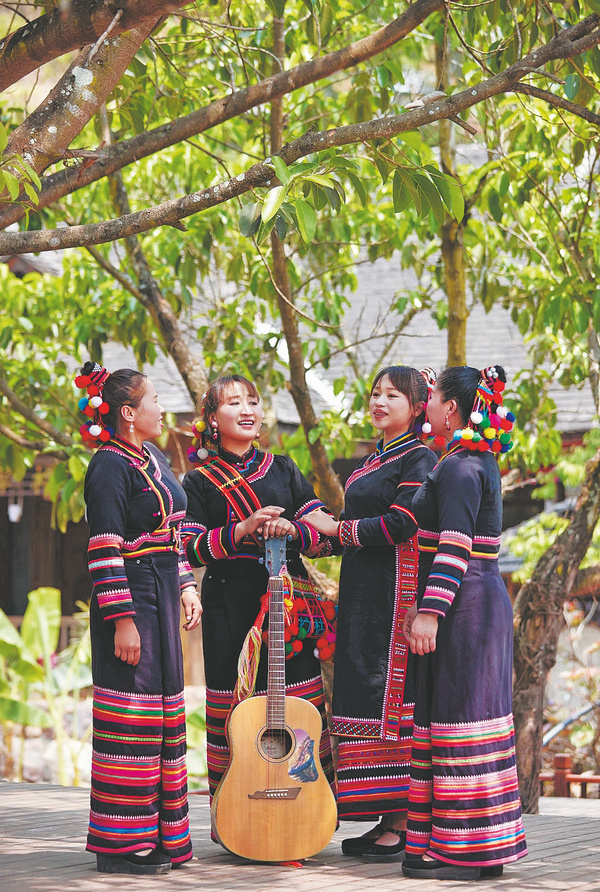
Growing up immersed in this rich cultural environment, Li says she was like any other child in the village.
"We learned to sing as soon as we could speak, and dance as soon as we could walk," she says.
One of the most enduring memories from her childhood is the image of her father playing the reed-pipe and her mother singing folk songs under the soft glow of moonlight.
When she was 13, her father introduced her to the guitar, selling a pig to afford the instrument.
With no formal training, Li taught herself to play.
"I took it upon myself to create melodies based on my feelings toward the life around me," she recalls.
In 2005, Li joined a local Lahu art organization, where her natural musical talent and deep understanding of Lahu culture quickly set her apart.
At the time, the troupe was facing significant challenges, with few performance opportunities and low visibility. Li saw these struggles and then took the initiative to work with her peers to explore new forms of performance.
Li began to promote the performance initiative among her fellow villagers and encourage them to join.
"I convinced them how it can be business mixed with pleasure, while showcasing and preserving our culture," she says.
Things took a turn for the better in 2006 when Li led the troupe at the Yunnan Spring Festival gala, where their performance of the song Happy Lahu composed by Li set off waves of applause from the audience.
They continued to captivate audiences at an international tourism festival in the provincial capital Kunming in 2007.
As their fame spread, they made their way to national television programs like China's Got Talent. Invitations to perform in Beijing, Shanghai, and overseas destinations such as Japan, also came their way, earning the Lahu culture international acclaim.
The success had Li establish a cultural company in 2013 to better preserve and promote Lahu culture while creating sustainable economic opportunities for her community.
To better cater to the tourism market needs, Li has found innovative ways to blend tradition with modern elements.
"We have ancient Lahu tunes that record our history, and we also create modern songs that reflect contemporary life. Our traditional instruments, like the reed-pipe, are still central to our music, but we incorporate modern sounds to keep our culture vibrant and relevant," she explains.
Under her guidance, her brother Zha Nu opened a music-themed homestay in Laodabao.
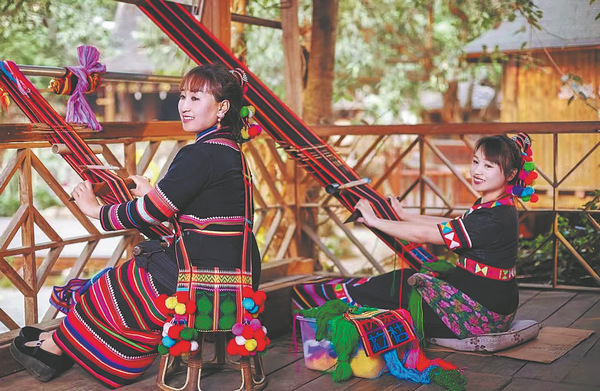
Every corner, from the woven tapestries on the pillars to the murals, the stage in the main hall, and the fire pit in the courtyard, reflects his meticulous design.
"Once, I moved to Beijing to pursue my music dreams, but my heart always remained with my family and talented friends in the village," Zha says.
"Now, I want to use what I've learned to preserve our culture through music and dance, and build a better home for our community," he adds.
His homestay has benefited from the rising number of tourists to the village and he has performed original songs for them.
In his spare time, he also teaches traditional music and dance to young villagers.
Huang Lingfei, a professor with the Yunnan Arts University, notes that Laodabao has successfully preserved Lahu culture through iconic performances like the reed-pipe and swing dances, as well as classic songs such as Happy Lahu.
The village stands as a shining example of how cultural heritage and tourism can be seamlessly integrated, creating a model for others to follow, Huang says.
Local people got out of poverty as stipulated by the country in 2016.
Looking back, Li says she sometimes still has a hard time reconciling to the fact that what she loves from childhood could help her hometown escape poverty.
Li says she also owes it to the rich opportunities for her to attend art training and learn from how other cultures transform their traditions into marketable crafts since the 18th National Congress of the Communist Party of China in 2012.
In addition to art performance, Li has launched a handicraft program, which has now grown to involve over 60 local women. They create traditional Lahu embroidery featuring dogtooth patterns.
"They are symbols of our respect for dogs. These crafts not only preserve our culture but also provide income for families right at their doorsteps," Li says.
Speaking about her future plan, Li says she would continue to promote what her hometown has to offer.
"My mission is not just to share our music with the world but ensure that our culture thrives for generations to come," Li says.
Contact the writers at yangfeiyue@chinadaily.com.cn