


Soulful tunes of an antique land









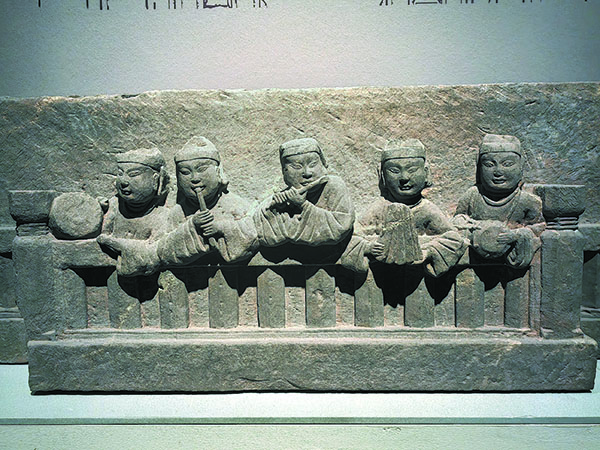
Chengdu Museum's special exhibition highlights artifacts that have the power to fascinate, Huang Zhiling and Peng Chao report.
Renate, a senior citizen from Cunha in Brazil's southeastern state of Sao Paulo, visited the Chengdu Museum in Southwest China's Sichuan province with her husband Arpad on March 15.
It was the couple's first visit to China and they arrived to explore the city's storied past and culture in the museum in the heart of Chengdu, the provincial capital.
Yet they had a pleasant surprise of finding themselves transported further back in time through a special exhibition in the museum featuring ancient musical treasures from different parts of China, according to Renate, a former nature photographer.
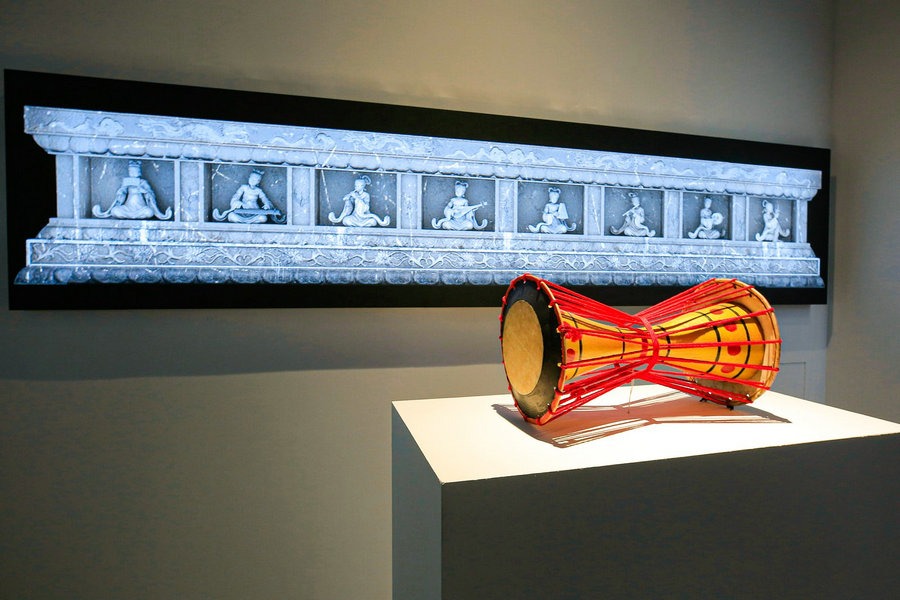
The special exhibition, titled Zithers and Flutes of the Brocade City, which runs through to May 5, is a collaborative effort by more than 30 institutions, including the Henan Museum in Central China's Henan province, the Palace Museum in Beijing, Dunhuang Academy in Northwest China's Gansu province, Yungang Grottoes Academy in North China's Shanxi province, the Shaanxi History Museum and Emperor Qinshihuang's Mausoleum Site Museum in Northwest China's Shaanxi province, says Huang Xiaofeng, deputy curator of the Chengdu Museum.
The showstopper, positioned in the most prominent place in the exhibition hall, is an 8,000-year-old bone flute unearthed in 1987 at the Neolithic Jiahu Site in Wuyang county, Luohe, Henan province.
This 23.1-centimeter artifact, on loan from Henan Museum, is among 88 national first-class cultural relics on display in the special exhibition.
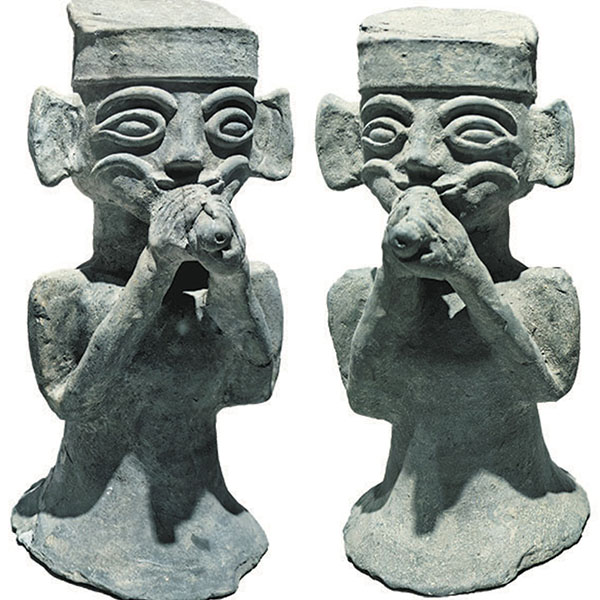
In the history of Chinese archaeology, the Jiahu Site dating back 7,800 to 9,000 years was one of the most developed ancient settlements in its time.
It was in the Neolithic Age.
Then, humans had just come out of caves and were clumsily trying to grow plants and breed domesticated animals.
But Jiahu shows a picture that is not completely primitive and backward, and transcends people's understanding of the initial stage of civilization.
Han Jianye, an archaeology professor at Renmin University of China in Beijing, says the origins of Chinese civilization was formed around 8,000 years ago, and the most shocking and direct evidence is Jiahu.
The production of pottery, bone ware, turquoise, especially the excavations related to the astronomical calendar and divination, had a great impact, he says.
Between 1984 and 2001, Jiahu witnessed the excavation of more than 30 flutes made from the wing bones of red-crowned cranes.
The Jiahu bone flute, on display in the Chengdu Museum, is shaped like a long pipe with seven holes drilled in a straight line down one side.
It is the earliest musical instrument unearthed in China, and it is also recognized as the earliest playable musical instrument in the world.
The delicate and small flute astonishes contemporary researchers as it is capable of playing the seven-tone scale.
In the opening ceremony of the special exhibition on Jan 21, a local musician used a homemade bone flute to play music.
Hearing the music was like catching whispers from a primordial dawn, said Lan Mei, a visitor who noted how the flute's haunting tones might have once echoed in ancient rituals.
The special exhibition's timeline leaps to the Tang Dynasty (618-907) with a 1,311-year-old guqin (a plucked seven-string Chinese musical instrument) from East China's Zhejiang Provincial Museum.
It was crafted by guqin master Lei Wei in 714, and was an imperial wedding dowry.
With a coating of vermilion lacquer and adorned with ice-crack patterns, the long zither got its lyrical name, Caifeng Mingqi, from the ever-changing glow of the sunset and the consonant cry of a phoenix.
Its producer Lei Wei had the reputation of being "China's No.1 luthier".