Inner Mongolia cuts water use in solar sector
Cities of Ordos, Baotou employ purification projects to push autonomous region to become leader in renewable energy










Editor's note: As protection of the planet's flora, fauna and resources becomes increasingly important, China Daily is publishing a series of stories to illustrate the country's commitment to safeguarding the natural world.
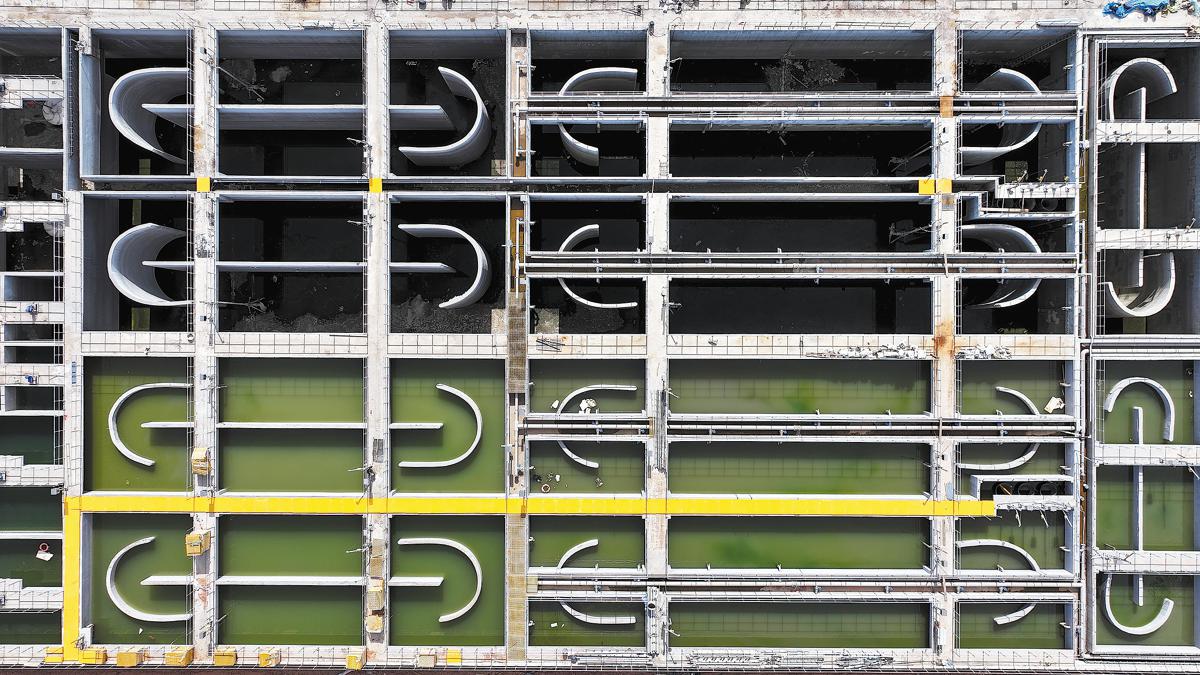
A state-of-the-art wastewater treatment plant in Ordos, Inner Mongolia autonomous region, has developed an innovative solution to minimize water consumption in China's rapidly expanding solar panel industry.
While the use of water in making solar panels is not as intense as in some other industries, this wastewater recycling solution further reduces the water footprint of solar panel manufacturing.
After wastewater flows out of the production line for crystalline silicon, which is used for producing photovoltaic solar cells — an essential component of solar panels — at a zero-carbon industrial park of the Mengsu Economic Development Zone, 95 percent of it will return to the production line as high-quality reclaimed water for reuse within only 35 hours.
At present, approximately 50,000 metric tons of wastewater produced in the zone is processed via this water recycling project every day, the total investment of which is over 2.2 billion yuan ($304 million).
Gao Wei, the project's Party chief, said this means only 2,500 tons of fresh water is needed daily to meet production needs.
As China advances toward its climate goals of peaking carbon dioxide emissions before 2030 and achieving carbon neutrality before 2060, the country's solar panel production has been continuously ramping up to meet the growing demand for solar energy. China's solar power capacity reached approximately 886 million kilowatts last year, reflecting a year-on-year increase of 45 percent, according to the National Energy Administration.
The zero-carbon industrial park serves as a prime example of China's efforts to enhance the use of reclaimed water in its rapidly growing solar panel industry, a step toward making the sector more sustainable.
Gao said the 5 percent of the water not reused in the production line undergoes a specialized treatment process through an evaporation and crystallization system. This means that there is no discharge of wastewater at all.
"This zero-emission model sets a precedent in the field of photovoltaic wastewater treatment in China," he said. "Conversely, concentrated water treatment in traditional sewage plants often faces challenges in achieving zero emissions, usually necessitating dilution or additional wastewater treatment to meet emission regulations."
The salts separated in the evaporation and crystallization system, such as sodium chloride and sodium sulfate, are utilized as resources, he said, adding the sodium chloride, for example, can be used for producing snow-melting agents.
"This method of resource utilization not only decreases waste emissions, but also creates extra economic value," he said.
Gao said the project's wastewater processing technique is designed to address a critical challenge in the solar panel industry — the high salt and hardness levels in wastewater, along with difficult-to-degrade organic matter.
The facility uses highly efficient silica and a hardness removal pretreatment process, he noted.
He said it also employs multiple technologies to treat challenging pollutants in wastewater from crystalline silicon production, including high levels of dissolved solids and chlorides.
These measures ensure that the reclaimed water meets requirements for the ultrapure water needed for photovoltaic manufacturing.