


The Great Wall of man and nature









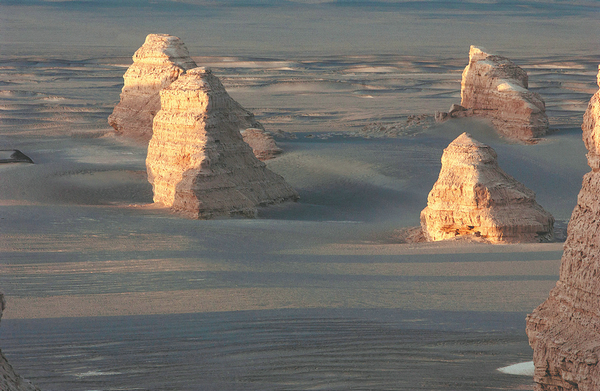
Remote frontier
From the start, the Han court encouraged migration to the corridor and had stationed troops to cultivate the land — a strategy that not only reinforced territorial control but also advanced local agriculture and economy. Successive dynasties continued this policy, as evidenced by historical records and painted bricks from excavated tombs in the region dating back to a period of time between the 2nd and the 4th centuries.
For China, that was a period of warfare, political strife and division. The Hexi Corridor, often seen as a remote frontier, became a refuge not only for displaced people but also for their minds and spirits. Confucianism, which struggled to find space amid the heartland's turmoil, flourished here, exemplified today by a temple-academy dedicated to the philosopher-saint in Wuwei, built in 1437 and still standing today.
Collectively, the painted tomb bricks rendered a vivid portrayal of local life, showing people farming, herding, dancing, gathering mulberry leaves for silkworms and, perhaps not surprisingly, enjoying barbecued meat in a more uninhibited fashion, using large skewers resembling a trident.
Yet, no other brick has told a more riveting tale than the one depicting a messenger astride a galloping horse, his left hand raised, clutching a scroll that surely bore an urgent message. In this land, what could be more precious than vital military intelligence — or a letter carrying the distant echoes of loved ones, thousands of miles?
Over 1,600 years after the construction of the Yumen Pass, another pass-cum-military fortress was built starting in 1539 during the Ming Dynasty (1368-1644), in what is now Jiayuguan city, named after the pass itself.
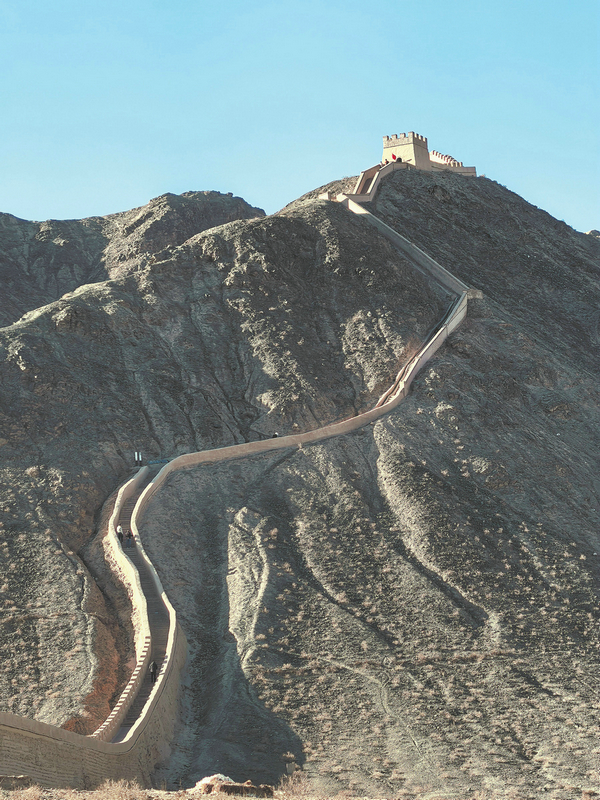
Located 160 km southeast of Yumen Pass, Jiayu Pass marks the western end of the Ming Great Wall. Nearly 80 percent of the existing structures, covering more than 33,500 square meters, date back to the Ming Dynasty. These include imposing tower buildings and large stone slabs with deep grooves left by passing carriages.
Stones for construction were sourced from the nearby Black Mountain. In winter, water was poured on the slopes to create a natural slide for easier transport. Winters are still harsh, and staying warm is essential for visitors who choose to experience the land at its most severe.
Interestingly, the rammed earth used for construction was sun-dried in summer and fried in a gigantic wok during winter to ensure that no plant seeds or insect eggs remained, preventing future threats to the wall's stability. With the Ming Great Wall extending north and south of it, the pass, located at the narrowest point of the Hexi Corridor, seemed to hold the corridor gently by the neck with its strategic control, or so it was believed.
Here stands the westernmost beacon tower of the Ming Great Wall, with bundles of sticks once burned to send urgent signals displayed in a nearby museum. By then, the ancient Silk Road had waned, replaced by what would become known as the Maritime Silk Road connecting southern and southeastern China with the broad market in the Indian subcontinent, the Arabian Peninsula, eastern Africa and Europe.
New frontiers emerged, and new world unveiled, yet these ancient passes and walls endured — witnesses to the might of ancient China, and to the great land route that bridged civilizations between the East and West.
Tong Yunshan contributed to this story.
Must visit:
? Yumen Pass and Han Dynasty Great Wall: Dunhuang, Gansu province
? Jiayu Pass and Ming Dynasty Great Wall: Jiayuguan city, Gansu
? Confucius Temple in Wuwei: No 172, Chongwen Street, Liangzhou district, Wuwei city, Gansu